
How to Identify the Krugerrand
A collector's guide to identifying the 1 oz gold Krugerrand by its Kruger portrait, springbok reverse, weight-and-fineness legend, size, and color.
Read the full Krugerrand encyclopedia entry →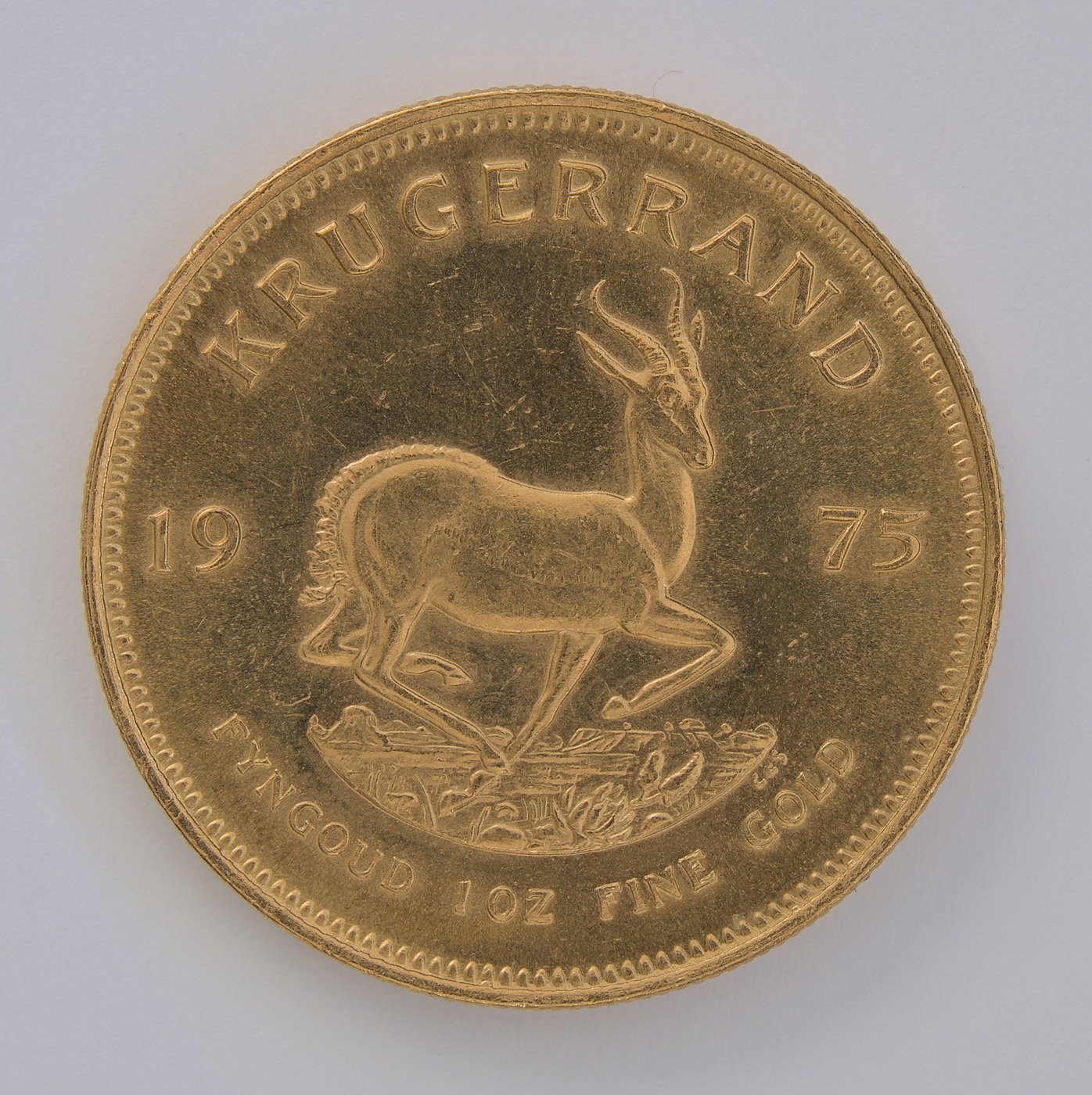
Start with the two portraits. A genuine Krugerrand pairs the left-facing bust of Paul Kruger on the obverse with a springbok antelope leaping left on the reverse. The obverse legend gives the country name in both Afrikaans ('SUID-AFRIKA') and English ('SOUTH AFRICA'), and the reverse spells out 'KRUGERRAND' above the springbok with the date, here 1975, placed beside the animal.
Read the weight-and-fineness legend, not a denomination. The reverse states 'FYNGOUD 1 OZ FINE GOLD', which both confirms the one-ounce size and tells you this is bullion rather than a face-value coin. The deliberate absence of a numeric denomination is itself a check: a Krugerrand never carries a rand figure. Fractional coins (half, quarter, and tenth ounce) were only introduced in 1980, so a 1975 coin should be the full one-ounce size.
Check size, weight, and color together. A one-ounce Krugerrand is about 32.6-32.7 mm across, roughly 2.8 mm thick, and weighs about 33.9 grams gross. That gross weight is higher than one ounce because the coin is 22-karat gold alloyed with copper; the copper also gives it a warmer, reddish-gold tone that is noticeably less yellow than a pure 24-karat coin. A coin that is the right diameter but too light, or that is bright yellow, warrants caution.
Inspect the edge and relief. Genuine Krugerrands have finely reeded (grooved) edges and a crisp, high-relief springbok with sharp detail in the legs and horns. Soft, mushy detail, an incorrect or plain edge, or seams can indicate a cast copy or plated fake.
Authenticate by physical measurement when in doubt. Because Krugerrands are heavily counterfeited, weigh the coin on an accurate scale and measure the diameter and thickness against published specifications; genuine gold pieces are non-magnetic and match all three figures closely. For any coin whose weight, dimensions, or ring seem off, have it verified by a reputable dealer or use gravity and ultrasonic testing before treating it as genuine gold.
Frequently asked questions
How can I confirm a coin is a one-ounce Krugerrand?
Look for the springbok reverse with 'KRUGERRAND' and the legend 'FYNGOUD 1 OZ FINE GOLD', plus the Kruger portrait on the obverse. Then verify the coin is about 32.6 mm across and roughly 33.9 grams; those specs together confirm the standard one-ounce type.
Why does a Krugerrand weigh more than one ounce?
It contains a full troy ounce of pure gold but is struck in 22-karat alloy with copper added for durability. The extra copper brings the gross weight to about 33.9 grams, so a slightly-over-one-ounce weight is normal and expected.
How do I spot a fake?
Weigh and measure it: genuine coins match the published diameter, thickness, and weight and are non-magnetic. Watch for a too-bright yellow color, soft or blurry springbok detail, a wrong or plain edge, and any weight that is off. When unsure, have a dealer test it.
Does the year on the coin affect identification?
The year, such as 1975 here, confirms the issue date and appears beside the springbok. A 1975 coin predates the 1980 introduction of fractional sizes, so it should be a full one-ounce piece; the design itself is otherwise consistent across bullion years.