
How to Identify the Kroton Tripod Stater
A guide to Kroton's silver stater, recognized by its Delphic tripod design, the archaic incuse reverse technique, and the ϘPO city inscription.
Read the full Kroton Tripod Stater encyclopedia entry →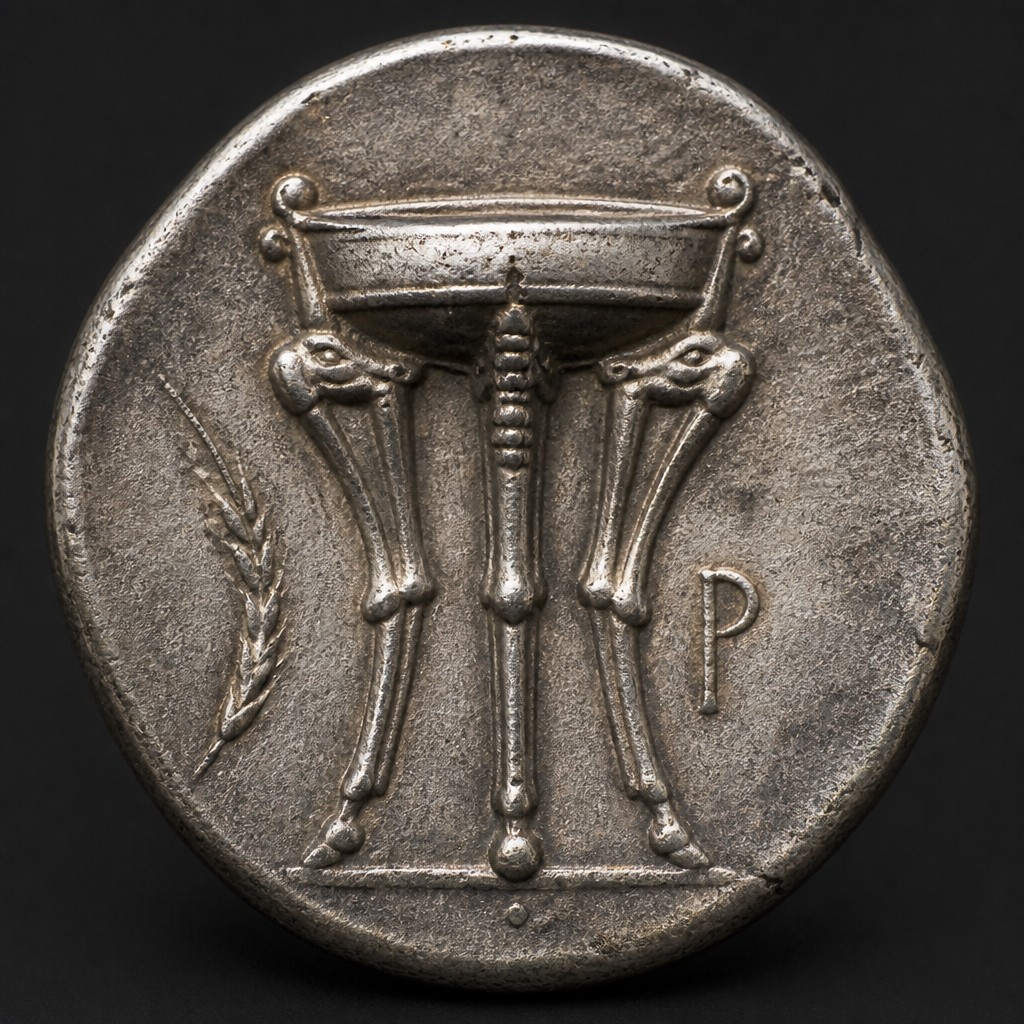
What It Is
Kroton (Croton), a Greek colony in Bruttium in southern Italy, was renowned in antiquity for its athletes, physicians, and philosophical school associated with Pythagoras. Its silver coinage, beginning around the mid-6th century BC, is built around the sacred tripod of Apollo, reflecting the city's close religious ties to the Delphic oracle, and it is one of the classic examples of the early South Italian "incuse" coinage technique.
Obverse
The obverse shows a tripod, a three-legged ceremonial stand associated with Apollo's oracle at Delphi, often with a snake coiled around one leg or perched on the rim, and sometimes a small crane or heron beside it. Later issues add other symbols in the field as the design evolves over time.
Reverse
On the earliest issues, the reverse repeats the tripod as a mirror-image incuse (sunken) impression rather than an independently designed image, matching the technique used at several other early South Italian mints. From the later 5th century BC onward, the reverse instead carries its own raised design, frequently an eagle, a heron, or Herakles, while the tripod remains standard on the obverse.
Inscriptions
The city name appears using the archaic letter qoppa combined with rho and omicron, rendered as ϘPO, an early abbreviation for Kroton that predates the more familiar Greek alphabet forms used elsewhere.
Size, Weight, and Metal
Kroton's staters are silver, struck on the Achaean (South Italian) standard at roughly 7.8-8 grams, with the earliest incuse issues showing the characteristic broad, thin, dish-like flan typical of that technique.
Identifying the Mint and Period
The tripod design combined with the archaic ϘPO legend is the clearest signature of a Kroton issue. The presence of a true mirror-image incuse reverse indicates an earlier issue, while a distinct raised reverse design (eagle, heron, or figural scene) marks a later 5th-century or 4th-century issue.
Telling It Apart From Similar Coins
The incuse tripod can be confused with other early South Italian incuse types, such as Metapontum's barley ear or Sybaris's bull, but the tripod shape itself, along with the ϘPO legend, is distinct. Later Kroton issues with an eagle reverse should not be confused with the eagle types of Akragas in Sicily, which pair the eagle with a crab rather than a tripod.
Grading at a Glance
Look for a well-centered, fully struck tripod with clear legs and rim detail, and, on incuse examples, a crisp mirror-image reverse without excessive doubling or weakness. On later relief-reverse issues, check that both the tripod and the reverse animal or figure are fully struck rather than cut off at the flan's edge.
Authenticity Red Flags
Be cautious of a warped or non-planar flan, a grainy or pitted surface, and a reverse incuse that does not precisely match the obverse relief on early-style pieces, all of which suggest casting rather than striking. An incorrect or garbled ϘPO legend and weight that falls outside the expected Achaean-standard range are additional warning signs.
Frequently asked questions
Why does Kroton's coinage show a tripod?
The tripod represents Apollo's oracle at Delphi, reflecting Kroton's strong religious and cultural ties to Delphic worship.
What does the ϘPO inscription mean?
It uses the archaic letter qoppa along with rho and omicron as an early abbreviation of the city name Kroton.
What is the incuse technique seen on early Kroton staters?
It is a striking method where the reverse die produced a sunken, mirror-image version of the obverse tripod rather than its own separate design, used by several early South Italian mints.
How can I tell an early Kroton stater from a later one?
Early staters have a true mirror-image incuse tripod on the reverse, while later staters (from the later 5th century BC onward) show an independent raised design such as an eagle or heron instead.