
How to Identify the Kotah State Rupee
A collector's guide to recognizing the Kotah rupee by its katar emblem, Persian and Devanagari legends, silver flan, and regnal-year dating.
Read the full Kotah State Rupee encyclopedia entry →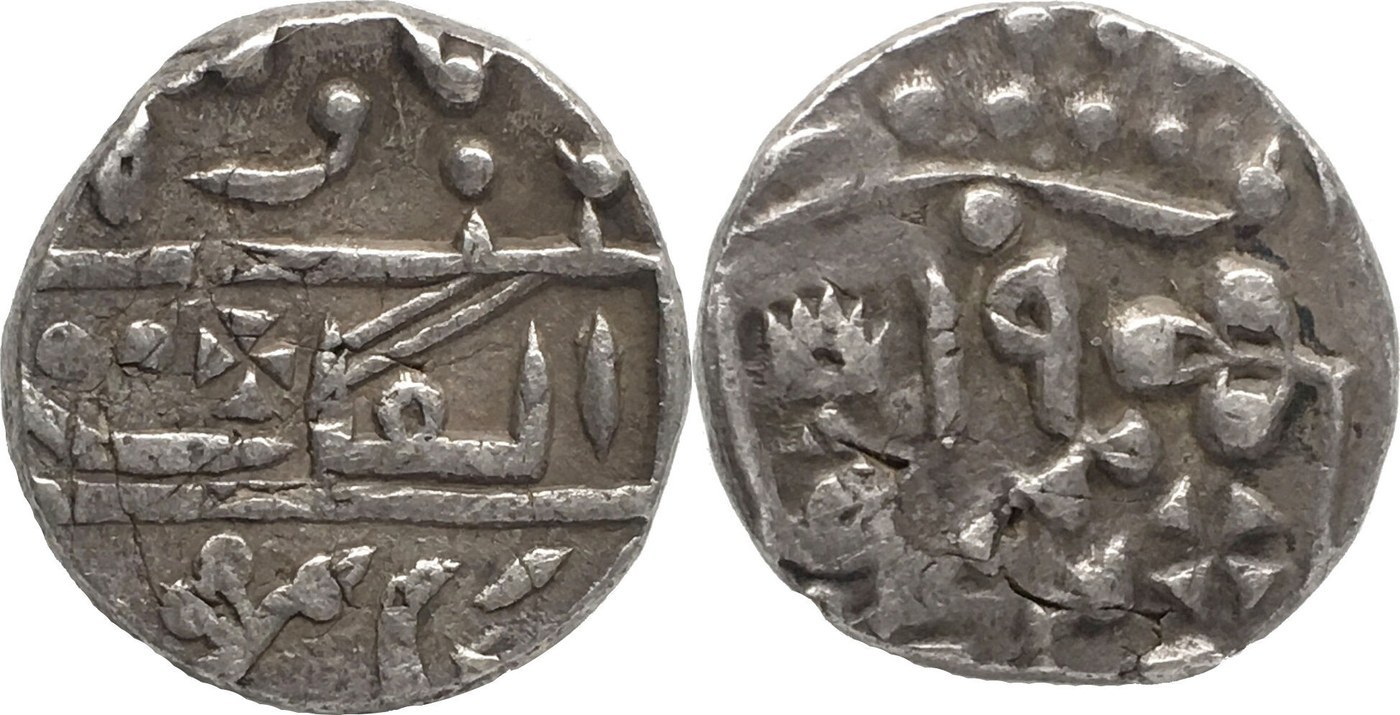
Begin with the overall format. A Kotah rupee is a broad silver coin covered on both faces with Persian (Nastaliq) legends, often with Devanagari letters or a symbol added, and it carries no portrait. If a rupee attributed to Kotah shows a monarch's bust, it is not a Kotah state issue but a British India or other coin; the state series is entirely aniconic.
Look for the katar. The single most useful diagnostic is the small push-dagger with an H-shaped handgrip placed in the field of the design. This is the emblem of Kotah and, together with the mint name in the legend, is what pins a coin to Kotah rather than to Bundi, Jaipur, Gwalior, or the many other states striking similar Persian-legend rupees. Train your eye to find it among the crowded inscriptions.
Check the metal, size, and weight. The coin should be silver, with the pale color, soft ring, and heft of a full rupee in the region of 10 to 11.5 grams on a wide flan. A magnetic, notably light, or base-metal piece is suspect. Because these were hand-struck, uneven centering, doubled strikes, and legends running off the edge are common and are not by themselves signs of a forgery.
Read the dating carefully. Expect a regnal year (RY, or julus) figure and a Hijri-era date rather than a Western year; the RY 19 on this example is part of that system. Confirming the exact mint, nominal sovereign, and date requires translating the Persian, so use a catalogue of Indian princely-state coinage or a specialist for a full attribution.
Watch for look-alikes and fakes. Kotah rupees are easily confused with the Persian-legend rupees of neighboring Rajput and central-Indian states, so verify the katar and mint name before accepting an attribution. Cast copies with soft, mushy lettering and visible seams exist; higher-value nazarana presentation strikes in particular attract fakes, so favor pieces with clear detail, correct weight, and ideally expert authentication.
Frequently asked questions
What is the fastest way to confirm a Kotah rupee?
Find the katar, the small H-gripped push-dagger, in the field of the design. Combined with the Persian mint name it is the clearest sign that a Persian-legend silver rupee belongs to Kotah rather than a neighboring state.
How do I tell a Kotah rupee from other Rajput state rupees?
Many states used similar aniconic Persian legends, so rely on the state emblem and mint name. The katar dagger points to Kotah; other states use different symbols such as a distinct floral mark or their own mint names.
What weight should a genuine example be?
Roughly 10 to 11.5 grams of silver on a broad flan, in line with a full-standard rupee. A piece that is magnetic, very light, or clearly base metal should be treated with caution.
Are nazarana rupees different from ordinary Kotah rupees?
Yes. Nazarana rupees are special presentation strikes made to a higher standard for ceremonial use. They are scarcer and more valuable, and because of that they are more often faked, so authentication matters most for them.