
How to Identify the Kiautschou 5 Cents
A collector's checklist for the 1909 Kiautschou 5 Cents: its bicultural design, denomination face, eagle side, nickel fabric, and authentication cautions.
Read the full Kiautschou 5 Cents encyclopedia entry →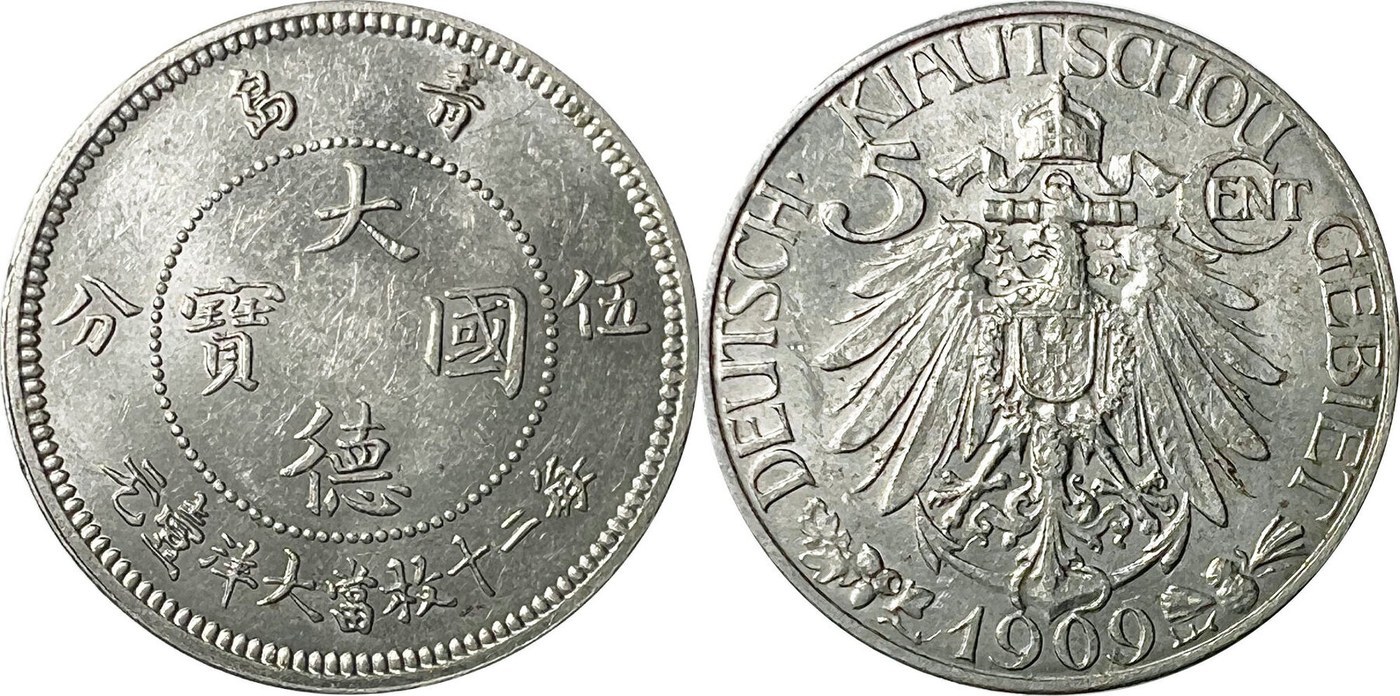
Start with the coin's defining trait: it is bicultural. Turn it so you find the face bearing Chinese characters grouped around a central numeral 5 inside a beaded border -- this is the denomination side. The other face carries the German imperial eagle (Reichsadler) over a shield with the date 1909. No other widely encountered coin combines Chinese script with the German state eagle in this exact way, so seeing both together is your primary confirmation.
Read the numeral and date carefully. The central 5 identifies the smaller of the two Kiautschou values; the companion coin shows 10. The date must be 1909, the only year the series was produced. An example claiming to be Kiautschou but showing any other date should be treated with suspicion.
Check the fabric and size. The coin is nickel, so it is pale silvery-gray rather than the reddish tone of the bronze cash and coppers that circulated in China at the time, and it is a small, light piece. Weighing and measuring it and comparing against published specifications for the type helps rule out altered or cast fakes, which may be the wrong weight or diameter.
Separate it from look-alikes. The 10 Cent sibling has the identical layout but a larger central numeral and slightly larger flan; do not mistake one denomination for the other. Chinese provincial nickel and copper coins, and ordinary German pfennig pieces, lack the eagle-plus-Chinese-characters combination and should not be confused with this issue.
Apply normal authentication caution. As a scarce, desirable colonial type, the Kiautschou 5 Cents attracts counterfeits and tooled coins; watch for soft or mushy details on the eagle and characters, casting seams, wrong color, incorrect weight, or artificial wear. For a valuable example, seek third-party grading and compare with documented genuine specimens before buying.
Frequently asked questions
What is the quickest way to confirm a Kiautschou 5 Cents?
Look for the combination of Chinese characters around a numeral 5 in a beaded border on one side and the German imperial eagle with the date 1909 on the other. That pairing, plus the 1909 date, is the fastest confirmation.
How do I tell the 5 Cent from the 10 Cent?
Both share the same design. Check the central numeral: 5 for the smaller Cent piece, 10 for the larger one. The 10 Cent is also slightly bigger in diameter.
How can I spot a fake?
Watch for soft or blurry detail on the eagle and characters, casting seams, the wrong color or weight, or artificial aging. Measure and weigh the coin against published specifications, and for higher-value pieces rely on professional grading.
Could this be an ordinary Chinese or German coin instead?
No. Mainland Chinese coins and standard German pfennig coinage do not combine Chinese characters with the German imperial eagle. That dual design is specific to the Kiautschou colonial issue of 1909.