
How to Identify the Kellogg & Co. Gold Piece
A privately minted California Gold Rush era gold coin struck by the San Francisco firm Kellogg & Co. in the mid-1850s, identified by its eagle reverse and stated denomination of twenty or fifty dollars.
Read the full Kellogg & Co. Gold Piece encyclopedia entry →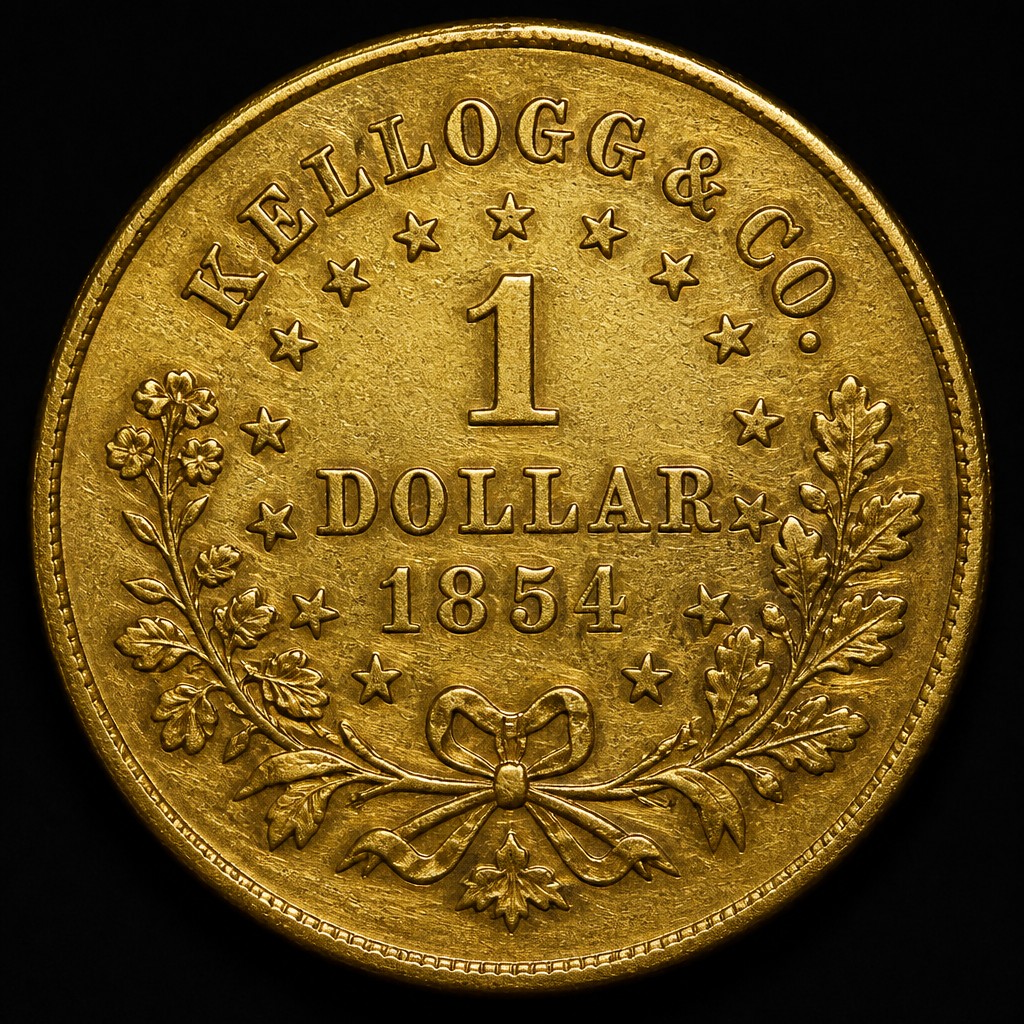
What It Is
Kellogg & Co. was a private minting firm operating in San Francisco during the California Gold Rush, striking gold coins in the mid-1850s to help meet the region's urgent need for a reliable medium of exchange after the closure of another well-known private minter left a gap in the local gold coin supply. These pieces circulated at face value in a region flush with newly mined gold but lacking a nearby federal mint capable of handling all of the demand.
Obverse Design & Inscriptions
The obverse typically shows a left-facing Liberty head design similar in style to federal gold coinage of the period, with the legend KELLOGG & CO. and the date around the border, identifying the issuing firm directly on the coin.
Reverse Design & Inscriptions
The reverse displays an eagle with spread wings, holding arrows and an olive branch, with the denomination (most notably TWENTY D. or FIFTY DOLLS.) and SAN FRANCISCO CALIFORNIA inscribed around the border, clearly marking both the value and the place of issue.
Size, Weight, and Metal
These coins were struck in gold, with the twenty-dollar pieces sized similarly to federal double eagles of the era and the fifty-dollar pieces notably larger, reflecting their higher stated value. Actual gold content was calculated to match the stated denomination based on the fineness of California gold available at the time.
Mint Marks
There is no federal mint mark since Kellogg & Co. was a private minting operation, not a branch of the U.S. Mint; the firm's name printed directly on the coin serves as its identifying mark instead of a small mint letter.
Telling It Apart From Similar Coins
Kellogg & Co. gold pieces are sometimes discussed alongside other California private gold issuers of the same period, but the KELLOGG & CO. name and SAN FRANCISCO CALIFORNIA legend make attribution straightforward. The fifty-dollar denomination in particular is a large, heavy, and visually distinctive piece compared to standard federal issues of the time, which did not include a fifty-dollar gold coin.
Judging Condition at a Glance
Look at the Liberty head's hair detail and the eagle's feathers for strike sharpness, since gold's softness means fine details wear down relatively quickly with handling. Because these coins were used actively in commerce, most surviving examples show at least light to moderate wear, and problem-free, sharply struck examples are considered notably desirable among collectors of California Gold Rush material.
Authenticity Red Flags
Because private California gold issues of this era are valuable and highly collected, counterfeits and later fantasy pieces are a serious concern. Warning signs include incorrect weight for the stated gold content, color or luster inconsistent with genuine period gold alloys, and lettering or design details that don't match documented genuine dies. Given the value and complexity involved, any Kellogg & Co. gold piece should be verified by a specialist experienced with California private gold coinage before being accepted as authentic.
Frequently asked questions
Why did Kellogg & Co. strike its own gold coins?
During the California Gold Rush, the region needed a reliable coined medium of exchange, and Kellogg & Co. stepped in as a private minter after gaps emerged in the local gold coin supply.
What denominations did Kellogg & Co. produce?
The firm is best known for twenty-dollar and fifty-dollar gold pieces, with the fifty-dollar denomination notably larger than any federal gold coin of the period.
How can I identify the issuer on the coin itself?
The legend KELLOGG & CO. appears on the obverse, and SAN FRANCISCO CALIFORNIA appears on the reverse, clearly marking the private issuer and location.
Does this coin carry a U.S. Mint mark?
No, since it was privately struck, it has no federal mint mark; the firm's own name functions as the identifying mark.
Why is authentication especially important for these coins?
Their high gold value and historical significance make them frequent counterfeit targets, so specialist verification of weight, design, and metal is strongly recommended.