
How to Identify the Joachimsthaler
An identification guide to the original 16th-century Bohemian joachimsthaler, the coin that gave the world the word 'dollar,' covering its lion and Saint Joachim designs, silver weight, and how to spot later restrikes and copies.
Read the full Joachimsthaler encyclopedia entry →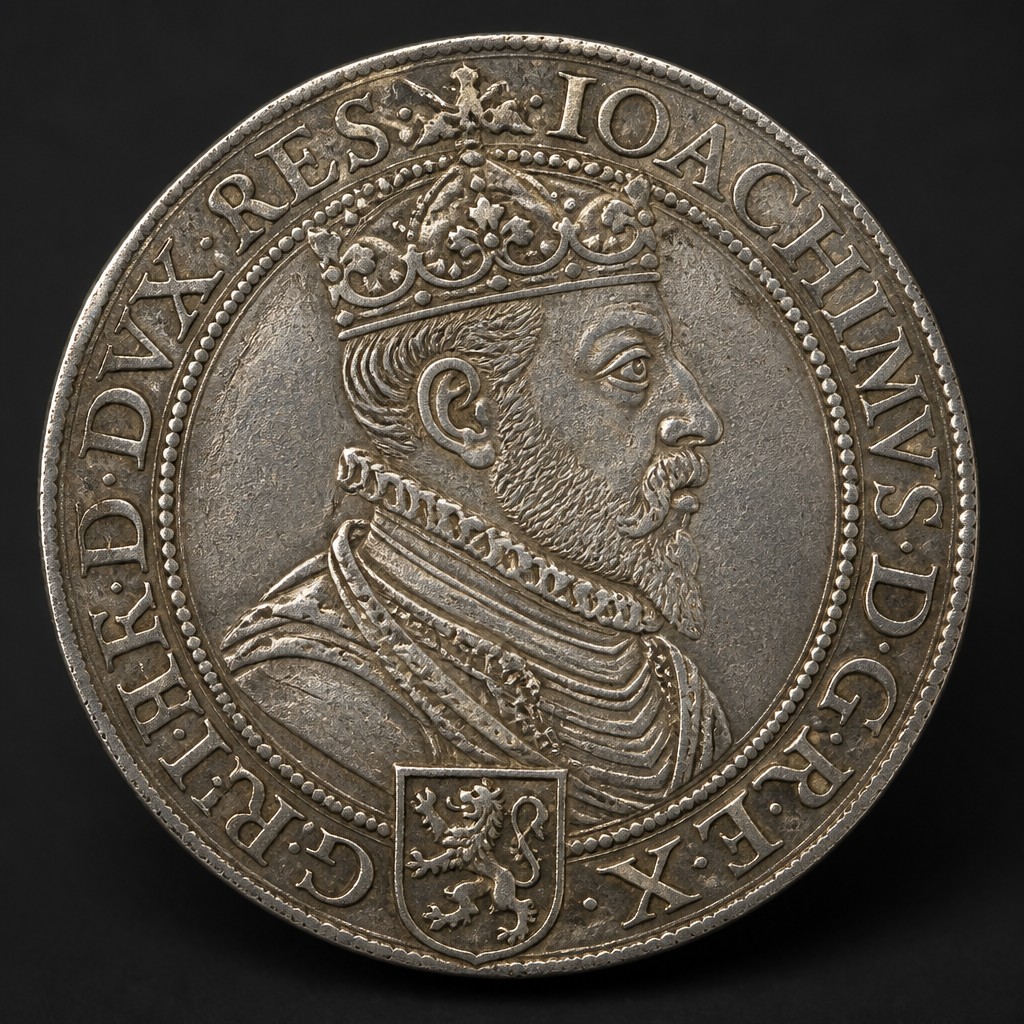
What This Coin Is
The joachimsthaler was first struck beginning in 1520 in the town of Joachimsthal (now Jáchymov) in the Kingdom of Bohemia, under the authority of the Counts of Schlick, using silver from a rich local mine. Its name was shortened over time to "thaler," which eventually gave rise to the English word "dollar."
Obverse Design
Depending on the specific issue, the obverse shows either the crowned Bohemian lion or a standing figure associated with the Schlick counts, along with a Latin legend naming the ruling count and his titles.
Reverse Design
The reverse typically shows a standing figure of Saint Joachim, the coin's namesake, or a detailed coat of arms, along with a legend including the mint location and sometimes the date.
Size, Weight, Metal, and Edge
The joachimsthaler is a large silver coin weighing approximately 29 grams and measuring roughly 41mm across, reflecting the newly standardized large-silver-coin format that would influence coinage across Europe for centuries. As a hand-struck coin, the edge is plain and the flan can be slightly irregular.
Mint Marks and Where to Find Them
There is no mint mark system in the modern sense; instead, the coin is identified by the Schlick family name and title within the legend, along with the mint town name Joachimsthal often spelled out or abbreviated in the inscription.
Telling It Apart From Similar Coins
The joachimsthaler should be considered alongside other early 16th-century German and Bohemian large silver "guldengroschen" coins that inspired and paralleled its introduction; these share a similar size and weight standard but carry different rulers' names and coats of arms. Careful reading of the legend for the Schlick name and Joachimsthal mint reference is the clearest way to confirm this specific issue.
Judging Condition
Because these are hand-struck coins from dies engraved in relatively high relief for the era, look at wear on the lion or saint figure's fine details and the legibility of the surrounding legend, keeping in mind that centering and strike quality varied significantly during production.
Authenticity Red Flags
Given the coin's historical importance, later collector-era restrikes and 19th-century reproductions exist alongside outright cast forgeries. Cast copies typically show soft, indistinct detail and a visible seam line, while genuine hand-struck originals show the somewhat uneven but sharply cut relief typical of early 16th-century die engraving.
Frequently asked questions
Why is the joachimsthaler historically important?
It was first struck in 1520 in Joachimsthal, Bohemia, and its name was shortened to 'thaler,' which eventually became the source of the word 'dollar.'
What images appear on a joachimsthaler?
Depending on the specific issue, the obverse shows the Bohemian lion or a Schlick family figure, while the reverse typically shows Saint Joachim or the family's coat of arms.
How much silver does a joachimsthaler contain?
It was struck at roughly 29 grams of silver, with a diameter of about 41mm, establishing the large-silver-coin standard later copied throughout Europe.
How do I know if my joachimsthaler is an original 1520s strike?
Compare die details, legend wording, and strike characteristics to reference examples, since later collector restrikes and forgeries exist and often show softer, less crisp detail than genuine early strikes.