
How to Identify the Japanese Wado Kaichin
Japan's first officially minted coin, issued in the early 8th century Nara period, a small round bronze piece with a square hole modeled on Chinese cash coins.
Read the full Japanese Wado Kaichin encyclopedia entry →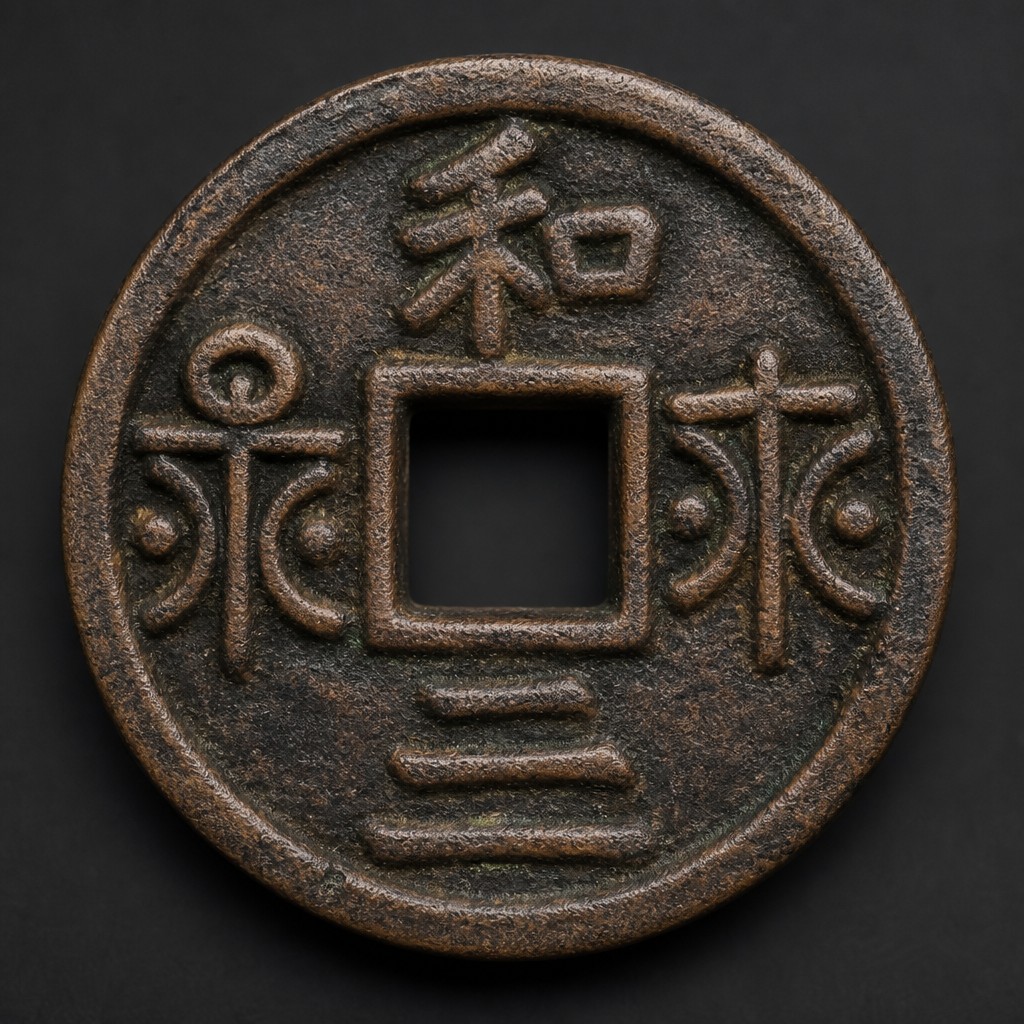
What the Coin Is
The Wado Kaichin (和同開珎) is regarded as Japan's earliest government-issued coin, struck beginning in 708 CE during the Nara period under Empress Genmei. It was created to fund the new capital and encourage a monetary economy, closely copying the format of Chinese Tang dynasty Kai Yuan Tong Bao cash coins.
Obverse Design & Inscription
The obverse carries four Chinese characters read clockwise around the central square hole: 和 (wa), 同 (do), 開 (kai), 珎 (chin/ho). Scholars still debate whether the last character should be read "chin" (treasure) or "ho," so you may see the coin labeled either way. There is no pictorial design, only the raised rim, the square hole, and the four characters.
Reverse Design
The reverse is plain, showing only a raised outer rim and inner rim around the square hole, with no inscription or imagery. A blank, symmetrical reverse is a key identifying trait.
Size, Weight, Metal, Edge
Most surviving specimens are cast in bronze/copper alloy, roughly 24 mm in diameter and weighing around 3.5 to 4.5 grams, though weight varies with wear and casting quality. A small number of early pieces were struck in silver before the mint standardized on copper. The edge is plain and unmilled, as with all early cast cash coins.
Mint Marks & Casting Clues
Because these were cast rather than struck, look for casting seams, sprue marks, and file marks around the rim where the coin was separated from the casting tree. There is no separate mint mark system; regional workshop differences show up mainly in calligraphy style and metal color rather than an added symbol.
Telling It Apart from Similar Coins
The closest look-alike is the Chinese Kai Yuan Tong Bao, which shares the same size and hole style but carries different characters (開元通寶). Later Japanese cash such as the Kan'ei Tsuho (Edo period) is thinner, lighter, and inscribed with different characters, and post-dates the Wado Kaichin by roughly 900 years. Genuine Wado Kaichin pieces also tend to show a slightly coarser, more archaic casting texture than later Japanese cash.
Judging Condition at a Glance
Well-preserved examples show clear, evenly raised characters and rims with minimal pitting. Because these coins are over 1,300 years old and were cast in a soft alloy, most surviving pieces show corrosion, edge chips, or worn characters; a sharp, fully legible example is considered exceptional for the type.
Authenticity Red Flags
Modern reproductions are common as souvenir and museum-shop items, often cast in lighter, more uniform metal with crisper, almost machine-like edges that lack the natural pitting of a 1,300-year-old bronze. Be cautious of pieces with suspiciously fresh, shiny surfaces, incorrect character proportions, or a diameter noticeably outside the typical range, as these suggest a modern casting rather than a period piece.
Frequently asked questions
How can I tell a Wado Kaichin from a Chinese Kai Yuan Tong Bao?
Read the four characters around the hole: Wado Kaichin reads 和同開珎, while the Chinese coin reads 開元通寶; the shapes of the characters and calligraphy style also differ.
Were Wado Kaichin coins ever made in silver?
Yes, a limited early issue was struck in silver before production shifted to copper/bronze, which became the standard metal.
Does the reverse have any design?
No, genuine examples have a plain reverse with only the raised rims around the square hole.
Why do most surviving examples look worn or corroded?
The coins are roughly 1,300 years old and were cast in a soft copper alloy, so heavy circulation wear and burial corrosion are typical.
What's the biggest giveaway of a modern replica?
Overly crisp, shiny surfaces and a casting texture that looks too clean or uniform compared to the naturally pitted, aged look of genuine period bronze.