
How to Identify the Japanese Mon (Kan'ei Tsuho cash coin)
A round Japanese cash coin with a square center hole, identified by the four characters 'Kan'ei Tsuho' arranged around the hole and cast, rather than struck, construction.
Read the full Japanese Mon (Kan'ei Tsuho cash coin) encyclopedia entry →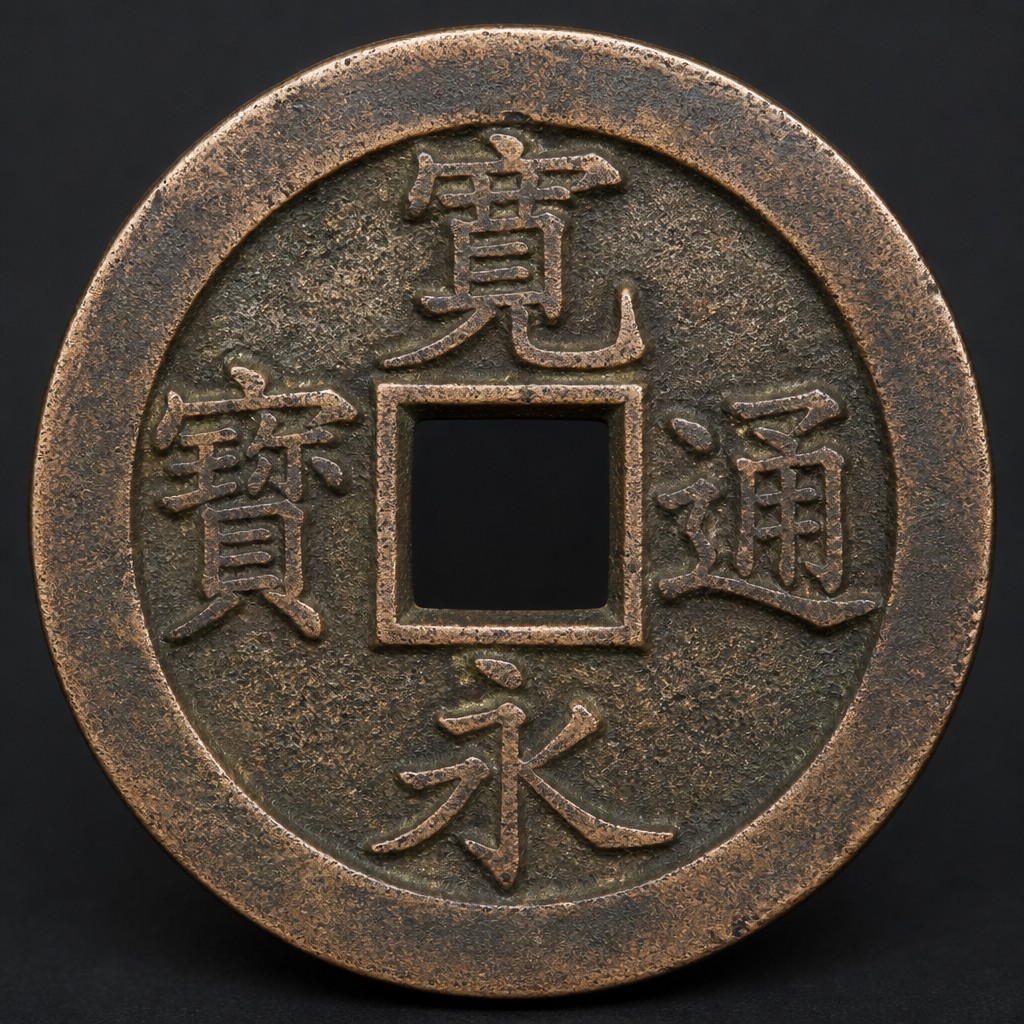
What This Coin Is
The Kan'ei Tsuho was Japan's standard low-denomination cash coin for much of the Edo period, first cast starting in the 1630s and continuing in various forms for roughly two centuries afterward, making it one of the most widely produced and commonly surviving Japanese coin types. It followed the same general round-with-square-hole tradition shared across East Asian cash coinage.
Obverse Design
The obverse displays four Chinese characters (kanji) arranged around the central square hole, reading "Kan Ei Tsu Ho" (寛永通寳), which translates roughly to "circulating treasure of the Kan'ei era," referencing the Japanese era name in use when the coin type was first introduced.
Reverse Design
The reverse varies considerably depending on the specific casting period and mint; many earlier examples have a plain, blank reverse, while later issues carry a small character, symbol, or numeral indicating the casting location or a denomination value (for later, larger four-mon pieces introduced in the eighteenth century).
Size, Weight, Metal, and Edge
Kan'ei Tsuho coins are cast in bronze, brass, or (for some later issues) iron, are thin and lightweight, and have a plain, unmilled edge consistent with traditional East Asian cash coin casting methods.
Mint Marks and Where to Find Them
Where present, small reverse characters or symbols indicate the specific mint or casting workshop responsible for that coin, since production was spread across numerous local minting operations authorized at different points during the coin's long production history.
Telling It Apart from Similar Coins
Kan'ei Tsuho coins can be confused with Chinese cash coins of similar size and format, but the four-character phrase "Kan Ei Tsu Ho" is unique to this Japanese type and distinguishes it immediately once the characters are read. Within the type itself, distinguishing an ordinary 1-mon piece from a larger 4-mon piece depends on size and the presence of reverse markings indicating the higher denomination.
Grading at a Glance
As with other cast cash coins, grading emphasizes how clear and well-formed the characters remain and the overall condition of the rim and square hole, since casting naturally produces softer character edges than a struck coin would show. Well-preserved examples display fully legible characters and a clean, intact rim.
Authenticity Red Flags
Because Kan'ei Tsuho coins were produced in enormous quantities over two centuries, most surviving examples are common and inexpensive, but reproductions do exist; signs of concern include unusually crisp, modern-looking characters inconsistent with traditional casting, a suspiciously light or heavy weight for the coin's apparent type, and surfaces lacking any honest handling wear or natural patina.
Frequently asked questions
What does 'Kan'ei Tsuho' mean?
It translates roughly to 'circulating treasure of the Kan'ei era,' referencing the Japanese era name when this coin type was first introduced in the 1630s.
How long was this coin produced?
It was cast in various forms for roughly two centuries during the Edo period, making it one of the most common historical Japanese coins found today.
How do I tell a 1-mon piece from a 4-mon piece?
The 4-mon denomination is generally larger and often carries a distinguishing mark or numeral on the reverse indicating the higher value.
Why does the reverse sometimes look blank?
Many earlier casting periods used a plain reverse, while mint or denomination marks were added on the reverse only in certain later production periods.