
How to Identify the Japanese Kan'ei Tsuho Cash
A common Edo-period cast copper coin produced for over two centuries, identifiable by its four-character inscription, square center hole, and dozens of mint and casting varieties.
Read the full Japanese Kan'ei Tsuho Cash encyclopedia entry →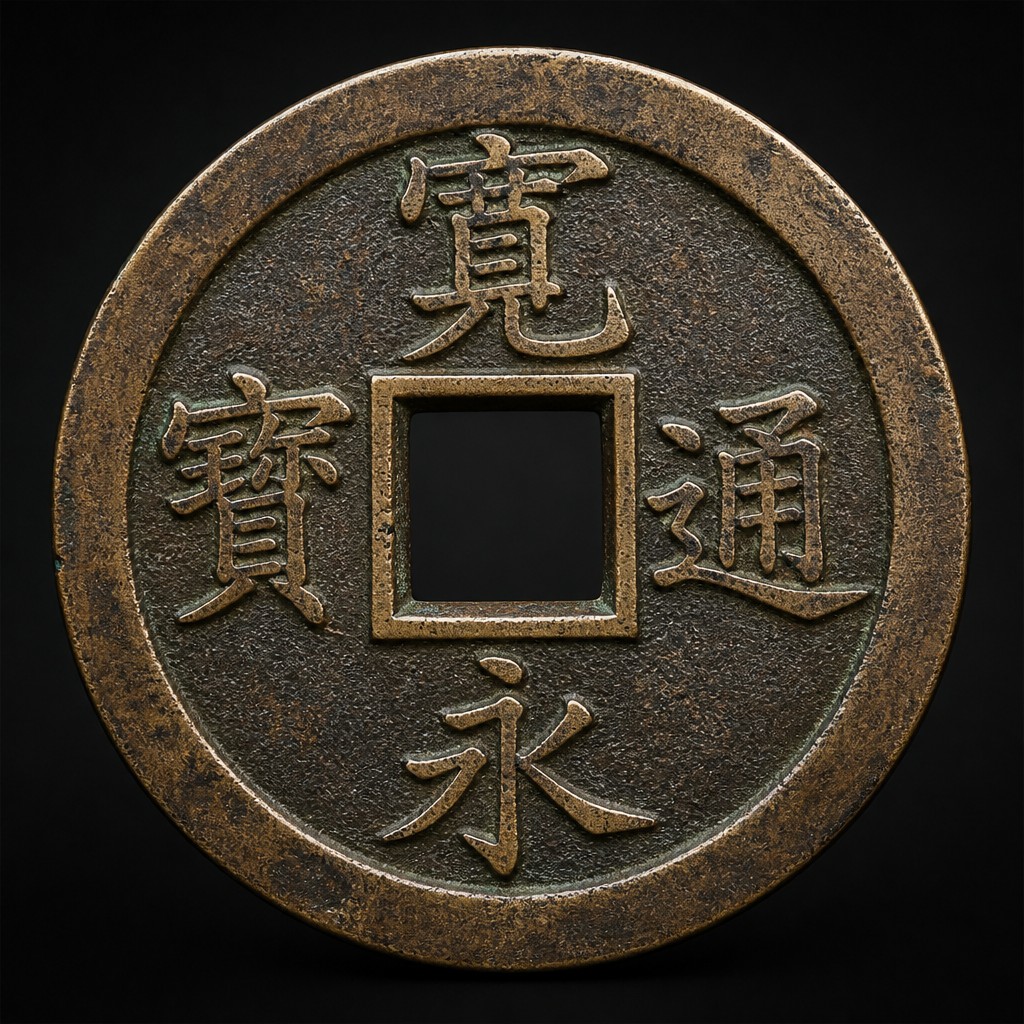
What the Coin Is
The Kan'ei Tsuho (寛永通寶) was Japan's standard low-denomination cash coin during the Edo period, first cast in 1636 and produced with variations for more than two centuries at numerous mints across Japan. It follows the East Asian cash-coin format: round with a square center hole, meant to be strung together on cords.
Obverse Design & Inscription
The obverse reads clockwise 寛永通寶 (Kan'ei Tsuho), referencing the Kan'ei era name in which the coin was first issued, though production long outlasted that era. Character style, stroke thickness, and spacing vary widely between mints and time periods, which numismatists use to sort the many varieties.
Reverse Design
Early Kan'ei Tsuho have a plain reverse. Later issues, especially 4-mon copper and iron pieces from the mid-to-late Edo period, add reverse elements such as a wave pattern (nami-sen) or a single character or dot indicating denomination or casting batch. A plain reverse generally points to an earlier or standard 1-mon issue.
Size, Weight, Metal, Edge
Standard 1-mon pieces are cast mainly in bronze/brass, roughly 24-25 mm in diameter. Larger 4-mon denominations run closer to 28-29 mm and often show the wave reverse. Iron versions also exist, feeling notably lighter in hand-density and prone to heavier rust and corrosion than copper alloy pieces. Edges are plain and unmilled, sometimes finished with light filing to remove casting flash.
Mint Marks & Casting Clues
Because so many domains and mints cast this coin over centuries, tiny differences in the characters, rim width, and hole shape are cataloged as distinct varieties by specialists. Look for casting seams and file marks on the rim; some later issues carry a small identifying character or symbol near the square hole on the reverse.
Telling It Apart from Similar Coins
Compared to the earlier Wado Kaichin, the Kan'ei Tsuho inscription is entirely different (寛永通寶 vs. 和同開珎) and the coin is generally thinner with sharper, later-period casting technique. It can also resemble Chinese and Korean cash coins of similar size; the giveaway is always the four-character inscription, which is unique to each country's coinage. Within the Kan'ei Tsuho series itself, comparing calligraphy style, rim thickness, and the presence or absence of reverse marks is how specialists sort coins into their specific mint and period variety.
Judging Condition at a Glance
Because so many examples survive, condition varies enormously. Look for well-centered casting, full rims, and crisp unworn characters for higher-condition pieces. Wave-reverse 4-mon coins with strong, undamaged wave detail are considered nicer examples of that variety.
Authenticity Red Flags
Given how common and inexpensive genuine examples are, outright fakes are less frequent, but be wary of coins with unnaturally uniform, machine-made looking surfaces, incorrect character forms, or wrong size-to-weight ratios, which can indicate later tourist reproductions rather than a period cast coin.
Frequently asked questions
What does "Kan'ei Tsuho" mean?
It references the Kan'ei era name plus "tsuho," meaning "circulating treasure/currency," a standard phrase used on East Asian cash coins.
How do I tell a 1-mon from a 4-mon piece?
The 4-mon coin is larger (around 28-29 mm) and usually shows a wave pattern on the reverse, while the 1-mon is smaller and often has a plain reverse.
Are iron Kan'ei Tsuho coins less valuable than copper ones?
Iron pieces were a lower-cost substitute and typically show more corrosion; collectors generally view copper/bronze examples as more desirable, though rarity of a specific variety matters more than metal alone.
Why are there so many minor varieties of this coin?
Production spanned over two centuries at many different mints across Japan, each with slightly different dies and casting practices, creating a large number of cataloged sub-types.
How is it different from Chinese cash coins of similar size?
The inscription is the key: Kan'ei Tsuho is specific to Japan, while Chinese coins carry different era names and reign titles in their four characters.