
How to Identify the Japanese Bunkyu Eiho (cash coin)
A distinctive oval-shaped cast bronze cash coin issued in Japan's late Edo period, valued at four mon and easily recognized by its elongated shape rather than the traditional round cash-coin form.
Read the full Japanese Bunkyu Eiho (cash coin) encyclopedia entry →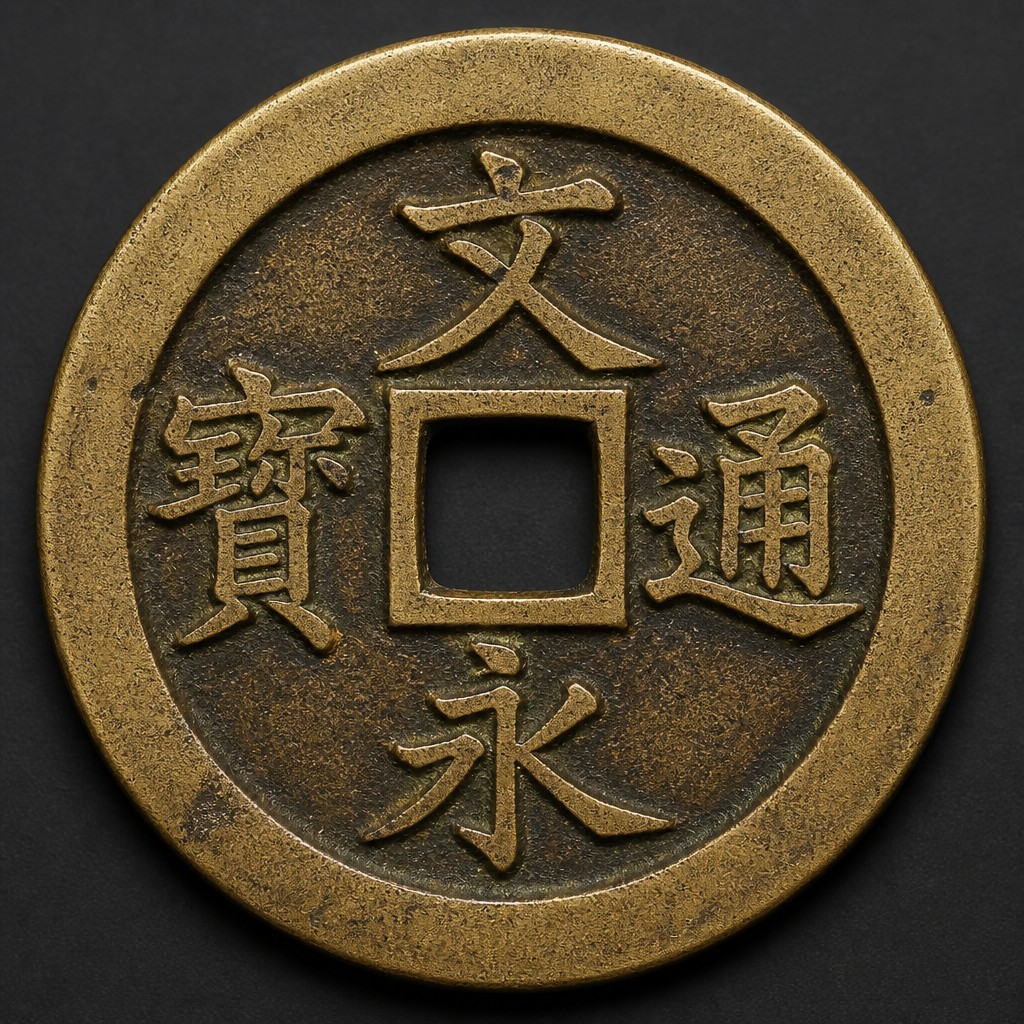
What It Is
The Bunkyu Eiho is a cast copper-alloy cash coin issued in Japan during the Bunkyu era of the late Edo period, roughly the 1860s, as the Tokugawa shogunate's monetary system faced growing strain in the years leading up to the Meiji Restoration. It represents one of the last major cash coin types issued under the shogunate's traditional currency system.
Obverse Design & Inscription
The obverse carries four Japanese characters (Han script used in Japan) reading "Bunkyu Eiho," read in the traditional cash-coin order of top, bottom, right, left, identifying the era name and using the standard "eiho" phrase common to many East Asian cash coin legends meaning circulating currency.
Reverse Design
The reverse is generally plain or carries minimal additional marks, consistent with the simple, function-first design typical of most East Asian cash coinage, prioritizing legibility of the value and issuing authority over decorative elements.
Size, Weight & Metal
The single most distinctive identifying feature of the Bunkyu Eiho is its shape: unlike the traditional round-with-square-hole format used by virtually all other Japanese, Chinese, Korean, and Vietnamese cash coins, the Bunkyu Eiho was cast in an elongated oval shape, still retaining the square center hole. It was cast in bronze or brass alloy and assigned a value of four mon, higher than the standard one-mon cash coin.
Mint Marks & Where to Find Them
Bunkyu Eiho coins were cast at multiple mint locations across Japan under shogunate authority; specific mint attribution is generally determined by subtle differences in casting style and character rendering compared across known reference varieties rather than a single obvious mint-mark character.
Telling It Apart from Similar Coins
The oval shape alone immediately distinguishes the Bunkyu Eiho from virtually every other East Asian cash coin, which are round. Within Japanese cash coinage specifically, it should not be confused with the also oval-shaped Genbun era four-mon coins from earlier in the Edo period, which carry a different era-name legend ("Genbun" rather than "Bunkyu") despite the similar elongated format.
Judging Condition at a Glance
Well-preserved examples show crisp, clearly separated strokes in all four characters and a clean, intact oval rim. Worn examples show flattened character strokes and a smoothed, rounded rim edge, along with surface oxidation typical of century-and-a-half-old cast bronze coins.
Authenticity Red Flags
Because Japanese cash coins are widely collected, reproductions exist; look for a surface and weight consistent with genuine cast bronze coins of the period, and be wary of pieces with unnaturally uniform, bright, or lightweight construction. Comparing the specific character style against verified genuine Bunkyu Eiho references helps confirm a piece matches known genuine casting varieties rather than a later reproduction.
Frequently asked questions
What makes the Bunkyu Eiho easy to recognize at a glance?
Its oval shape sets it apart immediately from almost all other East Asian cash coins, which are round with a square center hole.
How much was this coin worth?
It was issued with a value of four mon, higher than the standard one-mon cash coin common in earlier Japanese coinage.
Could this be confused with another oval Japanese coin?
Yes, the earlier Genbun-era four-mon coin also has an oval shape, but it carries a different era-name legend, so reading the characters carefully distinguishes the two.
What metal is it made of?
It was cast in a bronze or brass copper alloy, consistent with most Japanese cash coinage of the period.