
How to Identify the Japanese 1 Yen Silver Coin
A large Meiji-era silver coin featuring a coiled dragon on the obverse and a sunburst with the denomination in English on the reverse, widely used in Japan and Asian trade.
Read the full Japanese 1 Yen Silver Coin encyclopedia entry →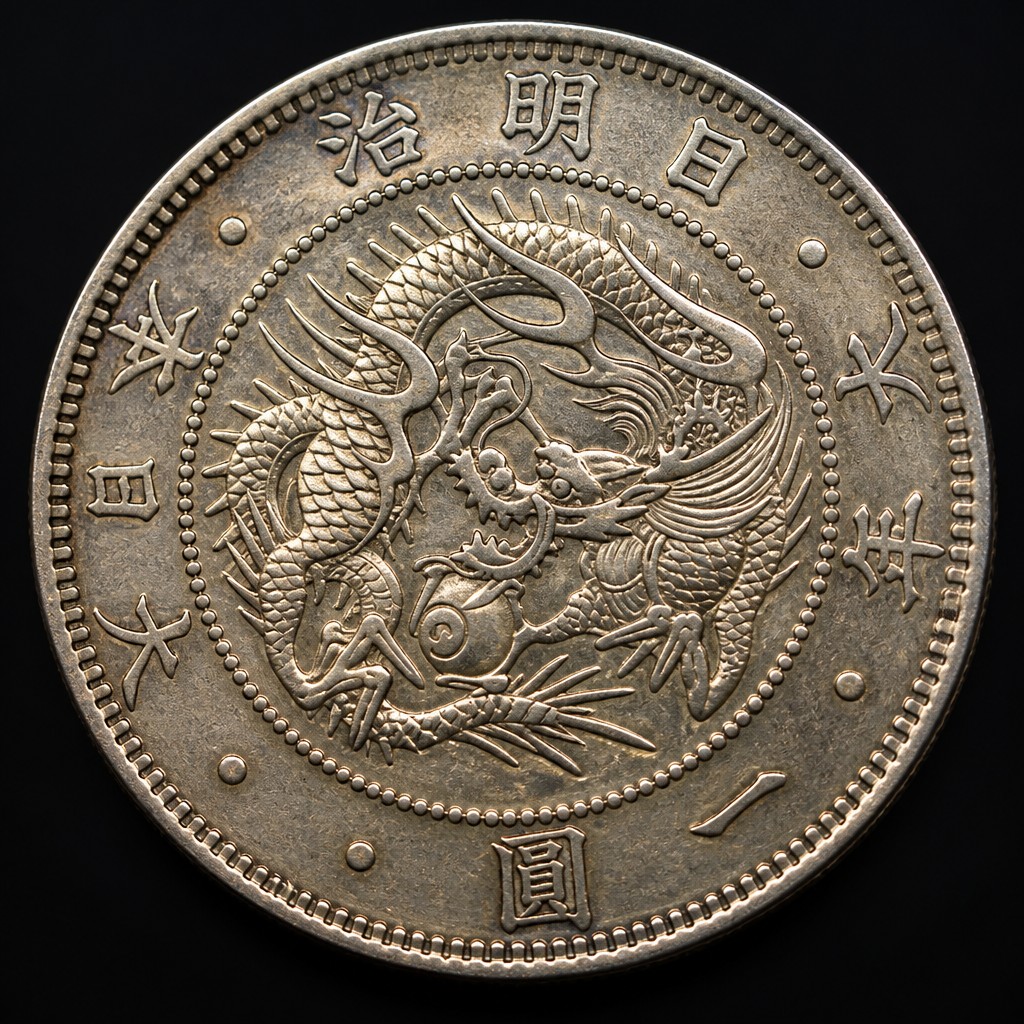
What the Coin Is
Introduced in 1870 under Japan's Meiji-era currency reforms, the silver 1 Yen coin served as the country's standard large silver denomination for decades. Though Japan adopted the gold standard domestically in 1897, silver Yen coins continued to be struck afterward specifically for use in overseas trade until production ended in the 1910s.
Obverse Design & Inscriptions
The obverse shows a coiled dragon grasping or chasing a flaming pearl, surrounded by a beaded border, with Japanese characters reading "Dai Nippon" (Greater Japan) and the era year arranged around the design.
Reverse Design & Inscriptions
The reverse features a sunburst with radiating rays at the top center, above a wreath encircling Japanese characters for the value, with "1 YEN" spelled out in English at the bottom, providing an easy identifier for foreign traders unfamiliar with Japanese script.
Size, Weight, Metal & Edge
The coin measures 38.1mm in diameter, weighs 26.96 grams, is struck in .900 fine silver, and has a reeded edge.
Mint Marks & Where to Find Them
These coins do not carry a separate mint mark letter in the way many Western coins do; production was centered at the Osaka mint, and identification instead relies on the era year rendered in Japanese characters on the obverse.
Telling It Apart From Similar Coins
Distinguish the 1 Yen from Japan's separate Trade Dollar issue of the 1870s by checking the reverse wording: the Trade Dollar spells out TRADE DOLLAR along with its weight and fineness in English, while the standard 1 Yen simply states "1 YEN" without the added weight declaration. Dragon style details also shifted somewhat across the coin's production span, so comparing scale patterns and border design can help narrow down the general period.
Judging Condition at a Glance
Examine the dragon's individual scales and the sunburst rays for smoothing or flattening, since these fine, raised details wear down first with circulation. A well-preserved coin shows crisp scale definition and sharply defined rays, while a heavily worn example will show a smoother, less detailed dragon body.
Authenticity Red Flags
Because these coins circulated so widely across Asia as trusted trade silver, they were frequently counterfeited both historically and in later reproduction form. Verify that the weight and diameter match expected standards, and look for sharp, well-defined lettering and dragon scale detail; cast fakes often show a grainy or pitted surface, indistinct scale patterns, or a dull ring when tapped compared to a genuine struck silver coin.
Frequently asked questions
What is shown on the obverse of this coin?
A coiled dragon grasping a flaming pearl, surrounded by Japanese characters reading Dai Nippon and the era year.
How is this different from the Japanese Trade Dollar?
The Trade Dollar explicitly states its weight and fineness in English on the reverse alongside the words TRADE DOLLAR, while the standard 1 Yen simply reads 1 YEN without that added inscription.
What is the silver content of the Japanese 1 Yen?
It is struck in .900 fine silver, weighing 26.96 grams.
Where was this coin produced?
Primarily at Japan's Osaka mint, identified by the era year in Japanese characters rather than a separate mint mark letter.