
How to Identify the James VI Ryal
A collector's guide to attributing the Scottish sword dollar of James VI by its lion shield, swordhand reverse, date, and countermarks.
Read the full James VI Ryal encyclopedia entry →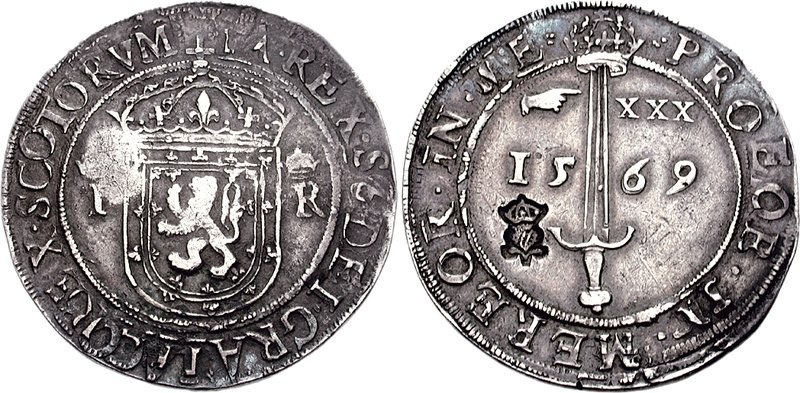
Start with the swordhand reverse, the type's defining feature. Look for a mailed (armored) hand issuing into the field and gripping an upright sword, with a date beside it — 1569 on the photographed coin. This design gives the ryal its "Sword Dollar" nickname and immediately separates it from other large silver coins of the era. Read the surrounding Latin motto, which refers to the sword being drawn for the deserving and against the unworthy.
Turn to the other face and confirm the obverse. It should show a crowned heraldic shield charged with the Scottish lion rampant, set within a decorative tressure, and encircled by a legend naming James as king of Scots. The crowned lion-shield combined with the swordhand reverse is the core signature of the type; both faces should agree before you attribute the coin.
Assess fabric, size, and metal. This is a large hammered silver coin, so expect a broad flan that is slightly out of round, uneven rims, hand-cut lettering, and the soft or occasionally doubled relief of hand-struck work. Weigh and measure the coin and compare against published specifications for the ryal; a markedly light coin may be clipped, which lowers both value and confidence in the piece.
Check for a countermark. Some ryals were officially stamped later in the century with a small mark to revalue them. Its presence, position, and form are useful for attribution and can add to a coin's interest, so examine the fields carefully and compare any mark against a standard reference for Scottish coinage.
Be cautious about authentication and look-alikes. Early Scottish silver is sometimes faked, and cast copies, tooled surfaces, and modern replicas exist; do not judge size or weight from a photograph alone. Watch for casting seams, bubbles, unnaturally smooth fields, or lettering that lacks natural hand-cut variation. For any coin of significant value, seek an opinion from a specialist in Scottish hammered coinage or a reputable grading service.
Frequently asked questions
Which side is the obverse?
The crowned shield with the Scottish lion rampant is treated as the obverse; the mailed swordhand with the date is the reverse. Both should be present to confirm the type.
How do I distinguish it from English coins of the same era?
The lion-rampant shield, the Latin legend naming the king of Scots, and the distinctive swordhand reverse mark it as Scottish. English coins of Elizabeth I use different designs and legends entirely.
How can I be sure it isn't a cast copy?
Genuine coins are hand-struck, showing an uneven flan and hand-cut lettering. Watch for casting seams, air bubbles, mushy detail, or incorrect weight. For a coin of this value, professional authentication is strongly advised.
Does a countermark make it more valuable?
A genuine, correctly applied countermark adds historical interest and can affect value, but it must be authentic. Compare any mark to standard references and have doubtful pieces examined by a specialist.