
How to Identify the Islamic Gold Dinar (Umayyad)
The Umayyad gold dinar is the first purely epigraphic Islamic coin, bearing only Arabic Kufic script and religious inscriptions with no human or animal imagery.
Read the full Islamic Gold Dinar (Umayyad) encyclopedia entry →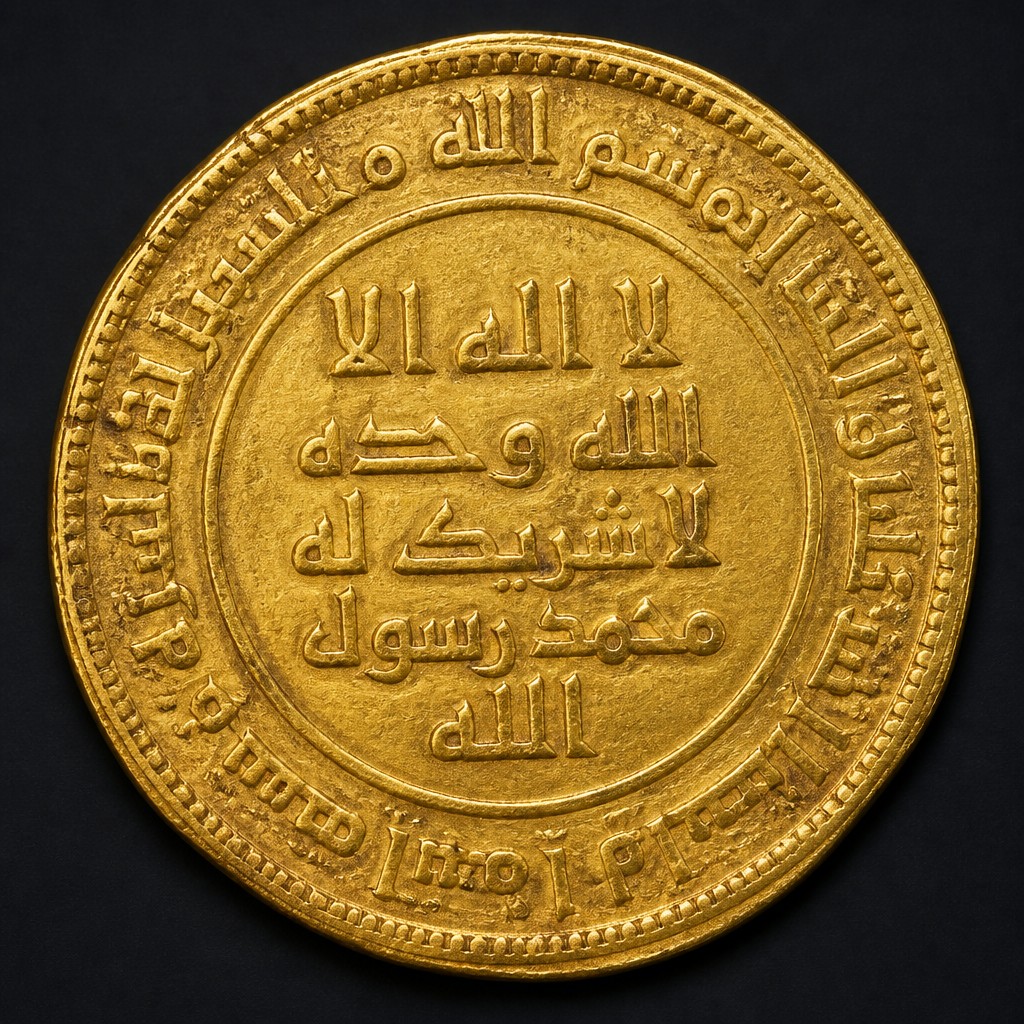
What It Is
The Umayyad gold dinar was introduced as part of Caliph Abd al-Malik's major coinage reform of 696-697 AD (77 AH), which replaced earlier transitional coins imitating Byzantine and Sassanian designs with a wholly new, text-only Islamic coinage. It set the template that Islamic gold coinage would follow for centuries afterward.
Obverse Design
The obverse carries no image at all—only concentric rings of Arabic Kufic script. The center typically bears the Islamic declaration of faith (the Shahada: "There is no god but God, alone, without partner"), while the surrounding marginal legend usually quotes further Quranic text, often referencing the nature of God as described in Surah al-Ikhlas.
Reverse Design
The reverse mirrors this text-centered layout, generally naming the Prophet Muhammad and his mission in the center, with a Quranic quotation (frequently from Surah al-Tawba, verse 33, on the truth of Islam) in the outer margin. Genuine coin dies of this period contain no portraits, animals, or symbolic imagery.
Size, Weight, and Metal
Struck in high-purity gold, the Umayyad dinar weighs close to 4.25 grams (based on the Islamic mithqal standard) with a diameter around 19-20mm, deliberately close to the Byzantine solidus it was meant to rival and replace in regional trade. Edges are plain and hand-struck, so flans can be slightly irregular in shape.
Mint Marks and Dates
Because the design is text-only, dating relies on a marginal inscription that spells out the Islamic (Hijri) year the coin was struck, sometimes along with a mint name—early dinars from the main Damascus mint often omit an explicit city name, while some provincial issues include one. Reading the date requires recognizing Arabic numeral-word forms of the period.
Telling It Apart From Similar Coins
The reformed Umayyad dinar is easy to distinguish from the earlier "Arab-Byzantine" transitional gold coinage, which still carried images of standing caliphs or crosses-on-steps copied from Byzantine prototypes. Any Islamic gold coin with human figures, crosses, or animals predates or falls outside the 697 reform; anything afterward from mainstream Umayyad and Abbasid mints should be purely epigraphic.
Judging Condition at a Glance
Assess condition by the crispness of the Kufic lettering strokes and the completeness of the marginal legend, since these coins have no portrait or pictorial high points to judge wear by. A well-centered strike with a full, legible margin is considered far more desirable than an off-center strike missing part of the date or mint legend.
Authenticity Red Flags
Be cautious of dinars with garbled, non-grammatical Arabic, letterforms that look modern or mix calligraphic styles inconsistent with early Kufic, a weight noticeably off the ~4.25 gram standard, or suspiciously uniform, machine-like lettering that lacks the slight hand-cut die irregularities typical of the period.
Frequently asked questions
Why does the Umayyad dinar have no pictures on it?
Caliph Abd al-Malik's 696-697 AD coin reform deliberately removed all figural imagery in favor of Arabic religious inscriptions, aligning the coinage with Islamic norms and distinguishing it from Byzantine and Sassanian designs it replaced.
What text usually appears on the obverse center?
The Shahada, the Islamic declaration of faith, is the most common central inscription, surrounded by further Quranic text in the margin.
How is a dinar from this period dated?
Through a Hijri (Islamic calendar) year spelled out in the marginal Arabic legend, often alongside or in place of a mint name.
What is an 'Arab-Byzantine' dinar and how does it differ?
These are earlier transitional gold coins struck before the 697 reform that still copied Byzantine imagery like standing rulers or crosses; true reformed Umayyad dinars are strictly text-only and postdate these types.
What weight should a genuine Umayyad dinar be close to?
Around 4.25 grams, based on the Islamic mithqal weight standard used across the early caliphate's gold coinage.