
How to Identify the Irish Pistole
A collector's guide to the rare Irish emergency gold pistole: weight-stamped faces, small heavy fabric, the double pistole, look-alikes, and authentication.
Read the full Irish Pistole encyclopedia entry →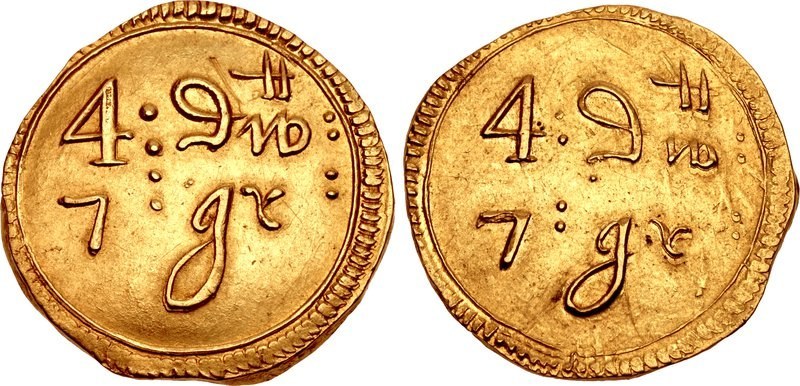
Begin with the design — or rather its absence. The defining trait of the Irish pistole is that both faces show denominal specifications, a stamped weight in pennyweights and grains, instead of a portrait or a full coat of arms. If a purported example carries a detailed royal bust or an ornate heraldic shield, it is not this austere emergency type. The observed piece shows exactly this simple weight marking.
Read the fabric of the coin. As a hammered emergency issue, it should have an irregular flan, individually punched value marks, and none of the crisp uniformity of machine striking. The gold color should be strong, and the coin should feel distinctly heavy for its small diameter, because its worth was defined by bullion weight rather than by tale.
Check weight against the denomination. The pistole is the lighter of the pair and the double pistole is roughly twice as heavy, so an accurate scale reading is central to attribution. Compare the measured weight to documented specimens; a piece that is significantly light may be clipped, damaged, a lower denomination, or not genuine at all. Since gold does not corrode, heavy dark tarnish is a warning sign about the metal.
Rule out look-alikes. Foreign gold pistoles — especially Spanish and other Continental pistoles — circulated widely and share the name, so confirm the piece is the Irish emergency type and not an imported coin. Simple weight-stamped fabric alone is not enough; the specific marks, weight standard, and provenance must fit the Irish series.
Be rigorous about authentication. This is one of the rarest and most valuable areas of Irish coinage, which makes it a target for casts, tooled pieces, and outright fakes. Watch for casting seams, surface bubbles, unnaturally smooth fields, wrong weight, and value marks that look engraved rather than punched. Given the rarity and value, never accept a piece without documented provenance and an opinion from a specialist in Irish hammered and emergency gold.
Frequently asked questions
How do I tell an Irish pistole from a Spanish pistole?
Spanish and other Continental pistoles are regular regal coins with a proper design and legend, and they circulated widely. The Irish emergency pistole instead shows only stamped weight marks. Confirm the fabric, weight standard, and provenance rather than relying on the shared name.
What distinguishes a pistole from a double pistole?
Weight. The pistole is the lighter denomination and the double pistole is roughly twice as heavy. An accurate scale reading compared against documented specimens is the reliable way to separate them.
Why is provenance so important for this coin?
Because genuine examples are extremely rare and valuable, forgeries and misattributions are common. A documented ownership history, together with expert examination of weight, metal, and fabric, is essential before accepting a piece as authentic.
Can I identify it from the design alone?
Not safely. The design is only a punched weight statement, which is easy to imitate, so identification must rest on measured weight, metal, hand-struck fabric, and specialist confirmation rather than on imagery.