
How to Identify the Irish Gun Money Sixpence
A collector's walkthrough for attributing a James II gun money sixpence by its bust, crown-and-shield reverse, VI value mark, date, and base-metal alloy.
Read the full Irish Gun Money Sixpence encyclopedia entry →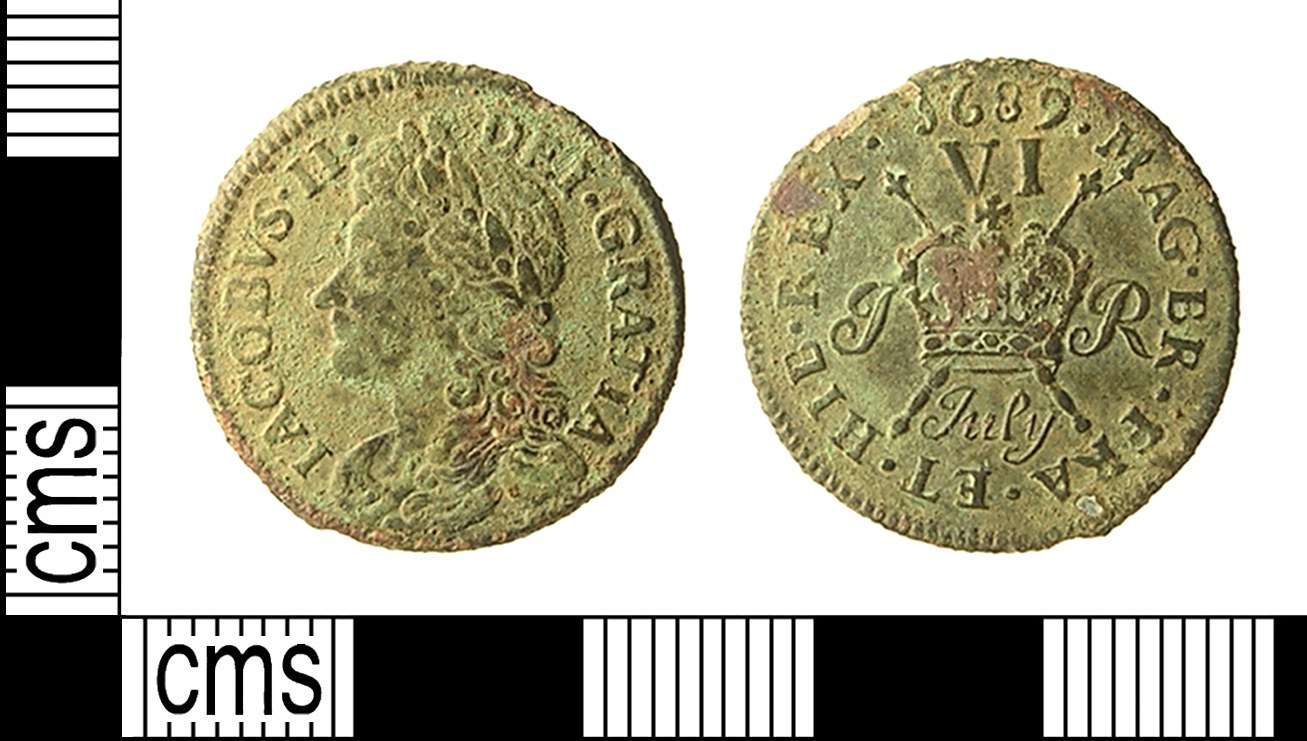
Begin with the metal, because it is the defining feature of the series. Gun money is struck on a base copper alloy, usually with a yellowish or brassy tone, not on silver. Worn pieces often show rough, slightly porous, or corroded surfaces consistent with recycled scrap metal. A coin of this design that is clearly silver, or that has the wrong color and surface, should be treated with caution.
Read the obverse next. You should see a profile bust of James II, typically laureate and draped, facing left, with a Latin legend naming him as king in a contracted form beginning IACOBVS II. On the reverse, confirm a large royal crown above a heraldic shield of arms, encircled by the legend and accompanied by a mark of value. The numeral VI confirms the sixpence and separates it from the shilling (XII), half crown, and crown of the same series.
Check the date and look for a month. Gun money of this type is dated 1689 or 1690, and many pieces also carry a month abbreviation placed near the date or below the bust. Finding and reading that month is central to attributing the coin, since collectors distinguish varieties by month of striking. Confirm too that the diameter and weight suit a sixpence rather than one of the larger denominations, which share the same general design.
Be alert to look-alikes and cautions. Because all gun money denominations use a similar James II portrait and crowned reverse, size and the value numeral are what separate them; do not rely on the design alone. The soft alloy means genuine coins are often weakly struck and unevenly worn, which is normal, but watch for casting seams, mushy detail, or artificial patina that can indicate a cast forgery or a tooled surface. Cleaning and corrosion are common and both reduce value.
For anything beyond a common worn example, match the bust, reverse, value mark, date, and month against a standard reference on Irish gun money, or seek a specialist opinion. The series is well documented, and careful comparison against published plates is the reliable route to pinning down the exact variety and confirming authenticity before paying a premium.
Frequently asked questions
How do I tell a gun money sixpence from a shilling or half crown?
They share the James II bust and a crowned reverse, so use size and the value mark. The sixpence is the smallest, with a VI value numeral, while the shilling shows XII and the crown and half crown are larger with higher value marks.
Where is the month on the coin?
On many gun money pieces a month abbreviation appears near the date or beneath the bust, alongside the year 1689 or 1690. Reading it is important because collectors distinguish varieties by the month of striking.
How can I spot a fake or a problem coin?
Genuine gun money is struck, not cast, so look for die-struck detail rather than casting seams or a soft, blurry surface. The metal should be a base copper alloy, not silver. Heavy corrosion, tooling, or an unnatural patina all reduce authenticity and value; for scarce pieces seek a specialist opinion.