
How to Identify the Indo-Greek Silver Drachm (Menander)
A bilingual silver coin of the Indo-Greek king Menander I, identifiable by its Greek obverse legend, Kharoshthi reverse legend, and figure of Athena Alkidemos.
Read the full Indo-Greek Silver Drachm (Menander) encyclopedia entry →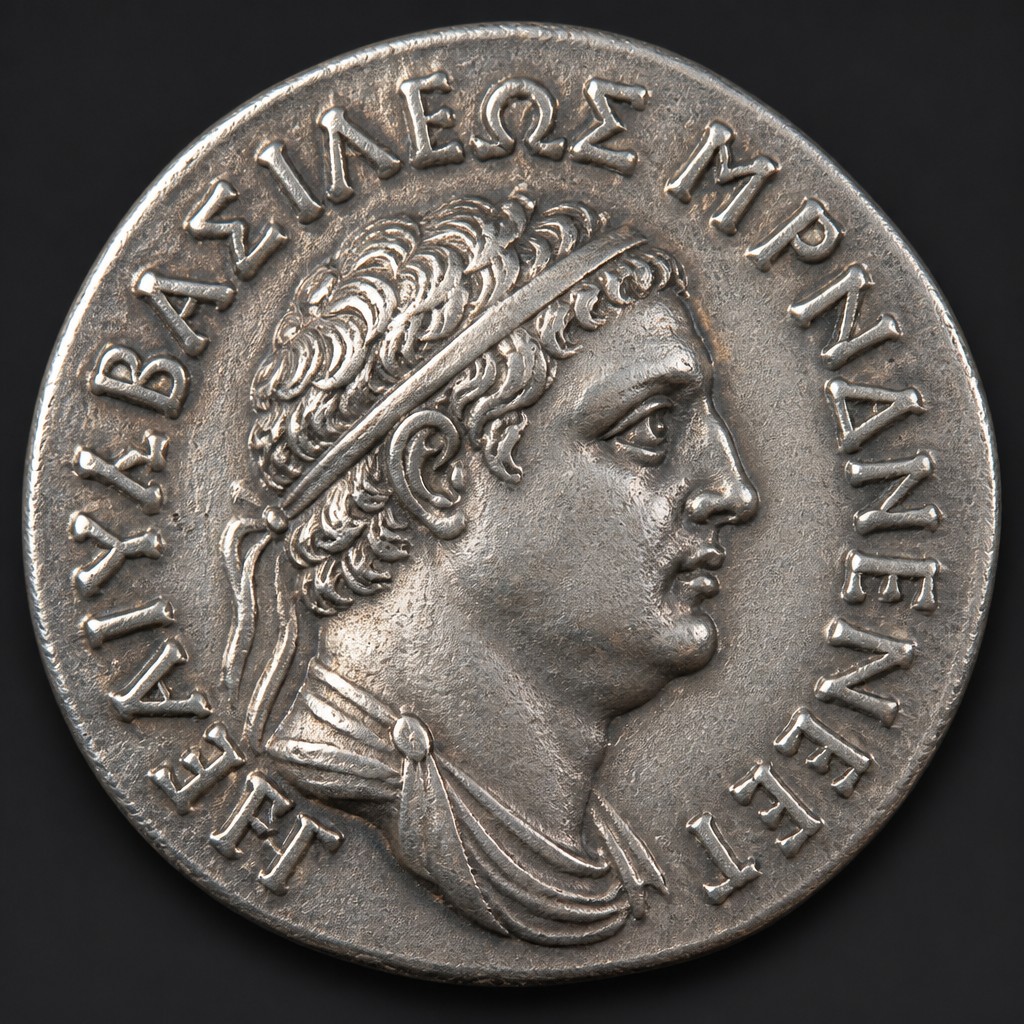
What the Coin Is
Menander I Soter was one of the most powerful Indo-Greek kings, ruling territory in the northwest Indian subcontinent in the 2nd century BCE. His silver drachms are among the most commonly encountered Indo-Greek coins today and are notable for pioneering bilingual, bi-script legends that reflect the cultural blend of the region.
Obverse Design & Inscription
The obverse shows a diademed, helmeted, or bare-headed bust of the king in profile, often wearing a crested helmet decorated with a bull's horn and ear. Around the border runs a Greek legend, typically "BASILEOS SOTEROS MENANDROU" ("of King Menander the Savior").
Reverse Design & Inscription
The reverse depicts Athena Alkidemos advancing right, brandishing a thunderbolt and holding a shield, a type borrowed from Macedonian royal coinage. The surrounding legend is written in Kharoshthi script, an Indian script, rendering the king's name and title in Prakrit as "Maharajasa tratarasa Menandrasa" (of the Great King, Savior, Menander).
Size, Weight, Metal, Edge
The drachm is struck in silver, typically around 2.4 to 2.5 grams on the Indian weight standard, with a diameter of roughly 17-18 mm. The edge is plain and irregular, typical of ancient hand-struck flans.
Telling It Apart from Similar Coins
The combination of a Greek obverse legend paired with a Kharoshthi reverse legend is the hallmark of Indo-Greek bilingual coinage and separates it from purely Greek coins from the Hellenistic west, which have no Kharoshthi, and from purely Indian punch-marked or cast coinage, which has no Greek. Among Indo-Greek kings, the specific name in both the Greek and Kharoshthi legends, along with the helmet style, confirms the coin belongs to Menander rather than another ruler using a similar Athena reverse type. Several later Indo-Greek and Indo-Scythian kings reused the Athena Alkidemos reverse, so always check that the king's name in the legend, not just the design, actually reads Menander before attributing a coin to him.
Judging Condition at a Glance
Look for a well-centered strike showing the full portrait and full Athena figure, with legends legible on both sides. Because these coins were struck by hand on irregular flans, off-center strikes are common; a coin with both legends fully readable and a clear portrait is considered a nicer example.
Authenticity Red Flags
Modern forgeries sometimes have a legend that mixes up the Greek and Kharoshthi wording, letterforms that look too neat or modern in style, or a portrait style that doesn't match known die work for Menander. A dull, overly uniform gray surface without natural silver luster or toning, or a suspiciously perfect strike on an ancient hand-made flan, can also indicate a cast or modern-struck copy rather than a genuine ancient coin.
Frequently asked questions
Why does this coin have two different scripts?
Indo-Greek kings like Menander ruled a mixed Greek and Indian population, so their coins used Greek on the obverse for the Hellenistic administration and Kharoshthi on the reverse for local Indian subjects.
What does the reverse figure represent?
It is Athena Alkidemos, a Macedonian royal coin type showing the goddess advancing with a thunderbolt and shield, adopted by several Indo-Greek kings including Menander.
How heavy should a genuine drachm be?
Most examples struck on the Indian standard weigh around 2.4-2.5 grams; a piece far outside that range is worth extra scrutiny.
How do I know it's Menander and not another Indo-Greek king?
Check that both the Greek legend (BASILEOS SOTEROS MENANDROU) and the Kharoshthi legend name Menander, and compare the helmet and portrait style to known Menander types.
Are off-center strikes normal for this coin?
Yes, ancient hand-struck coins on irregular flans often show some off-centering; it does not necessarily indicate a fake, though a fully centered, legible example is more desirable.