
How to Identify the Indian Punch-Marked Karshapana
The Karshapana is an early Indian silver coin identified not by a unified design but by a cluster of individually punched symbols stamped onto an irregular metal flan.
Read the full Indian Punch-Marked Karshapana encyclopedia entry →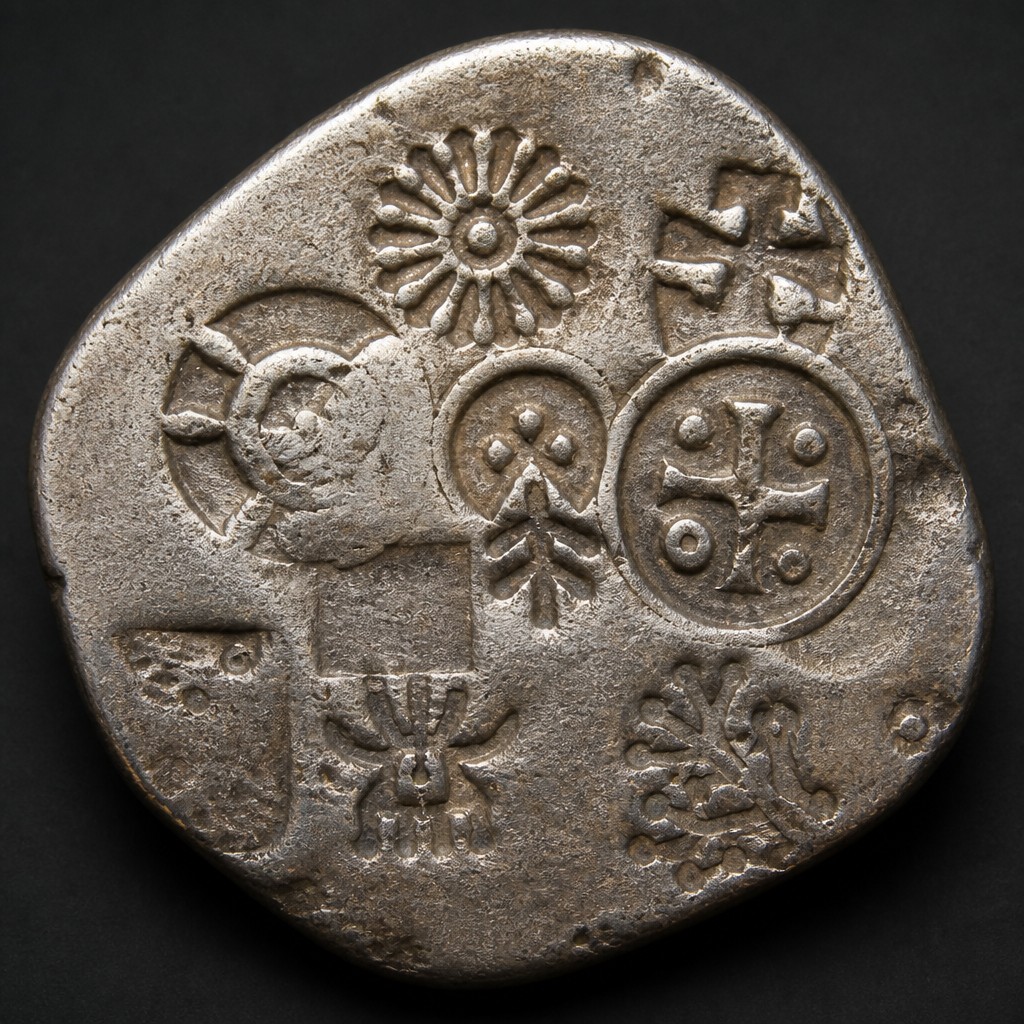
What It Is
Punch-marked karshapanas are among the earliest coinages of the Indian subcontinent, produced from roughly the 6th century BC through the 2nd century BC by various Janapadas (early states) and later the Mauryan Empire. Unlike coins with a single unified design, they were made by repeatedly stamping small individual punches into a pre-cut metal flan.
Obverse Design
There is no single "obverse design" in the modern sense—instead, the obverse carries a cluster of several distinct small punch marks, typically five on the most standardized Mauryan-period issues, each impressed separately and often at different times or by different authorities. Common symbols include a sun (a circle with radiating rays), a six-armed or six-petaled symbol, animals such as an elephant or bull, trees within railings, hills or mountain symbols, and geometric shapes.
Reverse Design
The reverse is generally either blank or carries a smaller number of additional punch marks, sometimes added later than the primary obverse group, possibly by subsequent authorities or merchants re-validating the coin's silver content and weight as it changed hands or crossed political boundaries.
Size, Weight, and Metal
Made primarily of silver (with some copper punch-marked issues also known), karshapanas have an irregular, roughly rectangular or occasionally more randomly shaped flan, since they were cut from silver sheet or bar rather than cast in a mold or struck between two dies with a fixed shape. Weight follows a standard historical unit of approximately 3.4 grams (traditionally described as 32 rattis), though individual pieces vary somewhat due to the hand-cutting process.
Mint Marks
There are no mint names, inscriptions, rulers' portraits, or dates on these coins at all—identification relies entirely on the specific combination and arrangement of symbols punched into the flan, which numismatists use to group coins by approximate region and period.
Telling It Apart From Similar Coins
Punch-marked karshapanas are easily distinguished from all later Indian coinages (Gupta gold dinars, Kushan coinage, or Indo-Greek issues) by the complete absence of any unified struck image, portrait, or legend—only a scatter of individually applied small symbols on an irregular flan. The specific symbol combinations also help separate earlier, more varied regional issues from the more standardized five-symbol Mauryan-period type.
Judging Condition at a Glance
Because there is no single design to show "wear" in the ordinary sense, condition is judged by how clearly each individual punch mark remains legible and by the flan's overall physical integrity (cracks, clipping, or corrosion). A coin where all symbols are crisply struck and undamaged is considered notably better than one with worn, overlapping, or partially missing punches.
Authenticity Red Flags
Because the punch-marked format has no unifying central design, reproductions can be harder to spot at a glance; things to check include an implausible or inconsistent symbol combination compared to documented groupings, a flan shape or thickness that looks machine-cut rather than hand-hammered, and a weight well outside the roughly 3.4 gram standard. A silver surface that looks too bright, uniform, or lacks the characteristic small striking depressions of hand-applied punches is also worth a second look.
Frequently asked questions
Why don't punch-marked karshapanas have a single unified design?
They were made by individually stamping separate small punches into a cut metal flan rather than striking the whole coin at once between two engraved dies, a technique that predates unified coin-die minting in India.
What do the symbols on these coins mean?
Scholars believe symbols like the sun, hill, tree-in-railing, and animals may have represented issuing authorities, regions, or guarantors of the coin's silver content, though precise meanings for many symbols remain debated.
How many punch marks are typical on the obverse?
Standardized Mauryan-period karshapanas commonly show five distinct punch marks on the obverse, though earlier regional issues can show more variation in number and combination.
What is the typical weight of a karshapana?
Approximately 3.4 grams, traditionally described in ancient sources as 32 rattis, though hand-cutting means individual coins vary somewhat from this standard.
Do these coins have dates or mint names?
No, there are no inscriptions, dates, or ruler names on punch-marked karshapanas; all attribution relies on interpreting the punched symbols themselves.