
How to Identify the Indian Head Quarter Eagle ($2.50)
A $2.50 gold coin minted 1908–1929, sharing the incuse design of its half eagle companion, with Liberty in a feathered headdress and a standing eagle recessed into the surface.
Read the full Indian Head Quarter Eagle ($2.50) encyclopedia entry →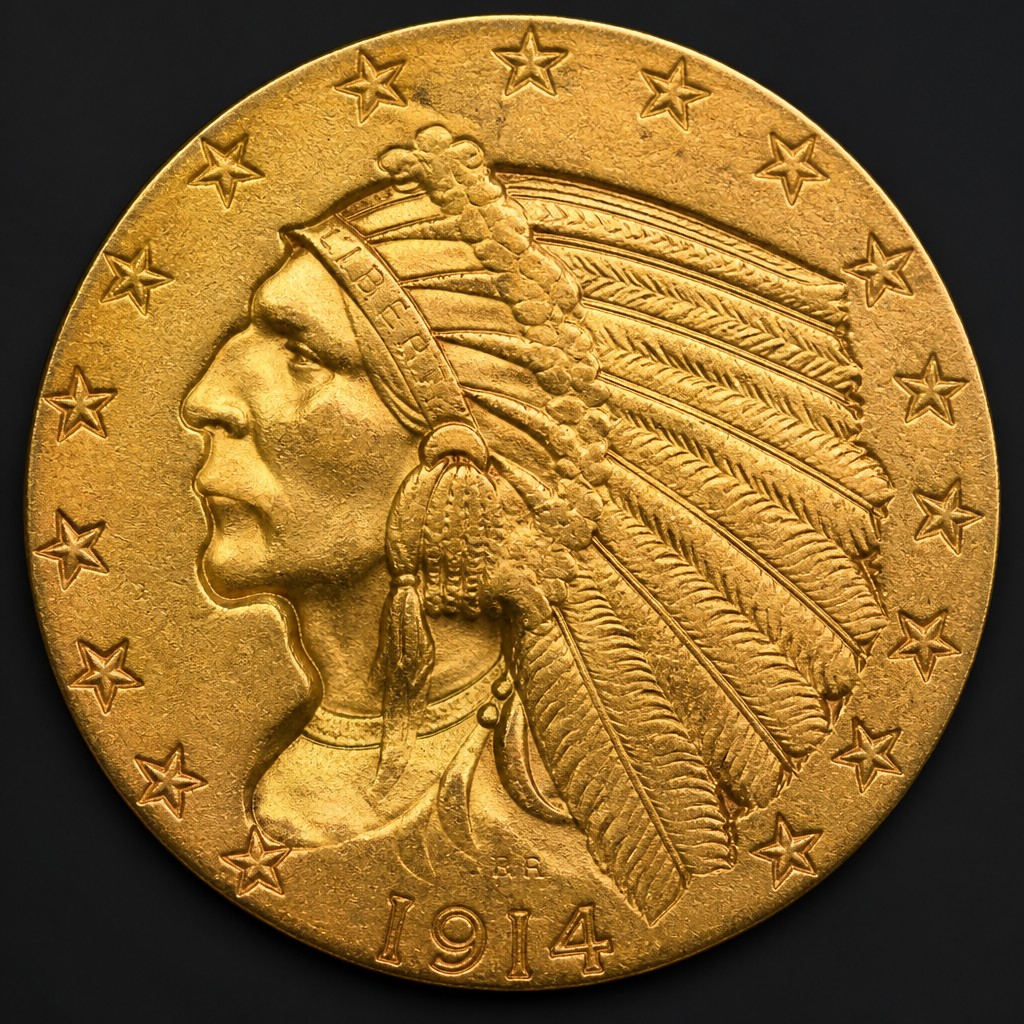
What It Is
The Indian Head quarter eagle is a $2.50 gold coin designed by Bela Lyon Pratt and struck from 1908 to 1929. Along with its companion half eagle, it is one of only two U.S. coin types made with an incuse design, where the devices are sunk below the coin's surface rather than raised.
Obverse Design
The obverse shows a Native American-style portrait of Liberty wearing a feathered war bonnet, recessed into the coin. "LIBERTY" appears on the headband, stars surround the portrait, and the date is below.
Reverse Design & Inscriptions
The reverse depicts a standing eagle on a bundle of arrows with an olive branch, also incuse. "UNITED STATES OF AMERICA" arches above, "2 1/2 DOLLARS" appears below, "E PLURIBUS UNUM" is lettered to the side, and "IN GOD WE TRUST" appears near the eagle.
Size, Weight, Metal, and Edge
The coin weighs 4.18 grams, is struck in .900 fine gold, measures 18 mm in diameter, and has a reeded edge.
Mint Marks and Where to Find Them
The mint mark appears on the reverse, to the left of the arrow points near the rim. A "D" indicates Denver; no mint mark means Philadelphia. San Francisco did not strike this denomination in this series.
Telling It Apart From Similar Coins
The incuse design instantly separates this coin from the earlier Liberty Head quarter eagle, which has a coronet portrait and eagle rendered in normal raised relief. It closely mirrors its larger companion, the Indian Head half eagle, in design style — the denomination wording and smaller size are the quickest ways to tell them apart.
Judging Condition at a Glance
Because the design sits below the surface, wear smooths the recessed high points rather than flattening a raised rim. Check Liberty's cheekbone and headdress feathers, and the eagle's wing and leg on the reverse, under good light to assess how much detail remains.
Authenticity Red Flags
Confirm weight and diameter against genuine specifications, since this is a small coin where deviations can be more noticeable. Examine the recessed design areas for crisp, well-defined edges — cast counterfeits attempting to replicate the incuse format often show mushy, rounded transitions instead of sharp sunken lines. A poorly defined or inconsistent rim is another common tell on altered or fake examples.
Frequently asked questions
What makes this coin's design distinctive?
Like its half eagle companion, it is struck incuse, meaning the design is recessed below the coin's surface instead of raised.
Where is the mint mark?
On the reverse, to the left of the arrow points near the rim; only Philadelphia (no mark) and Denver ('D') struck this coin.
How do I tell it apart from the Liberty Head quarter eagle?
The Liberty Head type has a coronet portrait in standard raised relief, while the Indian Head type has a feathered headdress design that sits below the coin's surface.
Where does wear show up first?
On the recessed high points — Liberty's cheekbone and headdress feathers on the obverse, and the eagle's wing and leg on the reverse.