How to Identify the Indian Head Half Eagle
A collector's walkthrough to confirm an Indian Head Half Eagle: the incuse design, headdress portrait, standing eagle, $5 size, mint marks, and fakes.
Read the full Indian Head Half Eagle encyclopedia entry →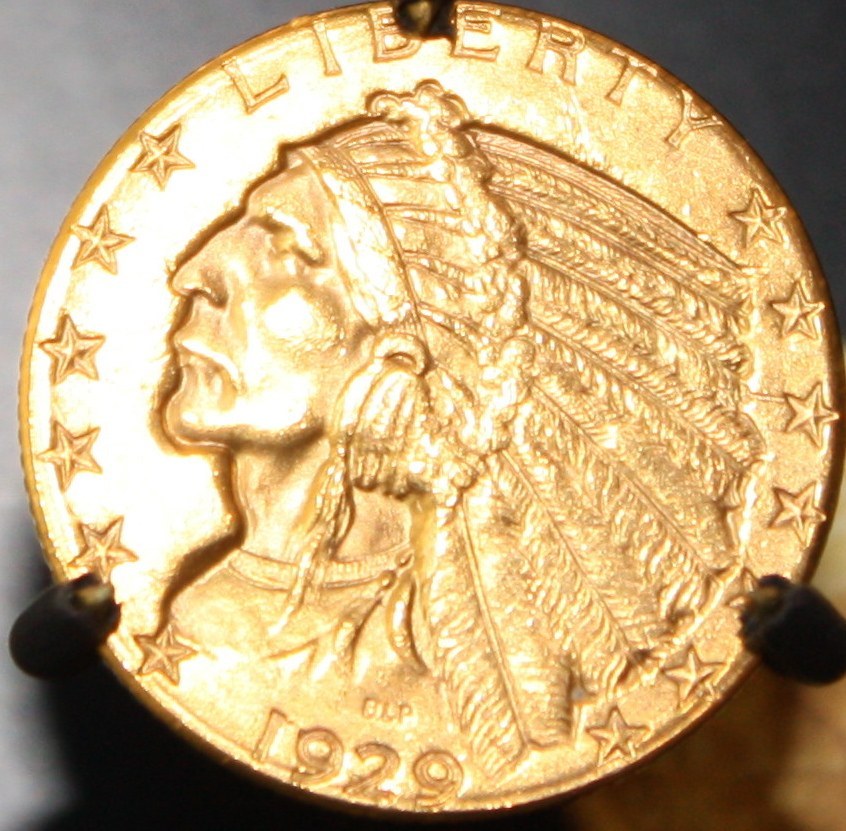
Start with the single most distinctive trait: this coin's design is incuse, or sunken. On almost every coin the devices stand up in relief; here the Native American portrait, the stars, and every letter are cut into a flat, unbroken field. If you tilt the coin and the highest points are the smooth outer field rather than the design, you are likely looking at a Pratt half eagle or its quarter-eagle sibling. This is the fastest way to separate it from the earlier Liberty Head (Coronet) half eagles, which are raised-relief.
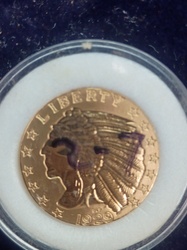
Read the obverse. You should see a Native American man wearing a feathered war bonnet, facing left, with LIBERTY arced above, thirteen stars around the rim, and the date below — 1929 on the example here. The portrait is often called a Liberty head with an Indian headdress, but it is modeled as a Native American man, not the classical Liberty of other gold coins. Sharp feather tips and clear facial detail suggest less wear; because the design is protected below the field, wear shows differently than on a normal coin, appearing first as flattening within the recesses.
Check the reverse and the size. A standing eagle perches on arrows and an olive branch, with UNITED STATES OF AMERICA and FIVE DOLLARS around the edge and the mottoes E PLURIBUS UNUM and IN GOD WE TRUST in the field. Confirm the denomination reads FIVE DOLLARS: the near-identical Indian Head Quarter Eagle instead reads 2½ DOLLARS and is clearly smaller. Measure if unsure — the half eagle runs about 21.6 mm and roughly 8.4 grams. The mint mark, when present, sits at the lower left of the reverse, just left of the arrow points; no mark means Philadelphia.
Because these are gold and valuable, authentication matters. Counterfeits and altered pieces exist, including added or changed mint marks to fake rarities like the 1909-O, cast copies with soft or grainy fields, and coins of the wrong weight. Verify the diameter and weight against published specifications, inspect the recessed fields for cast pitting or tooling, and be cautious with the key 1929. For any purchase of consequence, insist on a coin certified by a reputable grading service such as PCGS or NGC.
Frequently asked questions
How do I tell an Indian Head Half Eagle from an Indian Head Quarter Eagle?
Both share the incuse design and headdress portrait, but the half eagle is larger (about 21.6 mm) and its reverse reads FIVE DOLLARS, while the quarter eagle is smaller and reads 2½ DOLLARS.
What makes this coin different from a Liberty Head half eagle?
The Liberty Head (Coronet) half eagle uses a raised, classical Liberty portrait. The Indian Head half eagle uses a sunken, incuse design with a Native American in a feathered headdress — a completely different look and feel.
How do I check whether a mint mark has been faked?
Mint marks belong at the lower left of the reverse, left of the arrow points. Under magnification a genuine mark is part of the strike; tooling marks, a raised seam, or a mark that looks added are warning signs, especially on the rare 1909-O.
Should I clean or handle a raw example?
No. Avoid cleaning, which harms value, and handle by the edges. If the coin may be valuable, such as a 1929 or 1909-O, have it authenticated and graded before buying, selling, or insuring it.
Indian Head Half Eagle identified by the community
Recent Indian Head Half Eagle coins identified with Coin Identifier.