
How to Identify the Indian Head Half Eagle ($5)
A $5 gold coin minted 1908–1929, unmistakable for its incuse design where Liberty's portrait and the eagle are recessed into the coin rather than raised.
Read the full Indian Head Half Eagle ($5) encyclopedia entry →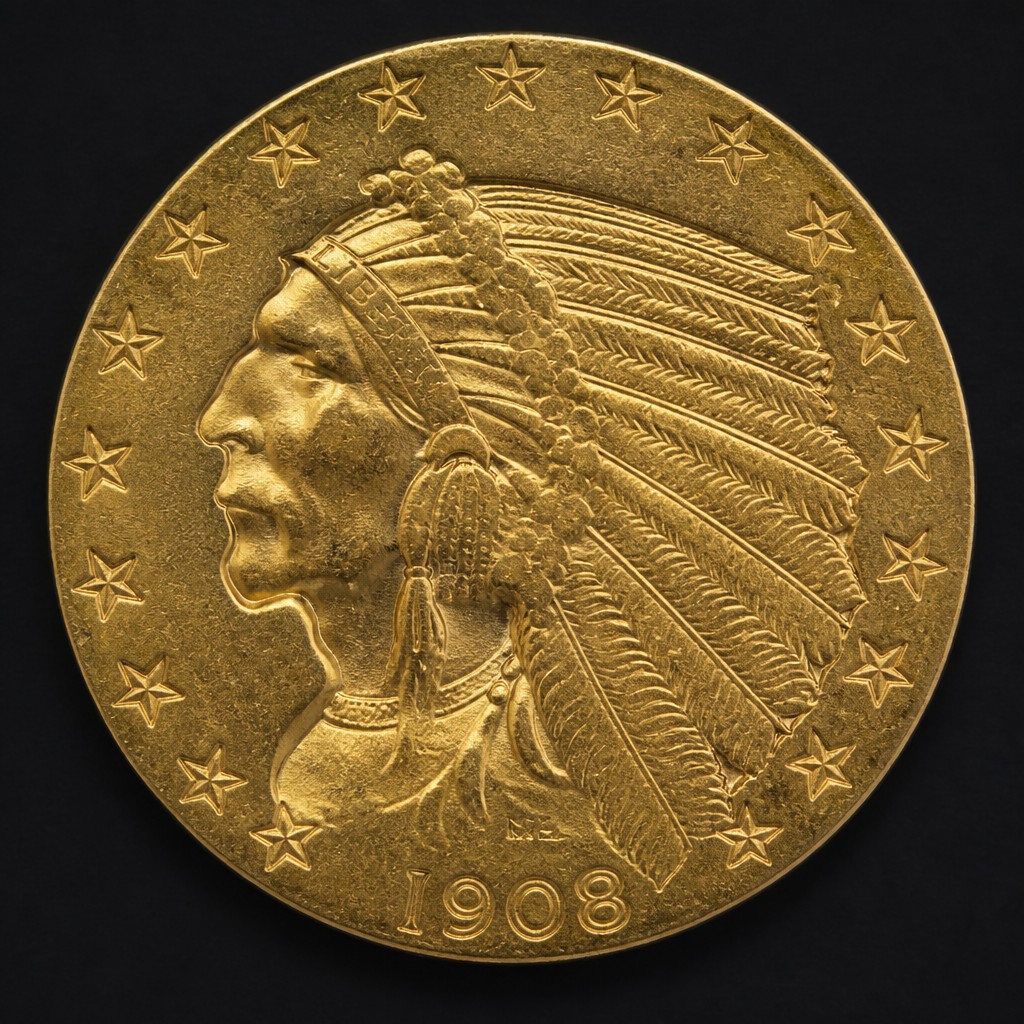
What It Is
The Indian Head half eagle is a $5 gold coin designed by sculptor Bela Lyon Pratt and struck from 1908 to 1929. It is best known for its incuse design — the devices are sunk below the coin's surface instead of raised above it, a technique used on only two U.S. coin types, this one and its companion quarter eagle.
Obverse Design
The obverse shows a Native American-style portrait of Liberty wearing a feathered war bonnet, recessed into the coin's surface. "LIBERTY" appears on the headband, stars surround the portrait, and the date is below.
Reverse Design & Inscriptions
The reverse depicts a standing eagle perched on a bundle of arrows with an olive branch, also rendered incuse. "UNITED STATES OF AMERICA" arches above, "FIVE DOLLARS" appears below, "E PLURIBUS UNUM" is lettered to one side, and "IN GOD WE TRUST" appears near the eagle.
Size, Weight, Metal, and Edge
The coin weighs 8.359 grams, is struck in .900 fine gold, measures 21.6 mm in diameter, and has a reeded edge.
Mint Marks and Where to Find Them
The mint mark appears on the reverse, to the left of the arrow points near the rim. A "D" indicates Denver and an "S" indicates San Francisco; no mint mark means Philadelphia.
Telling It Apart From Similar Coins
The incuse design alone makes this coin instantly recognizable — no other actively circulating U.S. gold coin has its design recessed below the surface rather than raised. Compare it to the Liberty Head half eagle that preceded it, which shows a raised coronet portrait and a shield-bearing eagle, both struck in the conventional relief style.
Judging Condition at a Glance
Because the design is incuse, wear behaves differently than on a typical raised coin: friction first smooths the recessed high points, such as Liberty's cheekbone and headdress feathers, and the eagle's wing and leg on the reverse, rather than wearing down a protruding rim. Examine these recessed areas closely under good light to judge how much detail remains.
Authenticity Red Flags
Because of the unusual incuse format, check that the sunken design areas have crisp, well-defined edges rather than mushy or rounded transitions, which can indicate a cast counterfeit. Confirm the coin's weight and diameter match genuine specifications, and inspect the rim for consistent height and thickness — an uneven or poorly defined rim is a common flaw on fakes attempting to replicate this less common striking method.
Frequently asked questions
What makes this coin's design unusual?
It is struck incuse, meaning Liberty's portrait and the eagle are recessed below the coin's surface rather than raised, a technique used on very few U.S. coins.
Where is the mint mark?
On the reverse, to the left of the arrow points near the rim; no mark means Philadelphia.
How does wear show up differently on this coin?
Because the design is recessed, wear smooths the sunken high points, such as Liberty's cheekbone and the eagle's wing, rather than flattening a raised rim as on typical coins.
How is it different from the Liberty Head half eagle?
The Liberty Head half eagle has a raised coronet portrait and shield-bearing eagle in conventional relief, while the Indian Head half eagle's design sits below the coin's surface.