
How to Identify the Indian Head Gold Quarter Eagle ($2.50)
How to recognize the small $2.50 Indian Head gold coin by its incuse design, headdress portrait, standing eagle reverse, and plain edge, and how to date it by size and weight.
Read the full Indian Head Gold Quarter Eagle ($2.50) encyclopedia entry →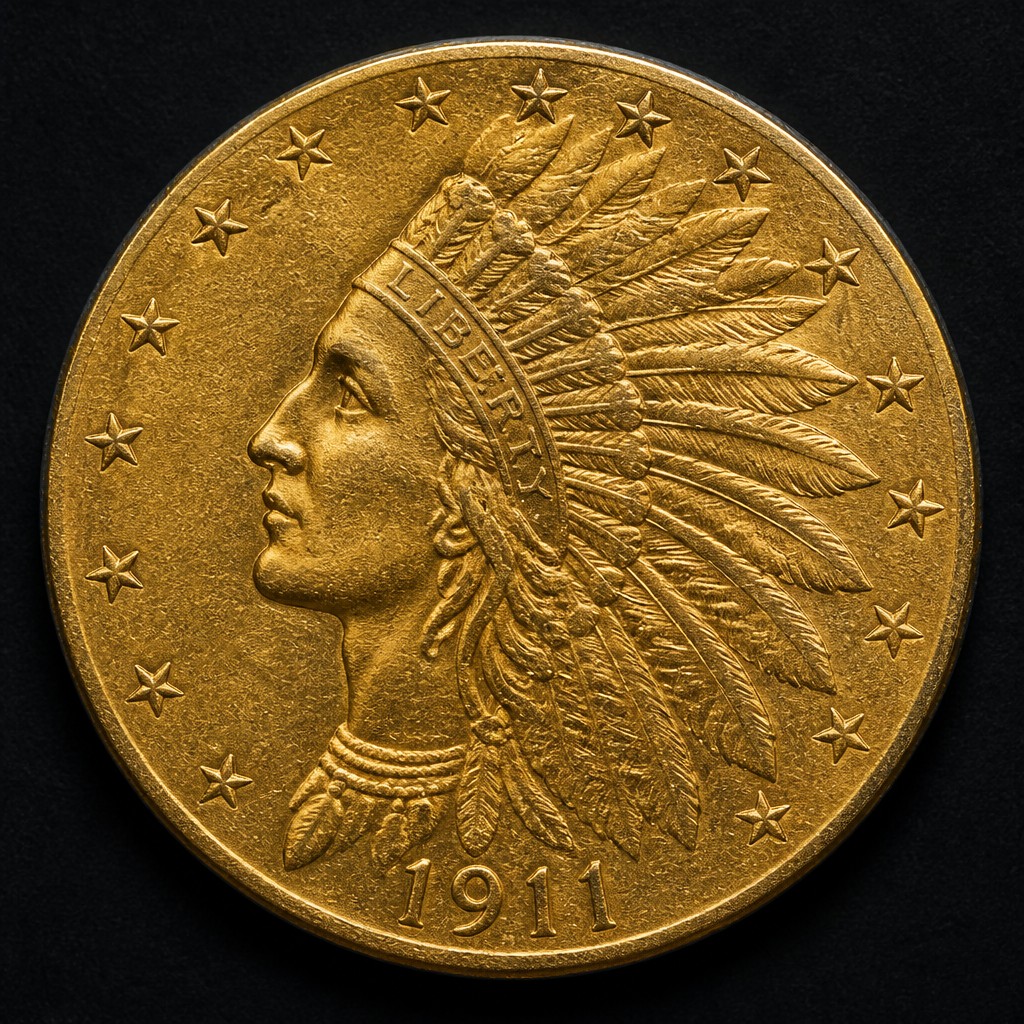
What It Is
The Indian Head quarter eagle, a $2.50 gold coin designed by Bela Lyon Pratt, was struck from 1908 to 1929. Like its larger companion the $10 Indian Head eagle, it uses an incuse design, with the devices recessed into the coin's surface, though the two coins were designed by different artists.
Obverse (Front)
A left-facing head of a Native American man wears a feathered headdress, with "LIBERTY" above and the date below. Unlike the $10 gold eagle's stylized Liberty figure, this obverse is generally viewed as a more literal depiction of a Native American man's portrait.
Reverse (Back)
A standing eagle, wings folded, perches on a bundle of arrows with an olive branch, with "UNITED STATES OF AMERICA," "E PLURIBUS UNUM," "IN GOD WE TRUST," and "2 1/2 DOLLARS" arranged around the design.
Size, Weight, Metal, and Edge
The coin is 90% gold, 10% copper, 18 mm in diameter, weighs about 4.18 grams, and has a plain edge, unlike the star-studded edge of the $10 gold eagle.
Mint Marks
The mint mark, when present, sits on the reverse to the left of the arrow bundle, near the rim: "D" for Denver; no mint mark means Philadelphia. This series was not struck at San Francisco.
Telling It Apart from Similar Coins
Its small size (18 mm) and light weight readily distinguish it from the larger $5 half eagle and $10 eagle gold coins, and its plain edge (rather than a star-edge) separates it from the Indian Head $10 eagle despite the similar incuse design concept. It should not be confused with the earlier Liberty Head (Coronet) quarter eagle, which has a conventional raised portrait of Liberty in a coronet, not a Native American headdress, and a reeded edge.
Judging Condition at a Glance
Look at the cheekbone and headdress feather tips on the obverse and the eagle's wing edges on the reverse for the first signs of wear, keeping in mind the recessed design can make judging wear slightly less intuitive than on raised designs. Strong, even luster within the recessed areas indicates a well-preserved coin.
Authenticity Red Flags
Because of its gold content and small size, cast counterfeits are common; check for a grainy surface texture, seams around the rim, incorrect diameter or weight versus genuine examples, and lettering that looks soft or indistinct rather than crisply recessed. Comparing weight and diameter against known specifications with a scale and calipers is one of the most reliable checks available without specialized equipment.
Frequently asked questions
How is this coin's design different from the $10 Indian Head gold eagle?
Both use an incuse design, but the quarter eagle shows a Native American man's portrait and has a plain edge, while the eagle shows a Liberty figure in a headdress and has a star-studded edge.
Where is the mint mark?
On the reverse to the left of the arrow bundle; it was struck only at Philadelphia (no mark) and Denver ('D').
What is the coin's size and weight?
It is 18 mm in diameter and weighs about 4.18 grams, made of 90% gold and 10% copper.
How do I avoid confusing it with the older Liberty Head quarter eagle?
The Liberty Head (Coronet) type shows a raised portrait of Liberty wearing a coronet with a reeded edge, quite different from the incuse Native American headdress design and plain edge of the Indian Head type.