
How to Identify the Indian Head Gold Eagle ($10)
Key visual features of the $10 Indian Head gold eagle, including its incuse (recessed) design, headdress obverse, standing eagle reverse, and edge star count.
Read the full Indian Head Gold Eagle ($10) encyclopedia entry →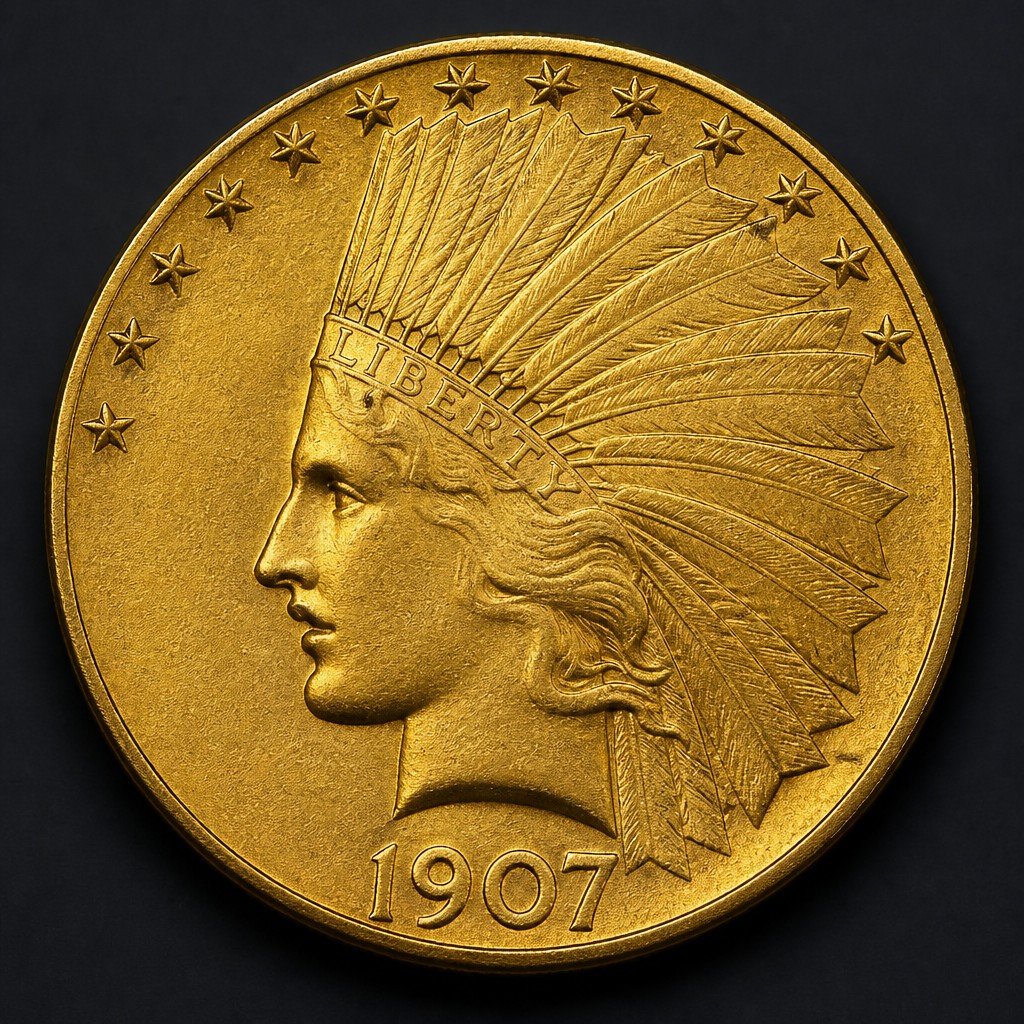
What It Is
The Indian Head eagle, a $10 gold coin designed by Augustus Saint-Gaudens, was struck from 1907 to 1933. It is notable for its incuse design, meaning the main devices and lettering are recessed below the coin's surface rather than raised — an unusual technique used only briefly in U.S. coinage.
Obverse (Front)
A left-facing head of Liberty wears a Native American-style feathered headdress, with "LIBERTY" on the headband. Thirteen stars line the upper rim, and the date sits at the lower right. All design elements are struck below the coin's flat field.
Reverse (Back)
A standing eagle, wings folded, perches on a bundle of arrows with an olive branch behind it, with "UNITED STATES OF AMERICA" and "TEN DOLLARS" arcing around, and "E PLURIBUS UNUM" to the side. Coins from 1908 onward also carry "IN GOD WE TRUST" to the left of the eagle, absent on the earliest 1907-1908 issues.
Size, Weight, Metal, and Edge
The coin is 90% gold, 10% copper, 27 mm in diameter, weighs about 16.72 grams, and has a unique edge featuring 46 raised stars (increased to 48 stars starting in 1912 to reflect the addition of Arizona and New Mexico as states), rather than reeding or lettering.
Mint Marks
The mint mark, when present, is on the reverse to the left of the arrow bundle, near the rim: "D" for Denver or "S" for San Francisco; no letter indicates Philadelphia.
Telling It Apart from Similar Coins
The incuse design and the star-studded edge (instead of reeding) make this coin easy to distinguish from other gold denominations, including the similarly themed Indian Head quarter eagle and half eagle, which are smaller and, notably, do use conventional reeded edges rather than stars. Checking the edge star count (46 vs. 48) also helps date a coin generally to before or after 1912.
Judging Condition at a Glance
Because the design sits below the surface, wear is easier to spot in the fields and the raised rim than on the recessed devices themselves; look at the high points of Liberty's cheek and the eagle's wing edges. Well-preserved coins retain strong original mint luster in the recessed design areas.
Authenticity Red Flags
Given its gold content, this coin is a frequent target for cast counterfeits, which often show a slightly grainy or pitted surface, incorrect edge star spacing or count, and an overall diameter or weight that doesn't precisely match genuine specimens when checked with calipers and a scale. Genuine coins have crisp, sharply defined incuse lettering; blurry or shallow lettering is a warning sign.
Frequently asked questions
What is unusual about this coin's design style?
It uses an incuse design, meaning the devices and lettering are recessed into the coin's surface rather than raised, a technique rarely used in U.S. coinage.
Why does the edge have stars instead of reeding?
The designer used a row of raised stars on the edge in place of the usual reeded edge; the count changed from 46 to 48 stars in 1912 to reflect new states joining the Union.
Where is the mint mark?
On the reverse, to the left of the arrow bundle near the rim; no mark means it was struck in Philadelphia.
What is this coin made of and how much does it weigh?
It is 90% gold and 10% copper, 27 mm in diameter, and weighs about 16.72 grams.