
How to Identify the Indian Head Gold Dollar
A collector's walkthrough for confirming an Indian Head gold dollar: the headdress portrait, wreath reverse, tiny gold size, mint marks, and look-alikes.
Read the full Indian Head Gold Dollar encyclopedia entry →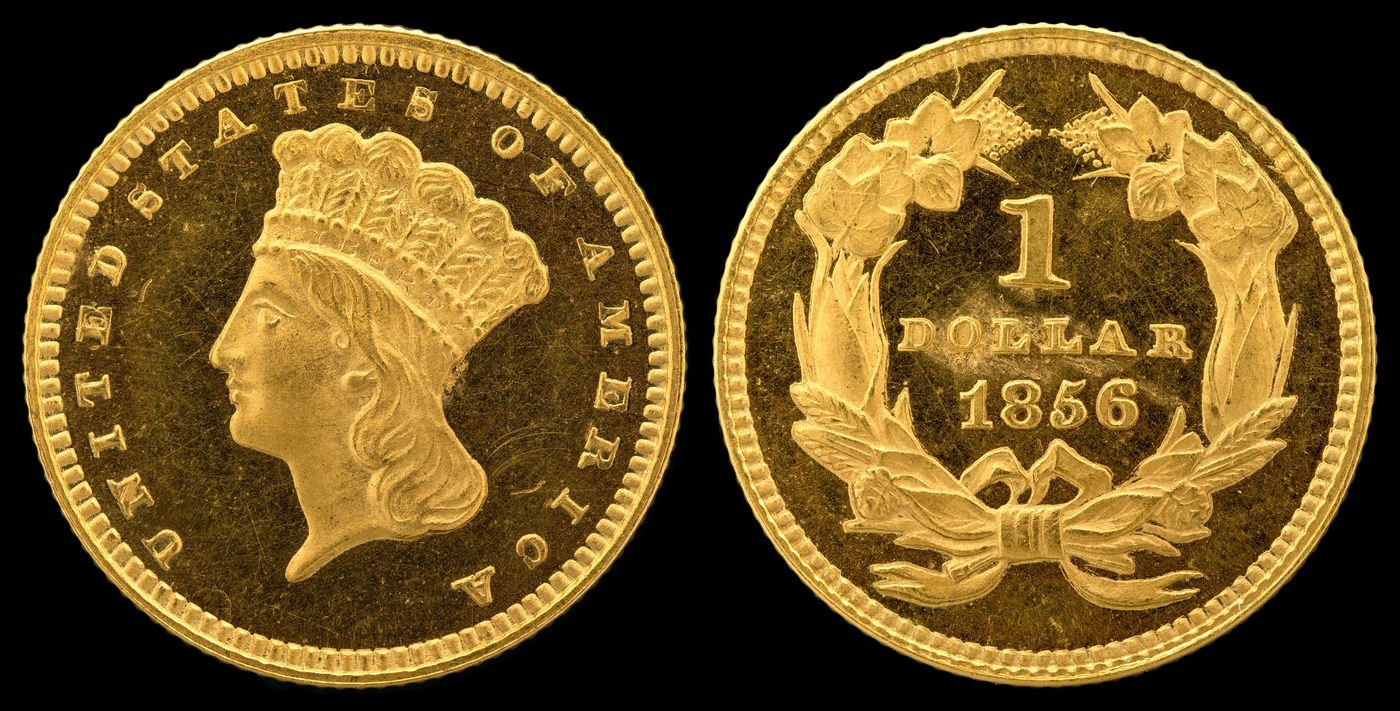
Start with the obverse portrait, which defines the type. An Indian Head gold dollar shows Liberty facing left in a tall feathered headdress with LIBERTY across the band and UNITED STATES OF AMERICA around the rim. If the coin instead shows Liberty in a plain coronet, it is the earlier Type 1 Liberty Head gold dollar, not this design. The headdress is the single fastest way to place the coin.
Check the reverse next. You should see the denomination '1 DOLLAR' and the date stacked inside a wreath of agricultural leaves, with any mint mark just below the wreath. There is no eagle on this coin; a reverse with an eagle-and-shield points to a different U.S. series entirely, so use the wreath to confirm you truly have a gold dollar.
Confirm size and metal, because this is the smallest regular U.S. gold coin. It should measure about 15 mm in diameter and weigh roughly 1.67 grams, struck in 90% gold with a warm yellow color. If your coin is dated 1856, compare the head: a higher-relief 'Small Head' with a soft date is Type 2, while a broader, flatter, cleaner-struck 'Large Head' is Type 3. Reading the mint mark also matters — Charlotte (C) and Dahlonega (D) pieces are especially collectible.
Authenticate carefully. Tiny gold coins are heavily counterfeited and were often mounted in jewelry, so inspect the rim for solder traces, filing, or smoothing, and check for a bent or thinned flan. Off-standard weight or diameter, lettering that looks mushy or lumpy, and wire-thin or added detail are red flags. For any coin of value, submit it to a reputable grading service such as PCGS or NGC before buying, selling, or insuring it.
Frequently asked questions
How do I tell this from the Type 1 Liberty Head gold dollar?
Look at the head. The Indian Head shows Liberty in a feathered headdress, while the Type 1 shows her in a plain coronet. Both are tiny gold dollars, but only the Indian Head wears the headdress.
My 1856 coin — is it Type 2 or Type 3?
Compare the portrait. The Type 2 'Small Head' is in higher relief and often has a weak date; the Type 3 'Large Head' is broader, flatter, and better struck. 1856 is the transition year, so both exist.
Could my coin be a different gold denomination?
Possibly. The Three Dollar gold piece also uses an Indian-princess headdress but is much larger (about 20.5 mm) and reads '3 DOLLARS.' The gold dollar is tiny, about 15 mm, and reads '1 DOLLAR.'
It looks like it was in jewelry — does that matter?
Yes. Solder marks, filed rims, or a bent flan from being worn as a pendant reduce collector value significantly, even though the gold content remains. Have such pieces evaluated before assuming a high price.