
How to Identify the Indian Head Eagle ($10)
A gold ten-dollar coin minted 1907–1933, recognized by Liberty wearing a Native American war bonnet and its distinctive edge of raised stars instead of reeding.
Read the full Indian Head Eagle ($10) encyclopedia entry →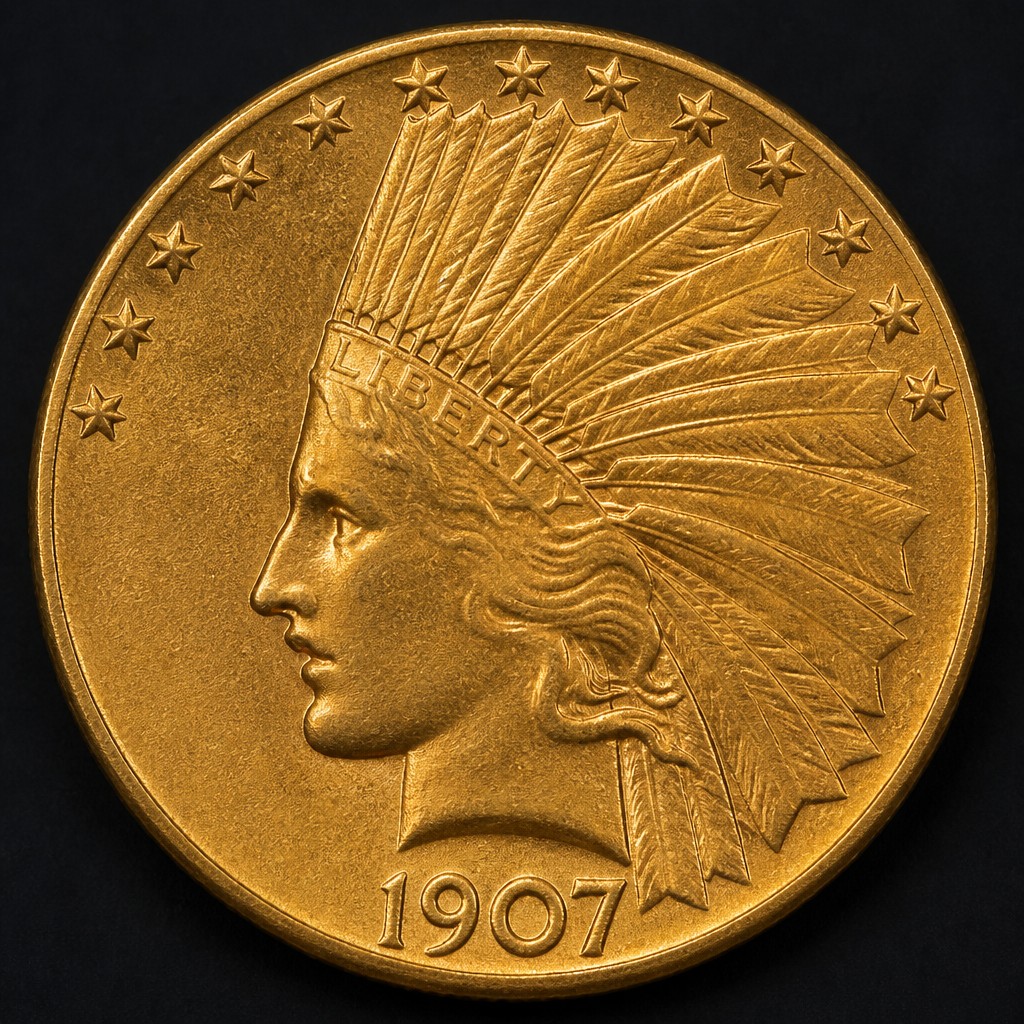
What It Is
The Indian Head eagle is a $10 gold coin designed by Augustus Saint-Gaudens and struck from 1907 to 1933. It was part of a broader redesign of U.S. gold coinage commissioned by President Theodore Roosevelt to bring higher artistic standards to American money.
Obverse Design
The obverse shows a portrait of Liberty facing left, wearing a Native American-style feathered war bonnet, an allegorical rather than literal depiction. "LIBERTY" is inscribed on the headband, stars surround the portrait (46 stars on early dates, 48 after New Mexico and Arizona joined the Union), and the date sits below.
Reverse Design & Inscriptions
The reverse depicts a bald eagle standing on a bundle of arrows with an olive branch beneath its talons. "UNITED STATES OF AMERICA" arches around the top, "TEN DOLLARS" appears below, and "E PLURIBUS UNUM" is lettered to one side. "IN GOD WE TRUST" was added above the eagle beginning in mid-1908; the earliest 1907 and part of 1908 issues lack this motto.
Size, Weight, Metal, and Edge
The coin weighs 16.718 grams, is struck in .900 fine gold (about 0.48375 troy ounce of pure gold), and measures 27 mm across. Its edge is unique among widely collected U.S. coins: instead of reeding, it carries raised stars — 46 on coins from 1907–1911 and 48 from 1912 onward, matching the star count on the obverse.
Mint Marks and Where to Find Them
The mint mark, when present, is located on the reverse to the left of the arrow points, near the base. A "D" indicates Denver and an "S" indicates San Francisco; no mint mark means the coin was struck in Philadelphia.
Telling It Apart From Similar Coins
The Indian Head eagle is easy to distinguish from its predecessor, the Liberty Head (Coronet) eagle, which shows Liberty wearing a coronet rather than a feathered headdress and has a reeded edge instead of raised stars. The edge star count and headdress design make the Indian Head type unmistakable at a glance.
Judging Condition at a Glance
Wear first shows on the feathers above Liberty's ear and on her cheekbone, and on the eagle's wing and leg on the reverse. Because the design sits at a slightly lower relief than some early Saint-Gaudens patterns, well-preserved coins should still show sharp feather detail in the headdress.
Authenticity Red Flags
Given the coin's gold content, verify weight and diameter carefully, and examine the edge stars for correct count, spacing, and sharpness — a common weak point on cast counterfeits. Blurred lettering, incorrect edge details, or a color that looks too yellow or too pale for .900 fine gold are all signs a coin needs closer authentication.
Frequently asked questions
What is unusual about the edge of this coin?
Instead of reeding, it has raised stars — 46 on coins from 1907–1911 and 48 from 1912–1933 — matching the number of stars on the obverse.
Where is the mint mark located?
On the reverse, to the left of the arrow points near the base; no mark indicates Philadelphia.
How can I tell this apart from the Liberty Head eagle?
The Indian Head eagle shows Liberty in a feathered war bonnet with a starred edge, while the Liberty Head eagle shows a coronet-wearing Liberty with a plain reeded edge.
Do all dates have 'IN GOD WE TRUST'?
No — the motto was added above the eagle starting partway through 1908; the earliest 1907 and part of 1908 issues do not have it.