
How to Identify the Imitation Abbasid Dirham
A collector's guide to telling a northern-European imitation dirham from a genuine Abbasid strike: script, flan, size, piercing and fakes.
Read the full Imitation Abbasid Dirham encyclopedia entry →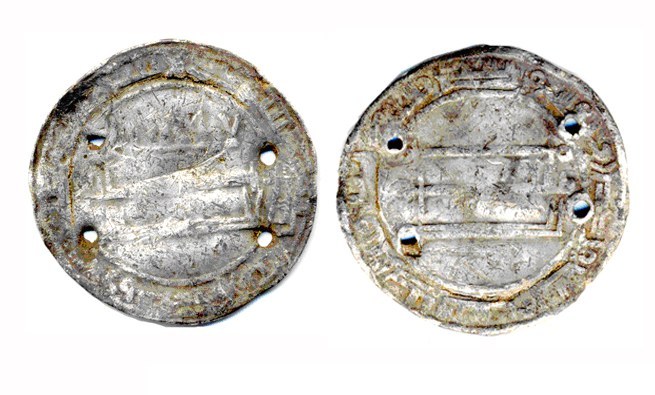
Begin with the flan and metal. An imitation Abbasid dirham is a thin, broad, aniconic silver coin, roughly circular, in the general range of the official dirham it copies — near 23–28 mm and about 2.7–3.0 grams — though imitations tend to be lighter, thinner or more irregular. Both faces should show only horizontal lines of Arabic-style lettering inside a beaded or circular border, with no portrait or figure. A magnetic, base-metal, or very thick coin is not this type.
The single most useful diagnostic is the legibility of the script. Compare the lettering against a known genuine dirham legend, which reads as coherent Kufic Arabic spelling the Islamic creed with a legible mint and Hijri date. On an imitation the same visual arrangement is present, but the characters are malformed, repeated, mirrored, or reduced to ornamental strokes, so the text cannot be resolved into real words, mint or date. Stray decorative marks in place of meaningful legend point strongly to a copy.
Assess the piercing and wear. A hole, a loop or mount, or smoothing and directional wear near the edge indicate the coin was suspended and worn — a hallmark of dirhams and their copies in the Viking-Age Baltic and Scandinavian world. While a piercing does not by itself prove imitation, it firmly places the coin in that northern trade context and pairs naturally with pseudo-Kufic legends.
Rule out look-alikes. Genuine Abbasid dirhams share the identical aniconic, all-lettering format, so do not call a coin an imitation simply because it is old and Arabic-looking — read the legend first. Other Islamic silver (Umayyad, Samanid and later dirhams) and imitations of those types can look similar, and precise attribution of blundered coins is genuinely difficult. When the legend is coherent and correctly datable, the coin is likely an official strike, not a copy.
Be cautious about authenticity. Viking-era silver is faked, and modern cast reproductions and "tourist" pieces exist. Genuine coins are struck: watch for casting seams, bubbles, a soft or grainy surface, a mould line at the edge, or wrong weight. Given the difficulty of reading garbled script and spotting good fakes, weigh and measure the coin, photograph both faces clearly, and seek a specialist opinion before treating an attribution as final.
Frequently asked questions
How do I tell an imitation from a genuine Abbasid dirham?
Read the script. A genuine dirham's Kufic legend spells out coherent Arabic with a legible mint and date; an imitation copies the same layout but with blundered, repeated or decorative letters that do not form real words. Illegible pseudo-Kufic points to a copy.
Does the hole affect identification or value?
The piercing helps confirm the coin's use as a worn ornament in the northern trade world, which fits the imitation context. For value, though, a hole is generally seen as damage and tends to lower the price versus a comparable unpierced coin.
What size and weight should I expect?
Imitations echo the official dirham at roughly 23–28 mm and near 2.7–3.0 grams, but are often lighter, thinner or more irregular. Measure and weigh the coin, as figures well outside this range suggest a different coin or a modern replica.
How can I avoid buying a modern fake?
Genuine coins are struck, not cast. Look for casting seams, air bubbles, a mould line at the rim, a soft grainy surface, or incorrect weight. Because Viking-era silver is faked and blundered legends are hard to judge, get a specialist opinion when unsure.