
How to Identify the Hyderabad One Anna
A collector's guide to recognising a Hyderabad Osmania one-anna coin: script, AH date, metal, and how to tell it from British Indian annas.
Read the full Hyderabad One Anna encyclopedia entry →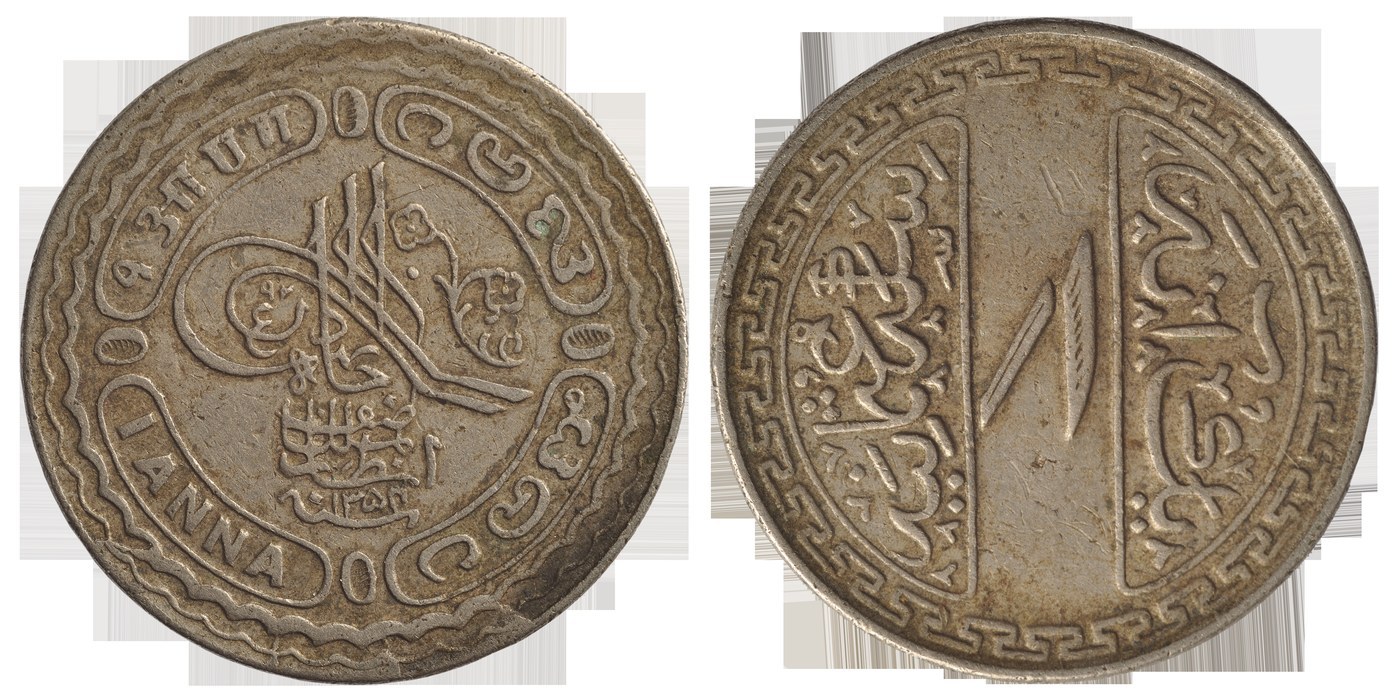
Begin with the metal and size. A Hyderabad one anna of this type is struck in copper-nickel, a pale silvery-grey base alloy, and is a small, light sub-rupee coin. If your piece is clearly silver, gold, or a large heavy coin, it is a different Hyderabad denomination rather than the anna. Base metal, small module, and a plain edge are the expected starting signs.
Read the script, not just the images. The decisive feature of an Osmania coin is that every legend is in Arabic-script Urdu/Persian with no English lettering and no human portrait. The obverse carries the ruler's name and titles set inside a floral or scrollwork border; the reverse shows the denomination (the anna value) among geometric ornament and script. The presence of Arabic-script legends on both faces, rather than a bust or Latin text, is what marks the coin as a Hyderabad state issue.
Confirm the date by the calendar. Hyderabad dated its coins in the Islamic Hijri (AH) system, so look for a year such as AH 1354 (about 1935 CE). An AH date is itself strong evidence for a princely-state or Indo-Islamic coin rather than a British Indian one, which would normally show a Gregorian (AD) year and English inscriptions.
Watch for the main look-alike: the British Indian one anna of the same period. Those are also small coins but are inscribed in English, dated AD, and often carry the effigy of the reigning British monarch — none of which appears on a Hyderabad anna. Other princely states also struck annas, so use the ruler's name in the obverse legend to confirm it is specifically a Hyderabad Osmania piece under Osman Ali Khan.
On authentication, ordinary copper-nickel annas are common and rarely worth faking, so outright forgery is uncommon, but be alert to corrosion, tooling, or heavy cleaning that can mask legends and reduce value. When the script is hard to read, photograph both faces clearly and check the legend and AH date against standard references or someone familiar with Osmania coinage before assigning an exact year or variety.
Frequently asked questions
How do I know it is a Hyderabad coin and not British Indian?
A Hyderabad anna is inscribed entirely in Arabic-script Urdu/Persian, uses an AH (Hijri) date, and shows no portrait. A British Indian anna uses English lettering, an AD date, and often a monarch's bust.
Where is the denomination shown on the coin?
The reverse states the value — the anna denomination — alongside geometric ornament and script, while the obverse carries the ruler's name and titles within a floral border.
How do I read the date?
The year is given in the Islamic Hijri (AH) calendar in Arabic numerals. This example reads AH 1354, which converts to roughly 1935 CE. Converting the AH year gives the approximate Gregorian date.
What metal is it, and can I test that?
It is copper-nickel, a pale base-metal alloy. It is not silver, so it will not carry a precious-metal value; its small size, light weight, and grey tone are consistent with a circulating minor coin rather than a bullion piece.