
How to Identify the Huguenot-Walloon Tercentenary Half Dollar
A collector's checklist for confirming a genuine 1924 Huguenot-Walloon half dollar—its two profiles, sailing-ship reverse, silver specs, and look-alikes.
Read the full Huguenot-Walloon Tercentenary Half Dollar encyclopedia entry →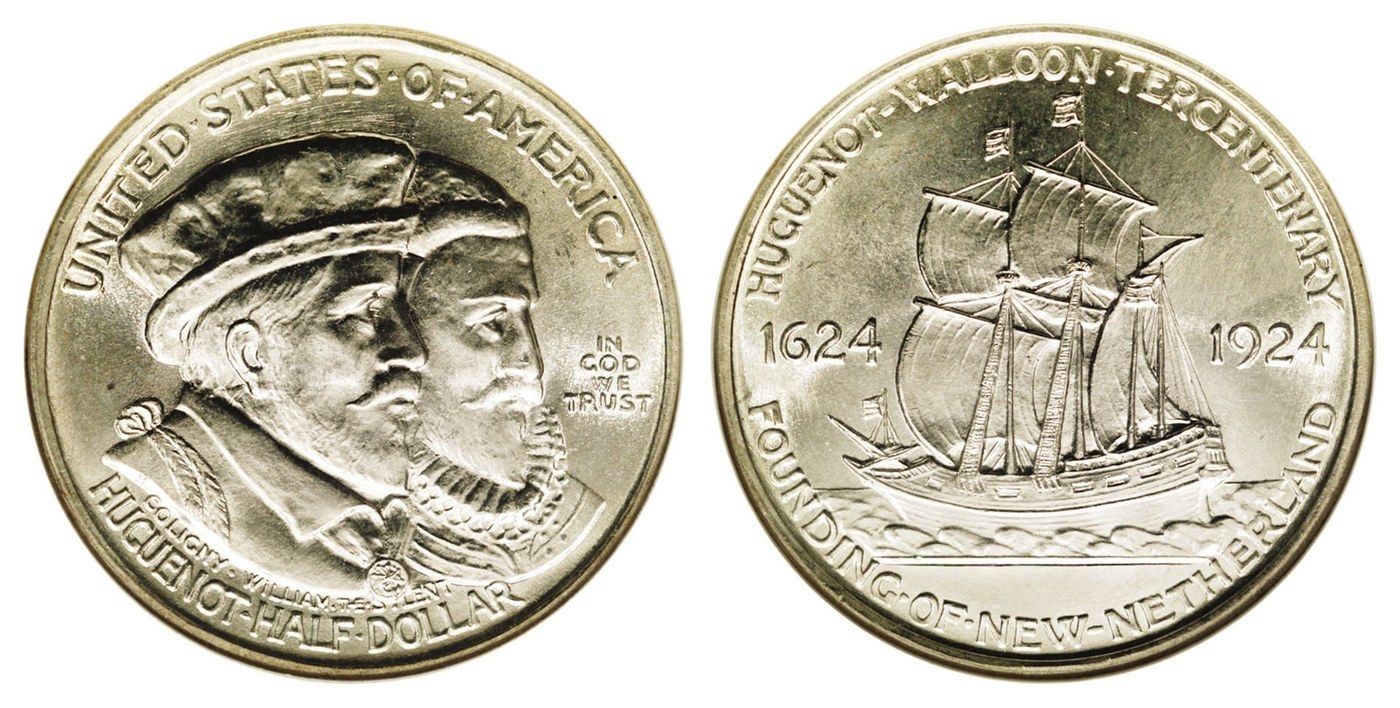
Start with the pairing of designs. A genuine Huguenot-Walloon half dollar shows two overlapping right-facing bearded profiles on the obverse and a single historic sailing ship under full sail on the reverse. Both must be present together, along with lettering naming the Huguenot-Walloon Tercentenary and the date 1924. That combination is what pins the type down.
Confirm the physical specifications. The coin should match a standard classic U.S. half dollar: 90% silver, about 30.6 mm in diameter, roughly 12.5 grams, with a reeded edge. A calibrated scale and calipers are the most reliable check—weight or diameter noticeably off the mark is a warning sign. The color should be the cool gray-white of circulated-era silver, not the bright white of a plated base-metal fake.
Expect no mint mark. Every genuine example was struck at Philadelphia in 1924, so there is no D or S to look for; a coin bearing a mint mark, or any date other than 1924, is not this type. Because it is a one-year issue, the date alone is a quick screening tool.
Separate it from other 1920s silver commemoratives. Many period halves share the same size, silver color, and reeded edge, so do not rely on metal and shape alone. The dual male profiles plus a full-rigged ship are specific to this issue; read the commemorative legend to rule out look-alikes such as other settlement or anniversary halves.
Be cautious on higher-grade or higher-value pieces. Check that lettering and design details are crisp, that surfaces have not been cleaned or tooled, and that the coin is non-magnetic. For any significant purchase, favor coins certified by PCGS or NGC over raw examples, since counterfeits and altered pieces exist for classic commemoratives.
Frequently asked questions
How do I quickly confirm the type?
Look for two overlapping right-facing profiles on the obverse, a sailing ship in full sail on the reverse, and the date 1924 with Huguenot-Walloon Tercentenary lettering. All together, they identify the coin.
What should it weigh and measure?
As a standard silver half dollar it should be about 30.6 mm in diameter and roughly 12.5 grams, struck in 90% silver with a reeded edge. Figures well off those numbers suggest a fake.
Should I worry that there is no mint mark?
No. The issue was struck only at Philadelphia in 1924 and carries no mint mark, so a blank field with no D or S is correct. A mint mark or a different date means it is not this type.
How is it authenticated?
Verify weight, diameter, and reeded edge, confirm the coin is non-magnetic, and inspect for cleaning or tooling. For valuable examples, rely on PCGS or NGC certification rather than appearance alone.