
How to Identify the Hong Kong Trade Dollar
A collector's checklist for the British Trade Dollar: the Britannia obverse, dragon reverse, chop marks, mint marks, and spotting fakes.
Read the full Hong Kong Trade Dollar encyclopedia entry →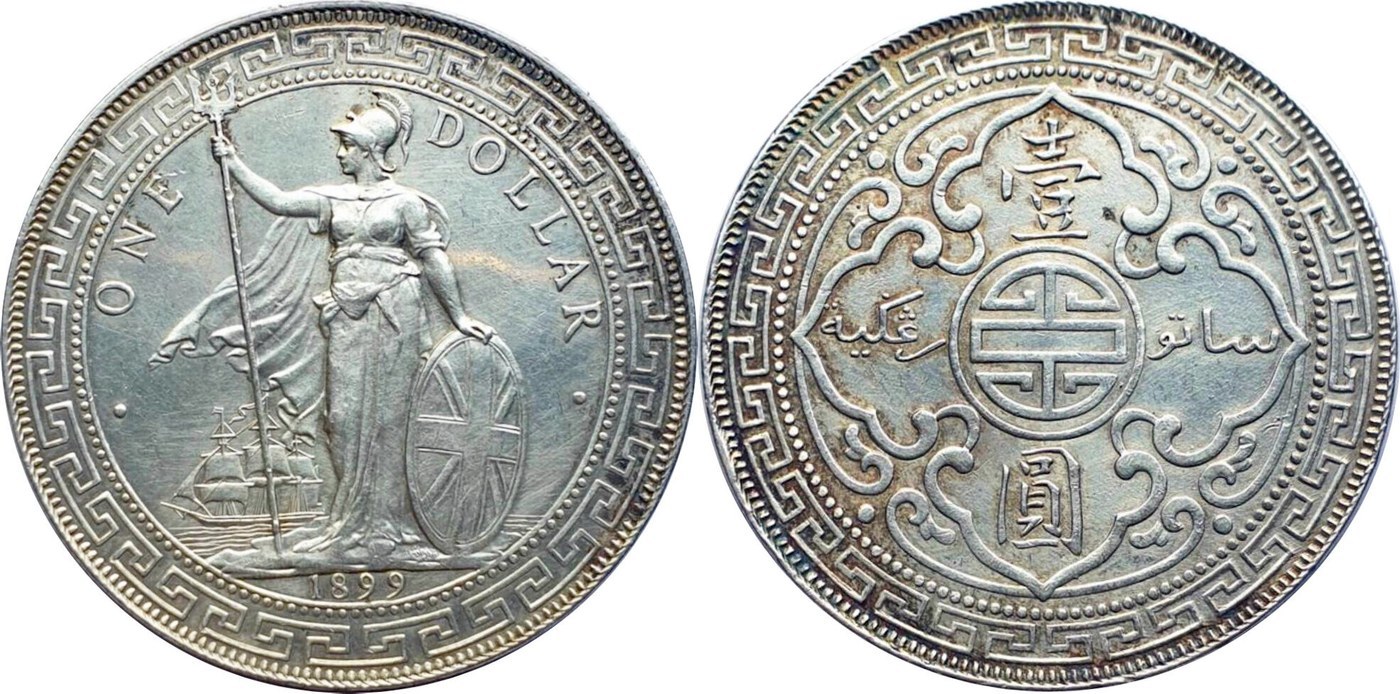
Start with the obverse figure. A genuine Trade Dollar shows Britannia standing on a shore, holding a trident in one hand and resting the other on a shield, with a ship often visible behind her. The legend ONE SILVER TRADE DOLLAR curves around the field, and the value is repeated in Chinese and in Jawi (Arabic-script Malay). The date sits in the exergue beneath Britannia; on this example it reads 1899.
Turn to the reverse to confirm the type. Look for the central Chinese dragon inside a decorative frame, ringed by Chinese characters and the Roman-letter word HONG-KONG. The combination of standing Britannia and a dragon with multilingual "one dollar" legends is the defining signature of this series and separates it from other silver dollars of the era, such as the Mexican peso or the U.S. trade dollar.
Check size and metal. The Trade Dollar is a crown-sized silver coin, close in diameter and weight to a U.S. silver dollar or British crown, and should feel heavy for its size with a bright silver ring. A small mint mark in the design indicates the Indian branch mint (Bombay or Calcutta) that struck it; read it directly on the coin, since it helps pin down the exact issue and its relative scarcity.
Expect chop marks on many circulated coins. These are small punched merchant test-stamps, sometimes several, that Chinese banks and traders applied to confirm the silver. They are original to the coin's working life and are not a sign of a fake; a coin with sensible, period-looking chops is often more convincing as genuine than one that is suspiciously pristine.
Apply firm authentication caution. The Trade Dollar was widely counterfeited in its own time and is faked today, so weigh and measure the coin, compare the dragon and Britannia detail against reference images, and be wary of pieces that are underweight, greasy or dull in surface, or show soft, mushy detail. For a valuable or high-grade example, professional grading gives the most reliable confirmation.
Frequently asked questions
How do I tell a Trade Dollar from a Mexican or U.S. trade dollar?
Look for the standing Britannia with trident and shield and the ONE SILVER TRADE DOLLAR legend on one side, and a Chinese dragon with the word HONG-KONG on the other. Mexican pesos show an eagle and cap-and-rays, and the U.S. trade dollar shows a seated Liberty, so the Britannia-and-dragon pairing is diagnostic.
Where is the date and mint mark?
The date sits in the exergue below Britannia's feet on the obverse; on this coin it reads 1899. A small mint mark identifying the Indian branch mint appears within the design; read it directly on the coin to attribute the exact striking.
Do chop marks mean the coin is damaged or fake?
No. Chop marks are period test-stamps punched by Chinese merchants to verify the silver, and they are original to the coin's trade use. They may slightly lower value for type collectors but are evidence of authenticity and history, not modern damage.
How can I spot a counterfeit?
Check that the weight and diameter match a crown-sized silver coin, and inspect the dragon and Britannia for crisp, well-defined detail. Underweight pieces, dull or greasy surfaces, and soft mushy design are warning signs. For anything valuable, get professional authentication.