
How to Identify the Holey Dollar
Collector checks for the 1813 New South Wales Holey Dollar: the punched ring form, NEW SOUTH WALES stamp, host Spanish dollar, and authentication cautions.
Read the full Holey Dollar encyclopedia entry →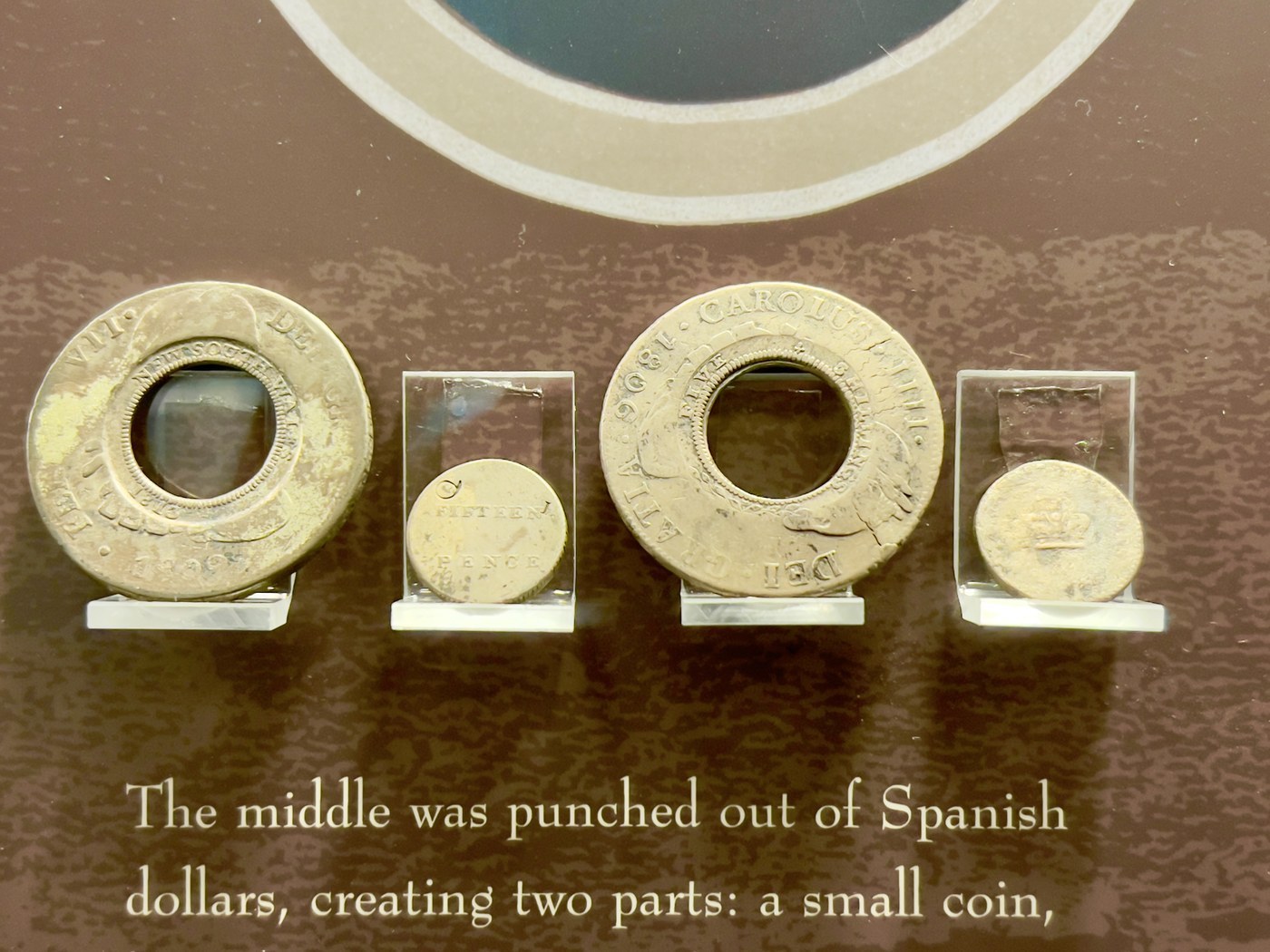
Start with the shape, because nothing else looks like it. A genuine Holey Dollar is a silver ring with a large central hole that was deliberately punched, not cast or drilled as decoration. If the piece is a solid disc, or the hole looks machine-neat and centred on a blank field, it is not an authentic Holey Dollar.
Read the counterstamped face next. Around the rim of the hole you should see the curved legend NEW SOUTH WALES with the date 1813. These letters were punched into an already-struck coin, so they often sit slightly unevenly and may overlap the underlying design. Crisp, perfectly aligned lettering on otherwise pristine surfaces is a warning sign of a modern reproduction.
Turn the coin over and look for the host Spanish dollar beneath the stamping. The reverse described here as a crowned coat of arms is the original eight-reales design, and a real Holey Dollar almost always shows traces of that Spanish or Spanish-American coin, sometimes including parts of its date, mint mark, or pillars. The presence of a genuine underlying dollar is one of the strongest authenticity signals.
Use size and weight as a cross-check. The outer diameter is roughly that of an eight-reales dollar, about 38-40 mm, but the coin weighs clearly less than a whole silver dollar because the centre plug was removed. It is silver, so it should not react to a magnet. A wildly off weight, a base-metal core, or magnetic response all point to a fake.
Finally, treat authentication as essential rather than optional. Given the coin's high value, souvenir copies, restrikes, and outright forgeries are common, and the small survival population means genuine pieces are usually documented. Do not rely on the NEW SOUTH WALES 1813 legend alone; have any candidate examined by a specialist in early Australian coinage, ideally with third-party certification and provenance, before treating it as real.
Frequently asked questions
How can I tell a genuine Holey Dollar from a replica?
A genuine piece was punched from a real Spanish silver dollar, so the host coin's design shows beneath the NEW SOUTH WALES 1813 stamp. Blank, pristine surfaces, machine-perfect holes, or crisp evenly spaced lettering suggest a modern copy.
What should be on the two sides?
One side carries the counterstamped NEW SOUTH WALES arc and the 1813 date around the hole; the other retains the original Spanish dollar's design, typically a crowned coat of arms and heraldic detail.
Is a magnet or scale useful for checking one?
Yes as a first filter. The coin is silver and should not stick to a magnet, and it should weigh clearly less than a whole eight-reales dollar because the centre was removed. Odd weight or magnetism indicates a fake, but passing these tests alone does not prove authenticity.
Should I get one authenticated?
Always. Holey Dollars are extremely valuable and heavily reproduced, and genuine survivors are few and usually documented. Seek a specialist in early Australian coinage and third-party certification before buying or selling.