
How to Identify the Higley Copper
A crude, hand-struck Connecticut copper from the late 1730s, privately issued by Dr. Samuel Higley and identified by its deer, axe head, or wheel designs and unusual value inscriptions.
Read the full Higley Copper encyclopedia entry →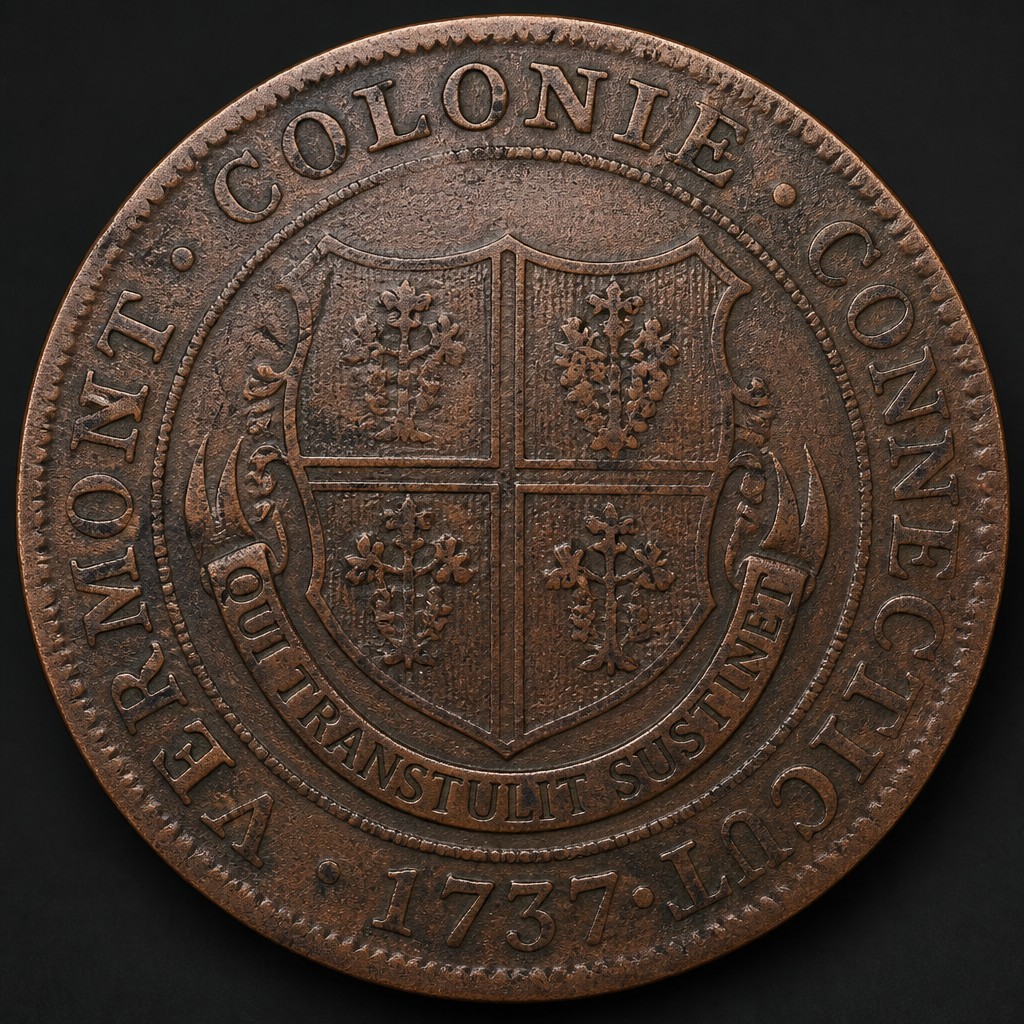
What It Is
The Higley Copper (sometimes called the Granby Copper) is one of the earliest privately produced coins struck in Britain's American colonies, made around 1737 to 1739 by Dr. Samuel Higley and later his brother John near Granby, Connecticut. Struck from local copper ore, these pieces circulated informally in Connecticut and Massachusetts at a time when small change was scarce. They were never authorized by any government, which makes them a fascinating example of grassroots colonial coinage.
Obverse Design & Inscriptions
Most Higley Coppers show a standing deer facing left, with the legend THE • VALUE • OF • THREE • PENCE around the border on early strikes, or later I • AM • GOOD • COPPER after the value was dropped. A small date, typically 1737, appears below the deer on many varieties.
Reverse Design & Inscriptions
The reverse typically depicts either three hammers arranged around a crown (with the legend CONNECTICVT), or an axe head, or three sledgehammers with the motto VALUE • ME • AS • YOU • PLEASE. This unusual phrase reflects the coin's informal, non-government status — buyers and sellers had to agree on what the copper was actually worth.
Size, Weight, and Metal
Higley Coppers are struck in nearly pure copper, roughly the diameter of a large cent (about 28-29 mm), with a plain, unlettered edge. Weight varies noticeably piece to piece because striking was done by hand with simple dies, so pieces can range from roughly 5 to 8 grams.
Telling It Apart From Similar Coppers
Because the designs and legends changed across the short production run, several distinct varieties exist: the three-hammers/deer type, the axe-head type, and the "value me as you please" broadaxe type. Collectors distinguish them by which motto and device combination appears, not by mint marks, since none exist. Genuine pieces show hand-cut, slightly irregular lettering and devices that are never perfectly centered.
Mint Marks
There are no mint marks on Higley Coppers — they were produced at a private, unofficial works, not a government mint. Any legitimate identifying feature comes from the die variety (deer pose, hammer arrangement, or presence/absence of the date and denomination).
Judging Condition at a Glance
Because these coppers were struck with worn, hand-engraved dies on irregular planchets, even Mint State examples show weakness in some areas. Look at the deer's body and the hammer/crown details for the sharpest strike; heavy circulation wear will flatten the deer's legs and smooth the lettering. Full, even color and legible legends are the mark of a well-preserved piece.
Authenticity Red Flags
Authentic Higley Coppers are extremely rare, and this rarity makes them a prime target for cast counterfeits. Cast fakes often show a slightly grainy or pitted surface, seams around the edge, and letters that look mushy or shallow instead of crisply cut. Genuine pieces have a hand-struck sharpness even where the design is off-center, and any coin claiming this identity should be evaluated by a specialist in early American coppers before assuming it is original.
Frequently asked questions
What makes a Higley Copper different from other colonial coppers?
Its private, unauthorized origin and unusual mottoes like VALUE ME AS YOU PLEASE, paired with a deer or crossed-hammers design, set it apart from officially sanctioned colonial issues.
Does the Higley Copper have a mint mark?
No. It was struck privately near Granby, Connecticut, with no government mint mark; identification relies on the design variety instead.
Why do some Higley Coppers lack a stated value?
Later strikes dropped the THREE PENCE denomination in favor of I AM GOOD COPPER, likely because authorities objected to a private coin declaring an official value.
Are all Higley Coppers dated 1737?
Most surviving pieces show 1737, though some varieties are undated; the entire production run is generally placed within a few years around that date.
How can I tell if a Higley Copper is a modern fake?
Check for cast texture, seams, or mushy lettering; genuine examples have crisp hand-cut die details despite an often off-center strike.