
How to Identify the Hessen-Homburg Kreuzer
Identify the coin by its crowned Hessen-Homburg arms shield, a wreathed 1 KREUZER value dated 1840, and its small thin silver German-states fabric.
Read the full Hessen-Homburg Kreuzer encyclopedia entry →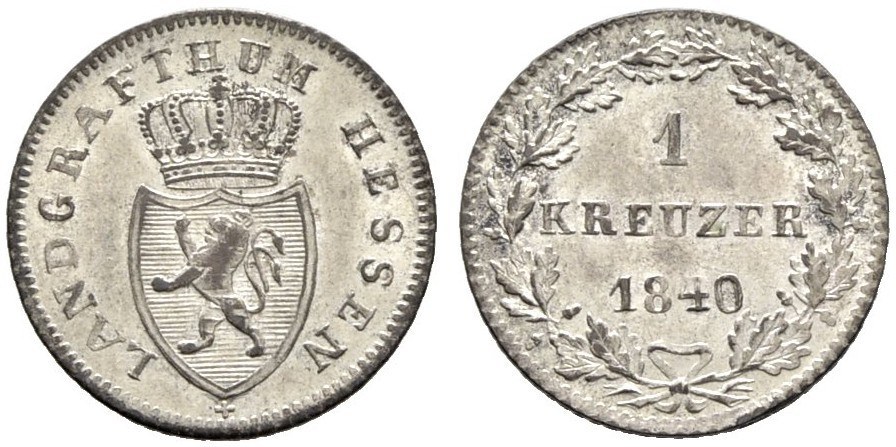
Start with the reverse legend. The clearest diagnostic is the denomination 1 KREUZER shown with the date inside a laurel wreath. Reading the wreath-framed value and the year (1840 on this example) immediately confirms the denomination and pins down a specific German-states minor coin.
Check the crowned shield on the obverse. The obverse should show a crown above a coat-of-arms shield carrying the heraldic elements of Hessen-Homburg, typically ringed by a legend naming the state or ruler. A crowned single shield paired with a wreathed kreuzer value is the signature of this landgraviate's fractional coinage.
Confirm size and metal. Expect a small, thin coin of low-denomination diameter struck in silver or low-grade silver/billon. It should be non-magnetic and lightweight; a large or thick planchet, or a base-metal core showing through, argues against a genuine period kreuzer.
Watch for look-alikes. Many German states issued 1-kreuzer pieces with very similar crowned-shield-and-wreath layouts, so the arms and legend — not the general format — are what distinguish Hessen-Homburg from Bavaria, Baden, Hesse-Darmstadt, Nassau, and others. Read the state name and match the heraldry carefully before attributing the coin.
Authenticate with care. For a scarce small-state coin, inspect the lettering and wreath for the crisp, even detail of an original strike, and be wary of tooled fields, cast copies with soft or grainy surfaces, harshly cleaned examples, or altered dates. When value is at stake, compare against reliably attributed specimens or seek a specialist opinion.
Frequently asked questions
How do I confirm the denomination and date?
Read the reverse: the value 1 KREUZER appears with the year inside a laurel wreath. On this coin the date is 1840, which fixes both the denomination and the year of issue.
How do I tell it apart from other German-states kreuzers?
Many states used a similar crowned-shield-and-wreath layout, so rely on the coat of arms and the legend naming Hessen-Homburg rather than the general design to distinguish it.
What size and metal should it be?
It is a small, thin low-denomination coin in silver or low-grade silver/billon. It should be light and non-magnetic; an oversized, thick, or base-metal piece is a warning sign.
What authentication cautions apply?
Check for crisp original detail in the legend and wreath, and be cautious of cast copies, tooled or cleaned surfaces, and altered dates. Compare with attributed examples or consult a specialist for valuable coins.