
How to Identify the Hawaiian Sesquicentennial Half Dollar
A collector's checklist for confirming a genuine 1928 Hawaiian half dollar — Cook portrait, standing chieftain, silver specs, and counterfeit cautions.
Read the full Hawaiian Sesquicentennial Half Dollar encyclopedia entry →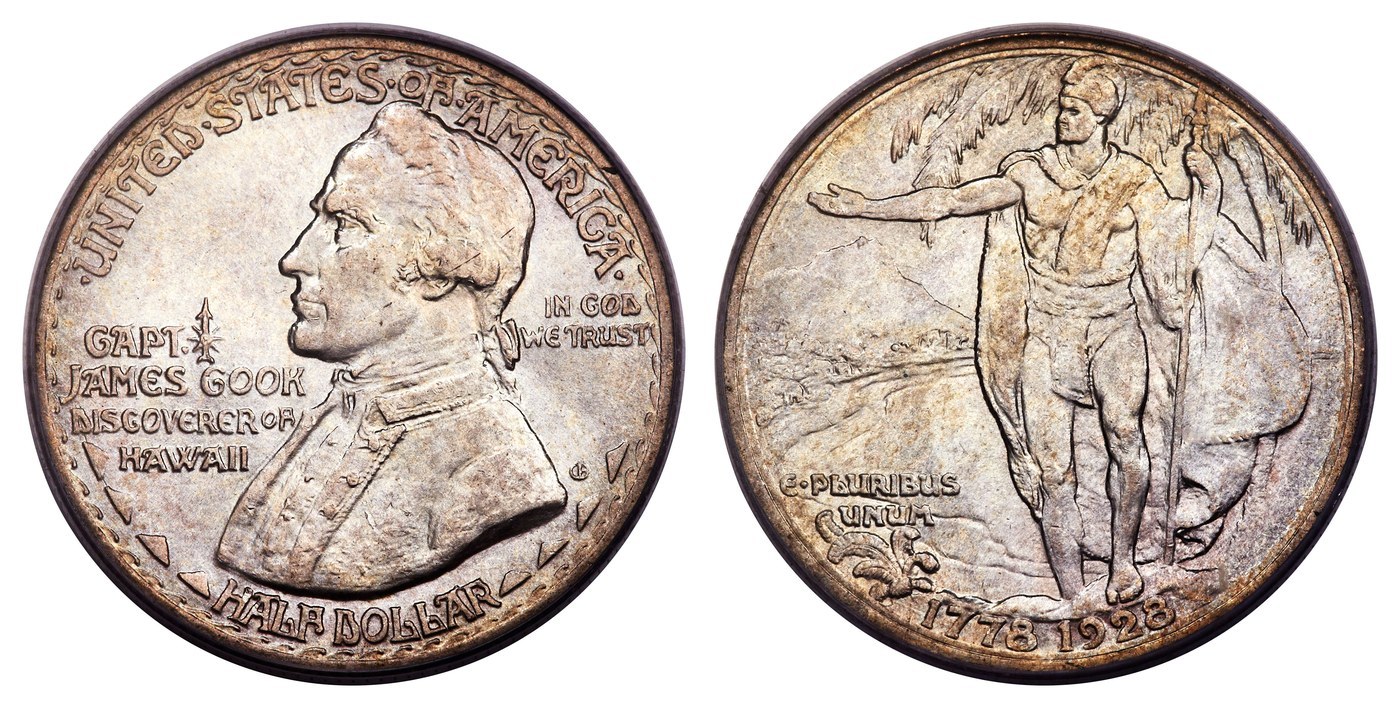
Start with the inscriptions, which are unmistakable. The obverse must read "CAPT. JAMES COOK DISCOVERER OF HAWAII" around a profile bust of Cook, with the date 1928. The reverse shows a standing native Hawaiian chieftain in feathered cloak and helmet, arm outstretched and holding a spear, above a landscape, with "E PLURIBUS UNUM" and "HALF DOLLAR." No other U.S. coin shares this pairing of designs, so matching both sides confirms the type at a glance.
Check the physical specifications against a standard silver half dollar of the period. The coin should be .900 fine silver, about 30.6 mm in diameter, weigh roughly 12.5 grams, and have a reeded edge. A coin that is underweight, the wrong diameter, magnetic, or plated is an immediate red flag. Because the design is only 1928, there is no legitimate variation in date to consider.
Look for the absence of a mint mark, which is correct here — the issue was struck only at Philadelphia. Any Hawaiian half dollar bearing a mint mark should be treated with suspicion. Examine the relief: genuine coins show crisp, well-defined detail in Cook's hair and features and in the chieftain's cloak and spear.
Be especially careful with authentication. This is a high-value key date and one of the most frequently faked classic commemoratives, targeted by both outright counterfeits and altered or added-detail pieces. Beware of coins with mushy detail, tooling marks, seams on the edge, or surfaces that look artificially aged. Given the sums involved, confirm any candidate with a trusted dealer or a third-party grading service (PCGS or NGC) before buying.
Finally, distinguish it from souvenirs and replicas. Modern copies, gold-plated novelty pieces, and gift-shop reproductions exist; genuine examples are original silver strikes matching the weight and diameter above, ideally accompanied by a reputable grading holder given the coin's value and counterfeit history.
Frequently asked questions
How can I tell a real Hawaiian half dollar from a fake?
Confirm it is 90% silver, about 30.6 mm and 12.5 grams with a reeded edge, non-magnetic, with crisp detail and no mint mark. Because fakes are common at this value, verify high-grade or expensive coins with PCGS or NGC.
Should there be a mint mark on the coin?
No. It was struck only at the Philadelphia Mint in 1928, so a genuine example has no mint mark. A Hawaiian half dollar showing a mint mark should be regarded as suspect.
Are there different dates or varieties?
The regular issue exists only dated 1928. There are also a few dozen special presentation "sandblast" proofs, which are extreme rarities; the standard business strike is the coin most collectors encounter.
What size and metal is it?
It is a standard U.S. half dollar: .900 fine silver, roughly 30.6 mm in diameter, about 12.5 grams, with a reeded edge. Any coin far off these figures is not a genuine strike.