
How to Identify the Hamburg Thaler
A silver thaler from the Free and Hanseatic City of Hamburg, identified by its distinctive city gate or castle emblem and civic (rather than royal) legends.
Read the full Hamburg Thaler encyclopedia entry →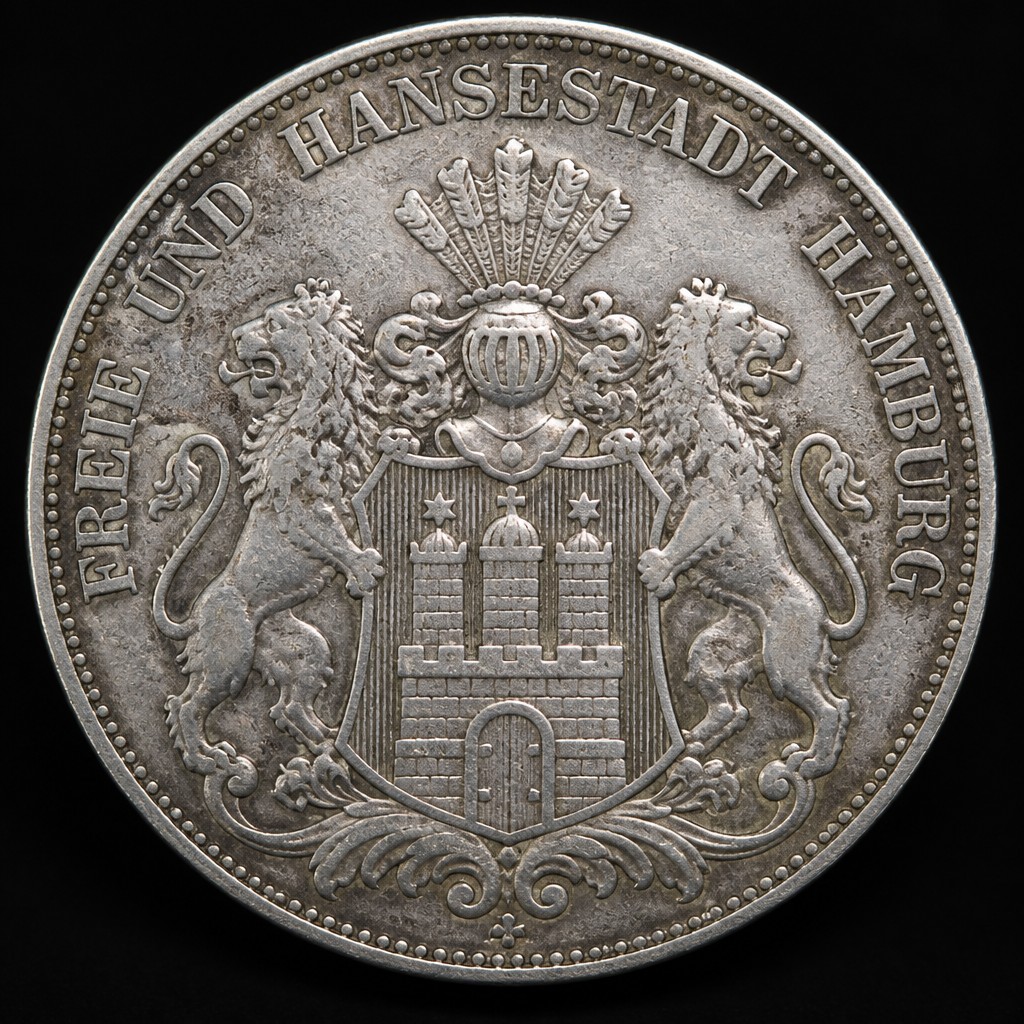
What It Is
The Hamburg Thaler is a silver coin issued by the Free and Hanseatic City of Hamburg, a self-governing city-state within the Holy Roman Empire and later the German Confederation and German Empire. Because Hamburg was a merchant republic rather than a monarchy, its thalers carry civic and heraldic imagery instead of a ruler's portrait, distinguishing them sharply from the royal thalers of neighboring German kingdoms. As one of the wealthiest trading ports in northern Europe, Hamburg minted substantial quantities of silver coinage to support its extensive commercial activity, and its thalers circulated widely alongside those of neighboring kingdoms despite the city's small territorial size.
Obverse Design and Inscriptions
The obverse typically displays Hamburg's civic coat of arms: a castle or city gate with three towers, often flanked by supporters such as lions, with the Latin legend identifying the free city, such as "MONETA NOVA CIVITATIS HAMBURGENSIS" (new coin of the city of Hamburg).
Reverse Design and Inscriptions
The reverse commonly shows an imperial eagle (reflecting Hamburg's historical status within the Holy Roman Empire) or, on later issues after German unification, the denomination and date within a wreath, along with further civic identification text.
Size, Weight, Metal, and Edge
Hamburg thalers follow standard German thaler weight conventions for their era, generally in the 22-33 gram range at .750-.900 fine silver depending on the specific period and monetary standard in force at the time of striking, with a diameter typically between 33-41 mm. The edge varies between plain, reeded, or lettered depending on the type.
Mint Marks and Where to Find Them
As a city with its own independent minting authority, Hamburg coins do not use a branch-mint letter system; instead, a mint master's initials or a small privy mark near the date or base of the design help identify the specific striking period.
Telling It Apart from Similar Coins
Hamburg Thalers are distinguished from royal German thalers (such as those of Prussia, Bavaria, or Saxony) by the complete absence of a ruler's portrait; the castle/city gate emblem paired with civic Latin legends is unique to Hamburg among German thaler issuers, though other Hanseatic free cities like Bremen and Lübeck used their own distinct civic emblems.
Judging Condition at a Glance
Examine the fine architectural detail of the castle towers and gate on the obverse and the eagle's feather detail on the reverse, since these are the highest-relief and most easily worn elements. A well-preserved coin shows crisp tower brickwork and individually defined feathers, while a worn example shows a smoothed, indistinct castle outline and a flattened eagle.
Authenticity Red Flags
Be cautious of coins with an incorrect weight or diameter for the claimed thaler standard, blurred or shallow architectural detail in the castle emblem, or a surface with a grainy or pitted texture and a visible seam, both signs of a cast reproduction rather than a genuine struck coin.
Frequently asked questions
Why doesn't the Hamburg Thaler show a king's portrait?
Hamburg was a self-governing free city rather than a monarchy, so its coinage uses civic heraldry, typically a castle or city gate emblem, instead of a ruler's portrait.
How do I tell a Hamburg Thaler from a Bremen Thaler?
Hamburg's emblem is a castle or gate with three towers, while Bremen uses its own distinct civic symbol; always compare the specific heraldic device and the city name in the legend.
What metal and weight should I expect?
Generally .750-.900 fine silver, weighing between roughly 22 and 33 grams depending on the specific period's monetary standard.
Where would a mint identifier appear?
Look for a small mint master's initial or privy mark near the date, since Hamburg used its own city mint rather than a branch-mint letter system.