
How to Identify the Halfpenny
A visual guide to the British bronze Halfpenny, identified by its seated Britannia or sailing-ship reverse, mid-sized bronze planchet, and plain edge.
Read the full Halfpenny encyclopedia entry →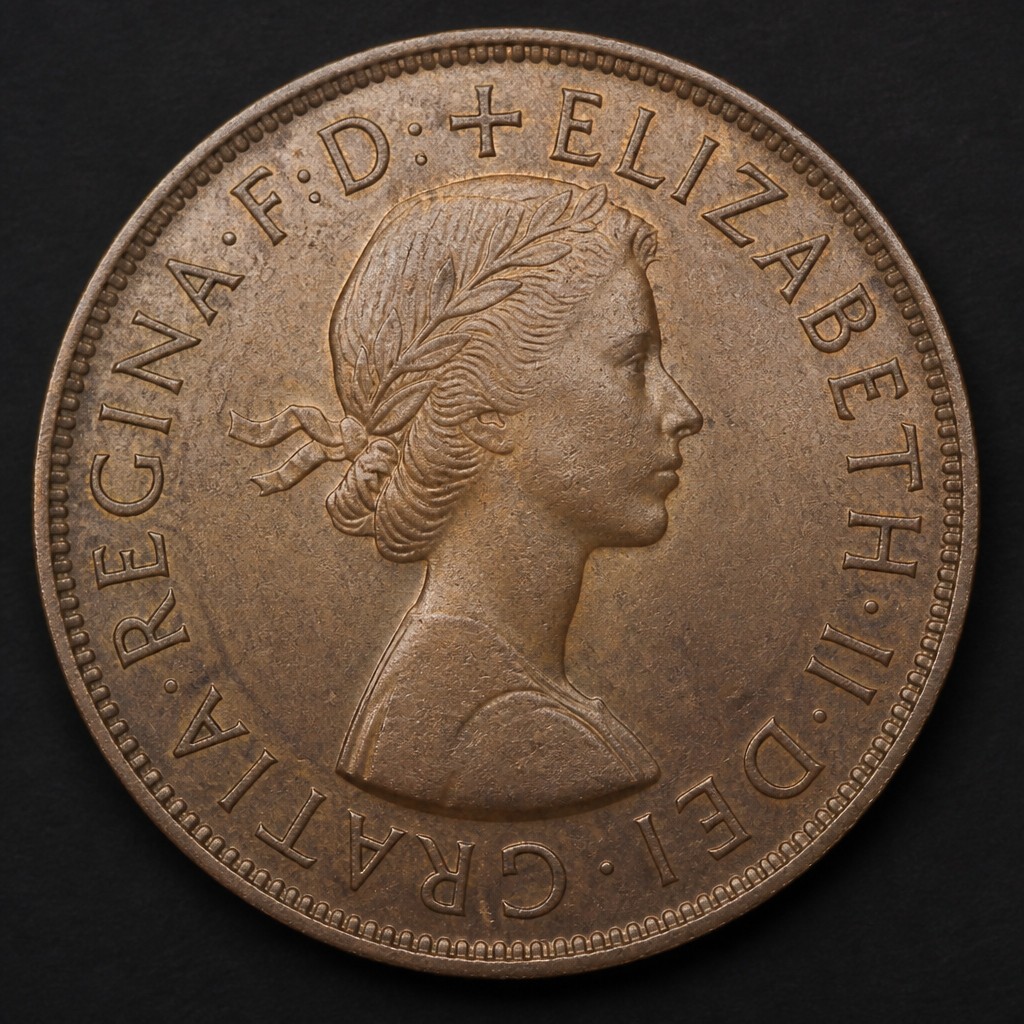
What It Is
The Halfpenny, worth half of one penny, was a everyday bronze coin used for small transactions across Britain until decimalisation, with the last pre-decimal design dated 1967. A different, much smaller decimal halfpenny was later introduced in 1971 and should not be confused with this older coin. Like the penny, the halfpenny was struck in copper before 1860 and switched to bronze afterward, so its exact color and surface texture can help hint at the coin's general age even before checking the date.
Obverse Design and Inscriptions
The obverse displays the monarch's profile portrait with the Latin title and date, consistent with the style of the corresponding penny of the same reign.
Reverse Design and Inscriptions
For most of its life, the halfpenny's reverse showed a seated Britannia similar to the penny's design, holding a trident and resting on a shield. From 1937, the design changed to a sailing ship (representing Sir Francis Drake's Golden Hind) shown in profile, a design that continued through the end of the pre-decimal series.
Size, Weight, Metal, and Edge
The halfpenny measures about 25.5 mm in diameter and weighs roughly 5.66 grams, struck in bronze. The edge is plain (smooth).
Mint Marks and Where to Find Them
Standard London-struck halfpennies carry no visible mint mark, in keeping with regular British bronze coinage of the period.
Telling It Apart From Similar Coins
Because it sits between the penny and farthing in size, careful measurement helps confirm identification: the halfpenny is smaller than the penny (31 mm) but larger than the farthing (20 mm). The ship reverse used from 1937 onward is a clear, easy way to distinguish later halfpennies from the earlier Britannia-seated design. When only a penny and halfpenny of the same era are available for comparison, placing them side by side usually makes the size difference obvious even without a ruler.
Judging Condition at a Glance
On the ship design, check the rigging lines and hull detail, which are fine and wear away quickly. On the Britannia design, look at the folds of drapery and the shield's edge. A coin with a sharp, unworn rim on both sides typically indicates lighter overall wear.
Authenticity Red Flags
Be alert for coins with an incorrect diameter or an unusually light weight, both common in cast counterfeits. A rough, sandy surface texture, especially inside recessed design areas, and a visible seam around the edge are further signs the coin may not be a genuine struck example. Because genuine halfpennies were struck in large numbers, an unusually rare-looking date paired with poor overall coin quality is often a sign of a low-value reproduction rather than a genuine scarce piece.
Frequently asked questions
What is shown on later halfpennies?
From 1937 onward, the reverse shows a sailing ship representing Sir Francis Drake's Golden Hind; earlier issues instead show a seated Britannia.
How big is an old halfpenny?
It measures about 25.5 mm in diameter, between the larger penny and the smaller farthing.
Is the old halfpenny the same as the decimal halfpenny?
No, the pre-decimal bronze halfpenny (worth 1/480 of a pound) is a completely different, larger coin from the small decimal halfpenny introduced in 1971.
What metal is the halfpenny made of?
It is struck in bronze, the same alloy used for the penny and farthing of the same era.