
How to Identify the Half Guinea of Anne
A collector's guide to recognizing Queen Anne's milled gold half guinea by its left-facing portrait, crowned shields, size, edge, and key varieties.
Read the full Half Guinea of Anne encyclopedia entry →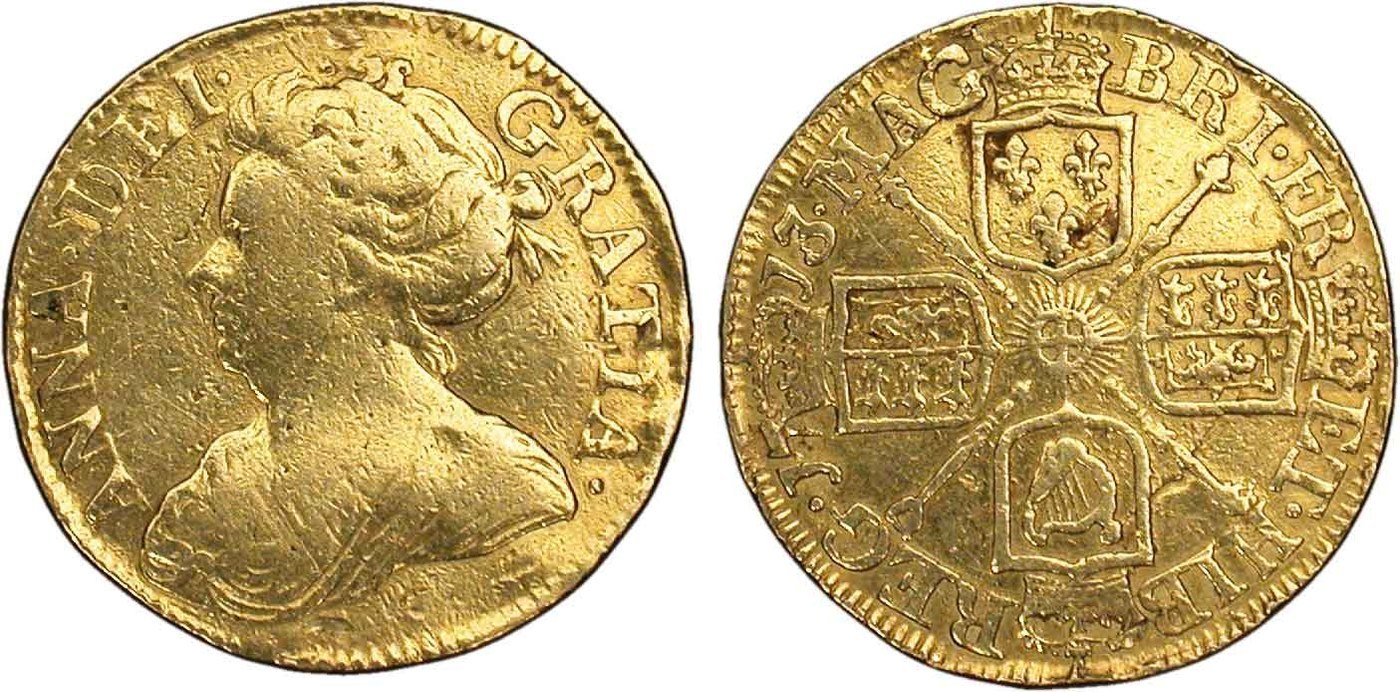
Start with the portrait. The obverse of a Half Guinea of Anne shows the queen in left-facing profile with a draped bust, surrounded by a Latin legend that begins ANNA D G GRATIA. The leftward-facing bust is a helpful early clue, since many earlier rulers face right. The lettering is even and machine-struck, so a small gold coin with this neat left-facing ANNA portrait is the first sign of the type.
Turn to the reverse. Look for crowned shields arranged as a cross, carrying the royal arms with fleurs-de-lis for the French claim and a crown at the center. Confirm both sides together before attributing the coin. Because the 1707 Union changed the arms, study the exact shield arrangement: the pre-Union design differs from the post-Union combined arms, and this detail dates the coin to before or after 1707.
Check size, weight, metal, and edge. The half guinea is a small but heavy gold coin — clearly smaller and lighter than the full guinea, yet struck from the same gold. As a milled piece it has a perfectly round flan, uniform thickness, and a decorated edge added to deter clipping. Weigh and measure the coin against published specifications; a badly underweight or magnetic piece is a red flag, and because gold does not tarnish, heavy dark toning warrants caution.
Look for key varieties and read the details. Note any provenance mark such as VIGO below the bust, which commemorates gold captured at Vigo Bay in 1702 and marks a scarce, valuable variety. Identify the date and bust style where legible, since these separate issues across the 1702–1714 span and affect both attribution and value.
Be cautious with authentication. As a valuable early milled gold coin, the Anne half guinea is a target for forgery, including cast copies, tooled pieces, altered dates, and modern replicas. Watch for casting seams, surface bubbles, unnaturally smooth fields, a plain or incorrect edge, wrong weight, and lettering that looks soft or reworked. Given the value at stake, obtain an opinion from a specialist in English milled gold or a reputable grading service before buying.
Frequently asked questions
Which side is the obverse?
The side with the left-facing draped bust of Queen Anne and the ANNA D G GRATIA legend is the obverse; the crowned cruciform shields with fleurs-de-lis form the reverse. Both should be present to confirm the type.
How do I tell a half guinea from a full guinea?
They share the same portrait and reverse design, so confirm the size and weight. The half guinea is distinctly smaller and lighter; measuring and weighing the coin against published figures is the reliable test.
Does the reverse help date the coin?
Yes. The 1707 Act of Union changed the royal arms, so a pre-Union half guinea shows a different shield arrangement from a post-Union one. Comparing the shields to published designs places the coin before or after 1707.
How can I be sure the coin is genuine?
Because it is high-value gold, forgeries exist. Check weight, metal, and edge, watch for casting seams, bubbles, and soft or altered lettering, and obtain professional authentication or grading before any purchase or sale.