
How to Identify the Half Escudo (800 Reis) of Joao V
A collector's guide to spotting Joao V's gold half escudo: the royal bust, crowned Portuguese arms, size and weight, and authentication cautions.
Read the full Half Escudo (800 Reis) of Joao V encyclopedia entry →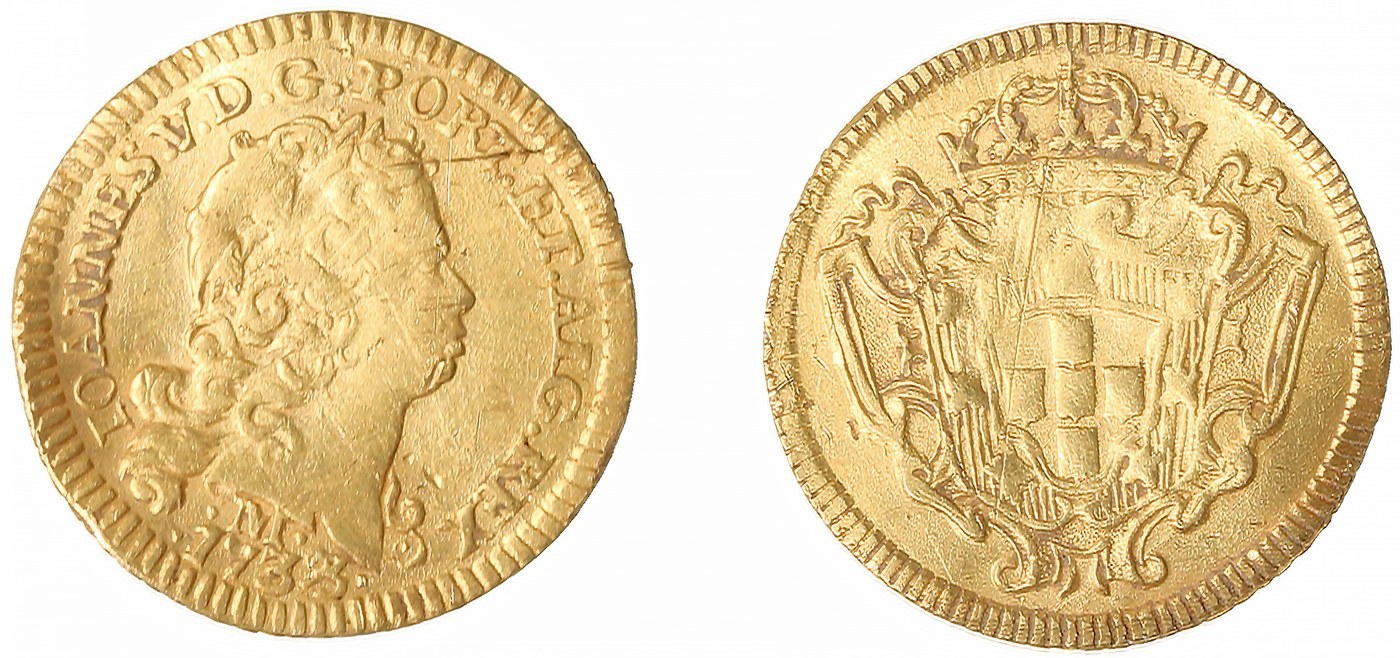
Begin with the two design elements. The obverse should show a right-facing profile bust of Joao V within a Latin legend naming the king — look for forms of IOANNES V and the abbreviation D G for Dei Gratia. The reverse should show a crowned shield containing the Portuguese arms: five small shields (the quinas) arranged in a cross, set within a bordure of castles. A clear date, such as 1733 here, sits with the design and helps place the coin within the 1706–1750 reign.
The most important step is measurement, because the escudo, half escudo and quarter escudo all use the same bust-and-arms motif and differ chiefly in scale. Weigh the coin and measure its diameter, then compare against published specifications for the half escudo. Do not judge the denomination from the pictures alone — a slightly larger or smaller coin of identical design will be a different value.
Confirm the metal. This should be a warm-toned gold piece that feels dense for its size; genuine gold does not tarnish or show base-metal spotting. Be wary of brassy color, light weight, or a dull ring, which can indicate a gilt or base-metal imitation. Because these coins are small and old, expect some honest wear on the high points of the bust and shield rather than perfectly sharp detail.
Watch for the hazards common to eighteenth-century gold. Many pieces were mounted as jewelry, so inspect the rim and fields for solder traces, filing, tooling, or a bent flan; such damage lowers value even when the coin is genuine. Cast counterfeits may show a soft, grainy surface, seams on the edge, or mushy lettering compared with a sharply struck original.
Finally, note that colonial Brazilian strikings and Lisbon strikings share the pattern but can carry different mint characteristics; matching a specific coin to a catalog by mint and date is a job for detailed references. For any purchase of consequence, favor coins authenticated by a reputable grading service and compare against known-genuine examples before relying on the identification.
Frequently asked questions
What is the fastest way to confirm this is a half escudo and not a full escudo?
Weigh and measure it. The escudo, half escudo and quarter escudo carry the same bust-and-arms design, so size and weight against published half-escudo specifications are what separate them, not the imagery.
What legends should I expect around the portrait?
An abbreviated Latin legend naming Joao V — forms of IOANNES V with D G for Dei Gratia and royal titles. The reverse legend continues the titulature around the crowned shield.
How do I spot a counterfeit or an altered coin?
Check that weight, diameter and gold color match references, and look for solder marks, filing or a bent flan from old jewelry mounting. Grainy surfaces, edge seams and soft lettering point to a cast fake.
Does a Brazilian mint make the coin different from a Lisbon one?
The core design is the same, but colonial Brazilian and Lisbon strikings can differ in mint details and desirability. Matching a specific coin by mint and date requires detailed catalog references.