
How to Identify the Guptas 'Horseman' Silver Coin
A Gupta-era silver coin imitating earlier Kshatrapa designs, identified by its garbled pseudo-Greek border or horseback king motif with a Brahmi legend.
Read the full Guptas 'Horseman' Silver Coin encyclopedia entry →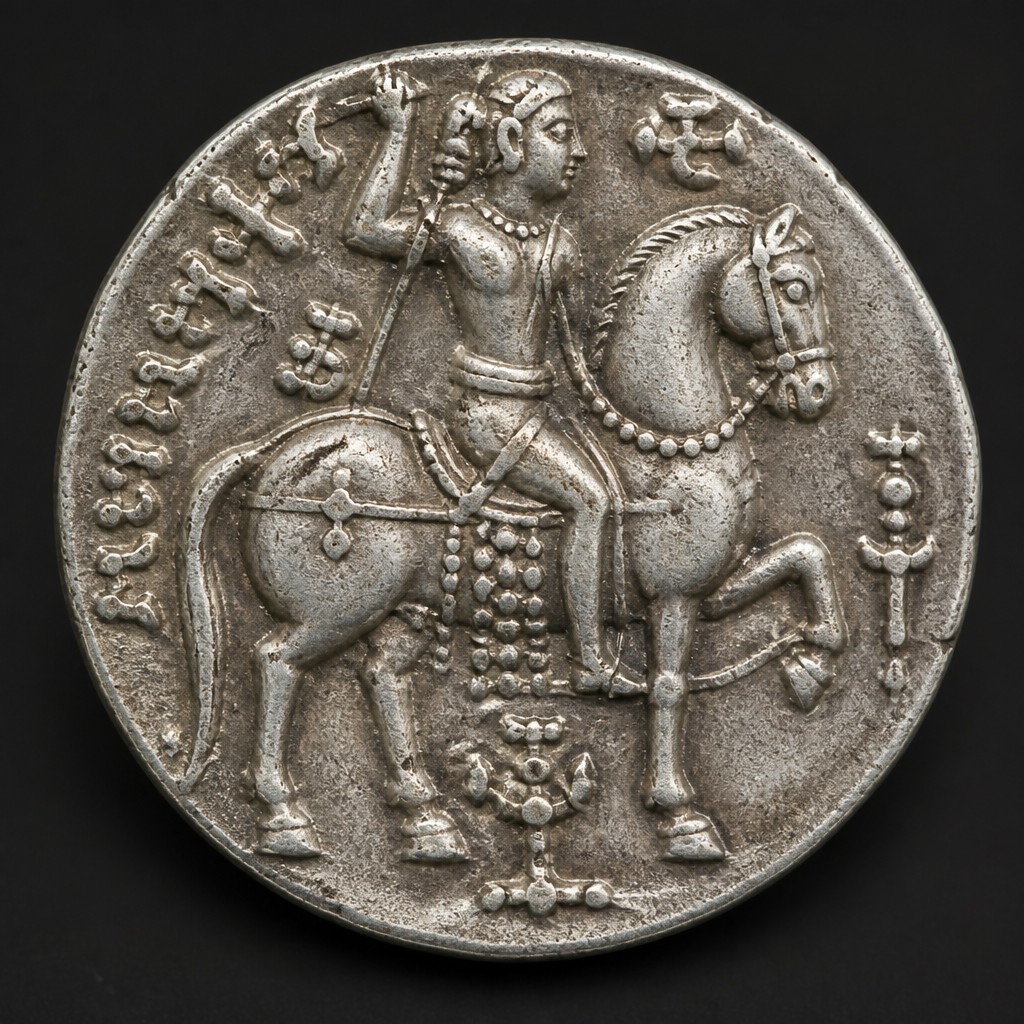
What It Is
This silver coin type was issued by rulers of the Gupta Empire, notably Chandragupta II and Kumaragupta I, for circulation in western India after the Guptas absorbed territory previously ruled by the Western Kshatrapas. Many varieties deliberately imitate the earlier Kshatrapa coinage style familiar to local populations, while some show a "king on horseback" motif that gives the type its popular "Horseman" name. This practice of continuing a conquered region's familiar coin style was a common strategy in the ancient world, helping a new ruling power maintain economic stability while gradually asserting its own identity through subtle design and inscription changes.
Obverse Design & Inscriptions
The obverse shows either a bust of the king in profile within a border of garbled, decorative pseudo-Greek lettering copied loosely from Kshatrapa prototypes, or, on the true "Horseman" variety, the king mounted on a galloping horse, often accompanied by a Brahmi legend naming the king below or beside the image.
Reverse Design & Inscriptions
The reverse typically shows a Gupta dynastic emblem such as a peacock or the mythical Garuda bird standard, surrounded by a circular Brahmi inscription giving the king's name and royal titles, such as "Paramabhagavata Sri Kumaragupta."
Size, Weight, Metal & Edge
It is a small silver coin, roughly 14-16mm in diameter, weighing around 2 grams. The alloy is often noticeably debased with copper compared to earlier Kshatrapa pieces. The edge is plain, typical of ancient hand-struck coinage.
Mint Marks & Where to Find Them
There is no formal city mint mark. The coin's own inscriptions — the king's name and titles in Brahmi — serve as the primary identification tool, along with small control symbols occasionally found in the field. Because Brahmi script can be unfamiliar to non-specialists, comparing the general shape and spacing of the inscribed letters against published Gupta coin references is a practical way to work toward an attribution even without fluency in the script.
Telling It Apart from Similar Coins
Compare the border legend closely: genuine Kshatrapa coins carry meaningful Greek lettering, while Gupta imitation issues show blundered, decorative approximations of that lettering. The presence of a Brahmi legend naming a Gupta king, rather than a Kshatrapa ruler's name, confirms Gupta attribution.
Judging Condition at a Glance
Assess wear on the king's profile or the horse-and-rider outline, and check whether the Brahmi legend remains legible, since heavily worn or off-center strikes make attributing the coin to a specific Gupta ruler difficult. Because these coins were struck on hand-cut blanks, slight irregularities in shape or centering are normal and do not by themselves indicate a problem piece.
Authenticity Red Flags
As with other ancient silver issues, be wary of cast reproductions showing seam lines, incorrect diameter or weight, or crisp designs unlike the typically soft, irregular strikes of genuine ancient dies. The alloy should show a somewhat dull silver-gray tone consistent with age rather than a bright, uniform sheen.
Frequently asked questions
Why does this coin imitate an earlier design?
After conquering territory from the Western Kshatrapas, Gupta rulers deliberately copied the familiar local coin style to ease acceptance of the new currency among the population.
What does "Horseman" refer to?
It refers to a variety showing the king mounted on a galloping horse on the obverse, distinguishing it from the more common bust-with-pseudo-Greek-border variety.
How can I tell this from a genuine Kshatrapa coin?
Genuine Kshatrapa coins carry meaningful Greek-letter legends, while Gupta imitations show blundered, decorative lettering, and a Brahmi inscription naming a Gupta king confirms the later attribution.
What metal purity does this coin typically have?
The silver alloy is often noticeably debased with copper compared to earlier Kshatrapa coinage, giving it a somewhat duller tone.
What should I look for to spot a fake?
Check for correct weight and diameter, and be cautious of coins with unusually crisp, mechanically uniform detail or visible casting seams, which suggest a modern reproduction rather than an ancient struck piece.