
How to Identify the Guinea
A historic British gold coin struck from 1663 to 1814, identified by the monarch's bust, a crowned shield reverse, and its name derived from the West African gold used to strike early issues.
Read the full Guinea encyclopedia entry →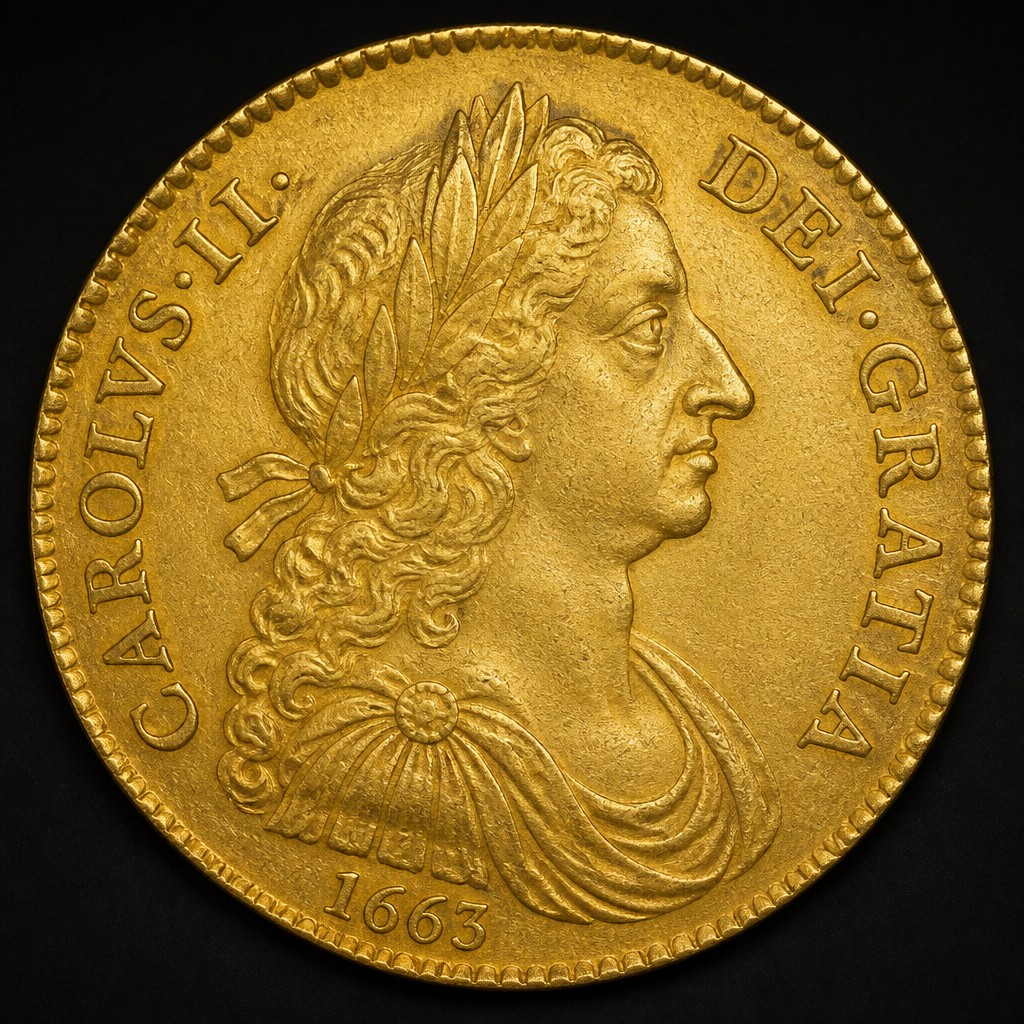
What It Is
The guinea was a British gold coin struck from 1663 until 1814, named for the West African region whose gold, supplied partly through the Royal African Company, was used in some of the earliest issues. Originally valued at 20 shillings, market fluctuations in the price of gold eventually pushed its value as high as 30 shillings before it was fixed by royal proclamation at 21 shillings in 1717, a valuation that persisted even after minting stopped and gave rise to the "guinea" as a unit still used informally for pricing today.
Obverse Design
The obverse carries a portrait bust of the reigning monarch, spanning the reigns from Charles II through George III, with hairstyle, laurel wreath, or other regalia details varying by monarch and helping to pin down the exact reign and type.
Reverse Design
The reverse typically shows a crowned shield bearing the royal arms, arranged in a cruciform pattern of four quartered shields around a central rose or star, though the design varies somewhat by monarch. A well-known late variant, the "spade guinea" of George III (struck circa 1787-1799), uses a shield shaped like a spade, giving that type its popular nickname. Some early Charles II guineas carry a small elephant, or elephant and castle, beneath the bust, marking gold supplied via the Royal African Company.
Size, Weight, and Metal
Guineas were struck in gold close to the sterling crown gold standard, with weight around 8.3 to 8.4 grams depending on era, and diameter varying somewhat by monarch and type, with later "spade guinea" issues notably smaller, around 20mm, than earlier, broader guineas.
Mint Marks and Where to Find Them
Guineas were struck at the Royal Mint in London, so there is no branch mint letter system to check; instead, dating and type identification rely on the monarch's portrait style, the date below the bust, and small design variants like the elephant-and-castle mark.
Telling It Apart from Similar Coins
The half guinea shares the same design themes at a smaller size and lighter weight, so measuring diameter and weight distinguishes the two easily. The later gold sovereign, introduced after the 1816 currency reform, replaced the guinea with a different weight standard and design conventions, so a sovereign should not be confused with a guinea despite both being British gold coins.
Judging Condition at a Glance
Look at wear on the monarch's hair curls and laurel wreath on the obverse, and on the shield's fine dividing lines and crown details on the reverse, since guineas circulated actively and many surviving examples show meaningful wear from long use, along with historical clipping or filing on some earlier specimens.
Authenticity Red Flags
Check the coin's milled edge pattern, which varied by period and can help confirm the type, along with precise weight and diameter for the specific monarch and date range, since contemporary counterfeits and clipped genuine coins circulated historically, and modern forgeries can be checked against these same physical standards.
Frequently asked questions
Why is it called a 'guinea'?
The name comes from the West African region of Guinea, whose gold, partly supplied by the Royal African Company, was used in some of the coin's earliest issues.
Why was the guinea worth 21 shillings instead of a round number?
Fluctuations in the market price of gold relative to silver caused the guinea's practical value to drift upward until it was formally fixed at 21 shillings by royal proclamation in 1717.
What does an elephant symbol under the bust mean?
It marks that the gold used for that coin was supplied through the Royal African Company, and it appears on some early Charles II era guineas, sometimes paired with a small castle.
What is a 'spade guinea'?
It is a popular nickname for a late George III guinea type, struck circa 1787-1799, whose reverse shield is shaped like a spade.
Is a guinea the same as a sovereign?
No, they are different coins from different eras; the guinea was replaced after Britain's 1816 currency reform introduced the sovereign with its own distinct weight standard and design.