How to Identify the Guangdong 20 Cents
A collector's checklist for the Kwangtung 20 Cents: reading the dragon, the Chinese legends, size and silver, and spotting common fakes.
Read the full Guangdong 20 Cents encyclopedia entry →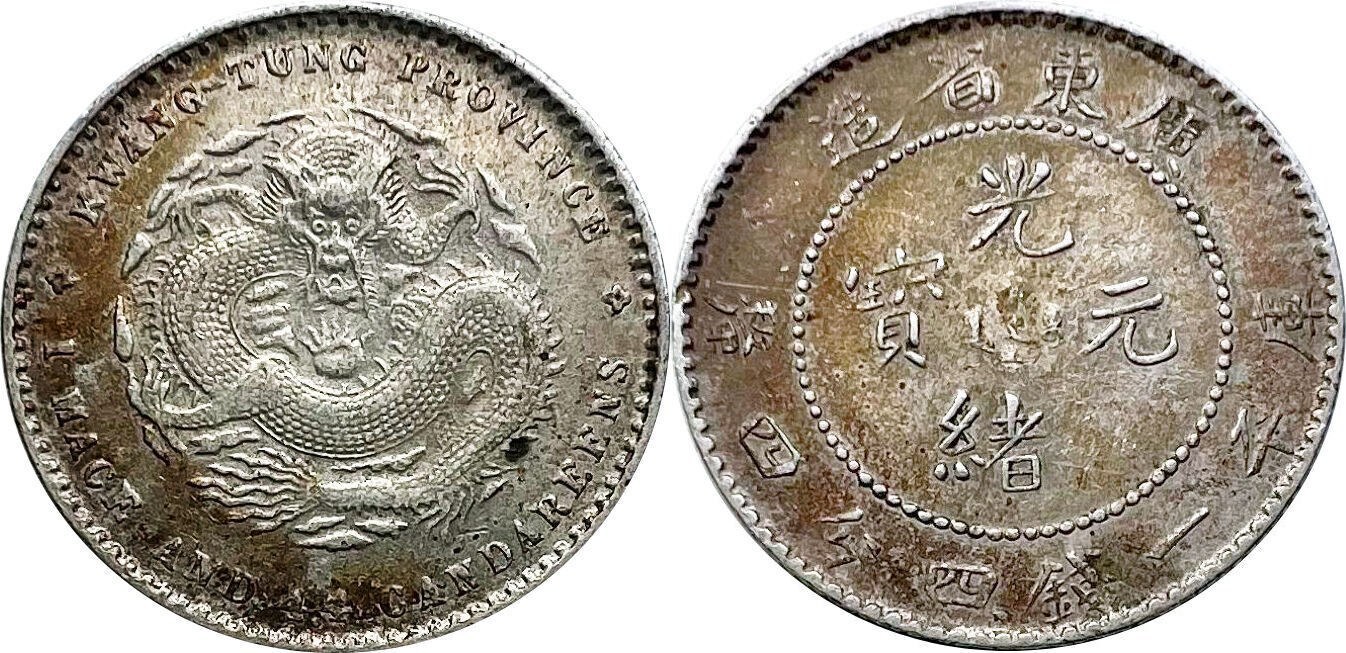
Start with the dragon side. The Guangdong 20 Cents shows a coiled, scaly dragon inside an ornamental circular border with radiating lines and a beaded rim. On many examples an English or romanized legend such as "KWANG-TUNG PROVINCE" and the value curve around this border, giving you the province and denomination directly. A crisp dragon with clear scales, claws, and pearl is also a first clue to grade and to a genuine strike.
Turn to the legend side, which carries Chinese characters arranged around a small floral rosette or sunburst ornament. These inscriptions name the province, the Guangxu reign title, and the denomination. Because the coin uses the reign title rather than a Western year, you will not find a calendar date here; note the characters and any variety details instead, and expect attribution to the 1875-1908 range as a whole.
Check the denomination and weight. The value appears as 20 Cents and as 1 Mace and 4.4 Candareens in the traditional weight system. Confirm the coin is silver and sized between the smaller 10-cent and 5-cent pieces and the larger half-dollar and dollar of the same series. Measuring the diameter and weighing the coin, then comparing against published specifications for the Kwangtung 20 Cents, is a strong authentication step.
Distinguish it from look-alikes. Other Qing provinces struck near-identical dragon 20-cent pieces, so read the province legend carefully to avoid confusing Kwangtung with Hupeh, Kiangnan, Fukien, or others. The larger and smaller denominations of the Kwangtung series share the same motifs, so verify the stated value rather than judging by design alone.
Apply firm authentication caution. Chinese dragon silver is among the most heavily counterfeited world coinage. Watch for wrong weight or diameter, mushy or lifeless dragon detail, cast seams or bubbles, incorrect character forms, and an unnatural surface or ring. For any coin of real value, favor examples certified by a reputable grading service and compare against trusted reference images before buying.
Frequently asked questions
How do I tell this from another province's 20 Cents?
Read the province legend on the dragon side. Kwangtung 20-cent pieces name the province in the English and Chinese inscriptions; other provinces such as Hupeh or Kiangnan used similar dragons but different province names, so the legend is the deciding clue.
How can I check the denomination?
Look for the value stated as 20 Cents and as 1 Mace 4.4 Candareens. Confirm the size falls between the 10-cent piece and the half-dollar of the same series; matching diameter and weight to published figures verifies the twenty-cent denomination.
What are the warning signs of a fake?
Common red flags include incorrect weight or diameter, soft or blurry dragon detail, cast seams or air bubbles, wrong or clumsy Chinese characters, and a dull, unnatural surface. Certification by a reputable grading service is the safest confirmation.
Can I date the coin exactly?
No. The coin bears the Guangxu reign title rather than a specific year, so it can only be placed within roughly 1875-1908. Die varieties and design details help refine attribution but rarely pin down a single year.
Guangdong 20 Cents identified by the community
Recent Guangdong 20 Cents coins identified with Coin Identifier.