
How to Identify the Grosz Koronny
A collector's guide to confirming a Polish Crown grosz by its crown-and-shield design, Polish Eagle, Latin legend, date, and small hammered-silver format.
Read the full Grosz Koronny encyclopedia entry →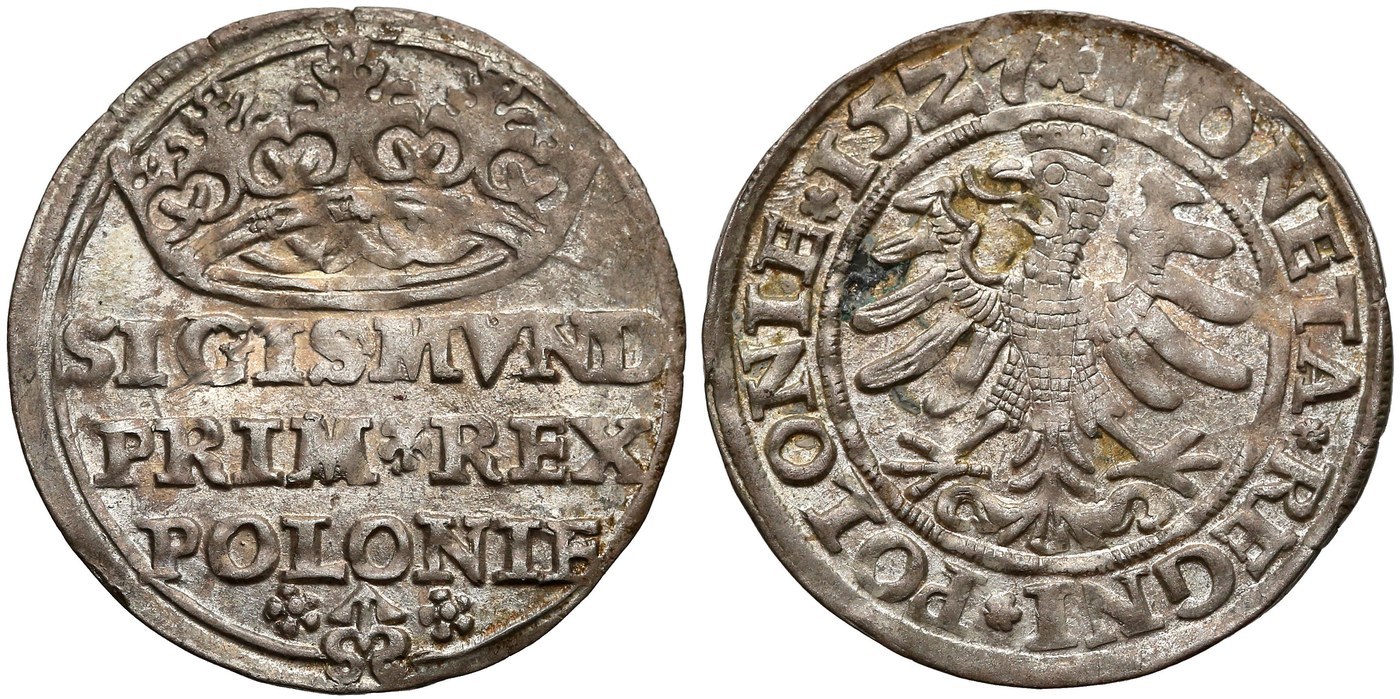
Read the Two Faces
Start by matching the designs. A Grosz Koronny of this type pairs a Polish royal crown set above a coat of arms or shield on one face with the Polish Eagle (Orzeł), wings spread, on the other. If one side does not show either the crown-over-shield motif or the spread-winged Eagle, you are likely looking at a different denomination or a coin of another country.
Find the Legend and Date
Look around the rim for a Latin inscription. On a genuine piece it names the king and his titles in abbreviated Latin and includes a grosz denomination spelling such as GROSSVS. The date, here 1527, appears in the legend as well. A readable royal legend and a clear date are strong confirmation of the type and are also what drives collector interest.
Check Size, Weight, and Metal
This is a small silver coin, roughly 20 mm across and only a couple of grams, so it should feel thin and light, not thick or heavy. It should be non-magnetic and show the gray tone or patina of old silver. A coin of this design that is oversized, thick, brassy, or attracted to a magnet is a warning sign.
Expect a Hammered Look
Because it was struck by hand, a real grosz of this era is often slightly off-round, unevenly centered, and stronger in detail on one side than the other. Do not treat modest irregularity as a fault of authenticity; instead be suspicious of pieces that look too perfectly round and uniform, which can indicate a cast copy or a modern replica.
Rule Out Look-Alikes and Fakes
Poland and Lithuania struck many small silver coins with eagles, crowns, and shields under Sigismund I and later rulers, so read the legend and denomination rather than relying on the Eagle alone; Lithuanian issues, half-groschen, and later-dated groszy share the family look. Watch for altered dates, tooled detail, cast seams, wrong weight, and cleaning. For any better example, compare against trusted reference images of dated Sigismund I groszy and, where value warrants, seek third-party authentication.
Frequently asked questions
How do I tell a Crown grosz from a Lithuanian one?
Read the legend and heraldry. The Crown (Koronny) grosz emphasizes the Polish Eagle and royal titles of the Polish Crown; Lithuanian issues use the Lithuanian Pogoń (mounted knight) and different legends, even when the format is similar.
What size and weight should it be?
Expect a small, thin silver coin about 20 mm in diameter and only a couple of grams. It should be light and non-magnetic; a heavy, thick, or magnetic piece of this design is suspect.
Is an off-center or uneven coin fake?
Not necessarily. Hammered coins are routinely off-center and unevenly struck. Irregularity is normal for the period; overly perfect roundness or cast seams are the real red flags.
Is a grosz like this worth authenticating?
For well-worn common examples the value is modest, but for sharp, high-grade, or scarce-variety coins authentication is worthwhile, since altered dates and cast copies of Sigismund I silver do exist.