
How to Identify the Grant Memorial Half Dollar
A collector's checklist for confirming a 1922 Grant silver commemorative — portrait, dates, the star variety, size and metal, and authentication cautions.
Read the full Grant Memorial Half Dollar encyclopedia entry →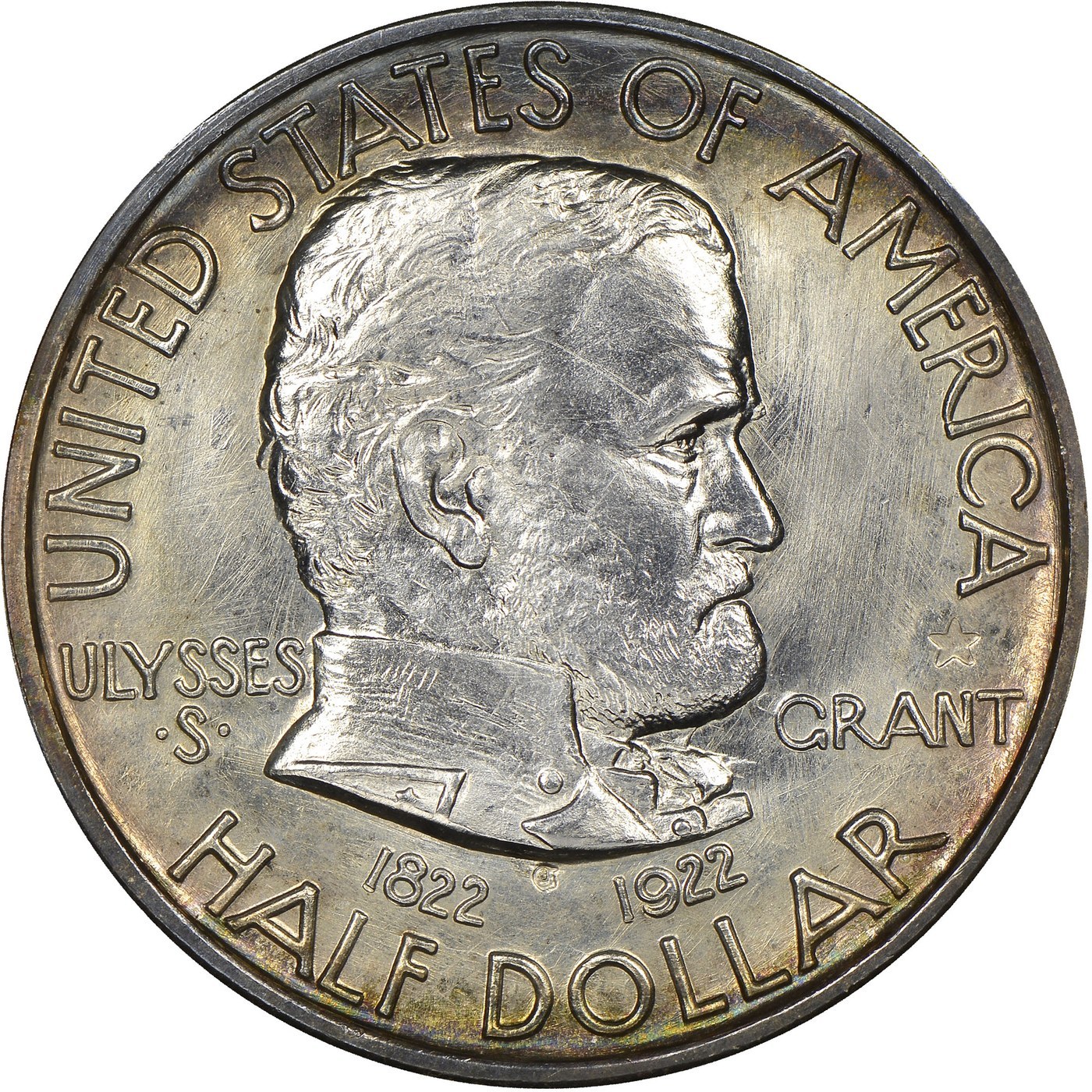
Begin with the obverse portrait and legends, because they identify the type immediately. You should see Ulysses S. Grant in a bearded bust facing right, the name GRANT beneath him, UNITED STATES OF AMERICA and IN GOD WE TRUST around the rim, HALF DOLLAR as the denomination, and the paired dates 1822-1922 flanking the bust. Those anniversary dates are the surest confirmation that you have the 1922 Grant commemorative rather than a regular circulating half dollar.
Next, hunt for the variety marker. Look closely at the obverse field just above the word GRANT: a small incuse star there identifies the scarce "With Star" variety, while a plain field identifies the common "No Star" version. A loupe helps, and it is worth examining the metal around the star carefully — because the star coin is so much more valuable, tooled or added stars on a genuine plain coin are a known deception.
Confirm the physical basics. A genuine Grant half is 90% silver, about 30.6 mm in diameter, and weighs roughly 12.5 grams, the same specifications as contemporary Walking Liberty and Barber halves. A verified weight and diameter, plus the ringing tone of silver, help rule out base-metal fakes and altered pieces.
Check the mint mark position and the reverse. All examples were struck at Philadelphia and carry no mint mark, so any Grant half showing a "D" or "S" should be treated with suspicion. The reverse, not shown on these photographs, depicts Grant's log-cabin birthplace among trees with E PLURIBUS UNUM above; a reverse that does not match this is a red flag.
For authentication, treat the star variety with particular care. Because a star can be added to a common coin, high-value star examples are best purchased certified by a major grading service (PCGS or NGC), which authenticates the variety and grade. When in doubt, compare the star's shape, depth, and placement against verified reference images before paying a star-variety premium.
Frequently asked questions
How do I tell a Grant commemorative from an ordinary 1922 half dollar?
The Grant coin shows Grant's right-facing bust with the dates 1822-1922 and his name on the obverse. The U.S. did not strike regular circulating half dollars in 1922, so this dual-dated Grant portrait is distinctive.
Where exactly is the star, and why does it matter?
It is a small incuse star in the obverse field just above the word GRANT. It matters because the 'With Star' variety is far scarcer and worth much more, so its presence dramatically changes the coin's value.
Could the star be faked?
Yes. Because the star variety carries a large premium, stars are sometimes added to genuine plain coins. For any star example of significant value, rely on third-party certification rather than eye appeal alone.
What should the coin weigh and measure?
A genuine piece is 90% silver, roughly 30.6 mm in diameter, and about 12.5 grams. Figures well off these numbers suggest a counterfeit or a non-silver copy.