
How to Identify the Grant Memorial Gold Dollar
A collector's checklist for confirming a genuine 1822-1922 Grant gold dollar: portrait, size, the tiny star variety, and authentication cautions.
Read the full Grant Memorial Gold Dollar encyclopedia entry →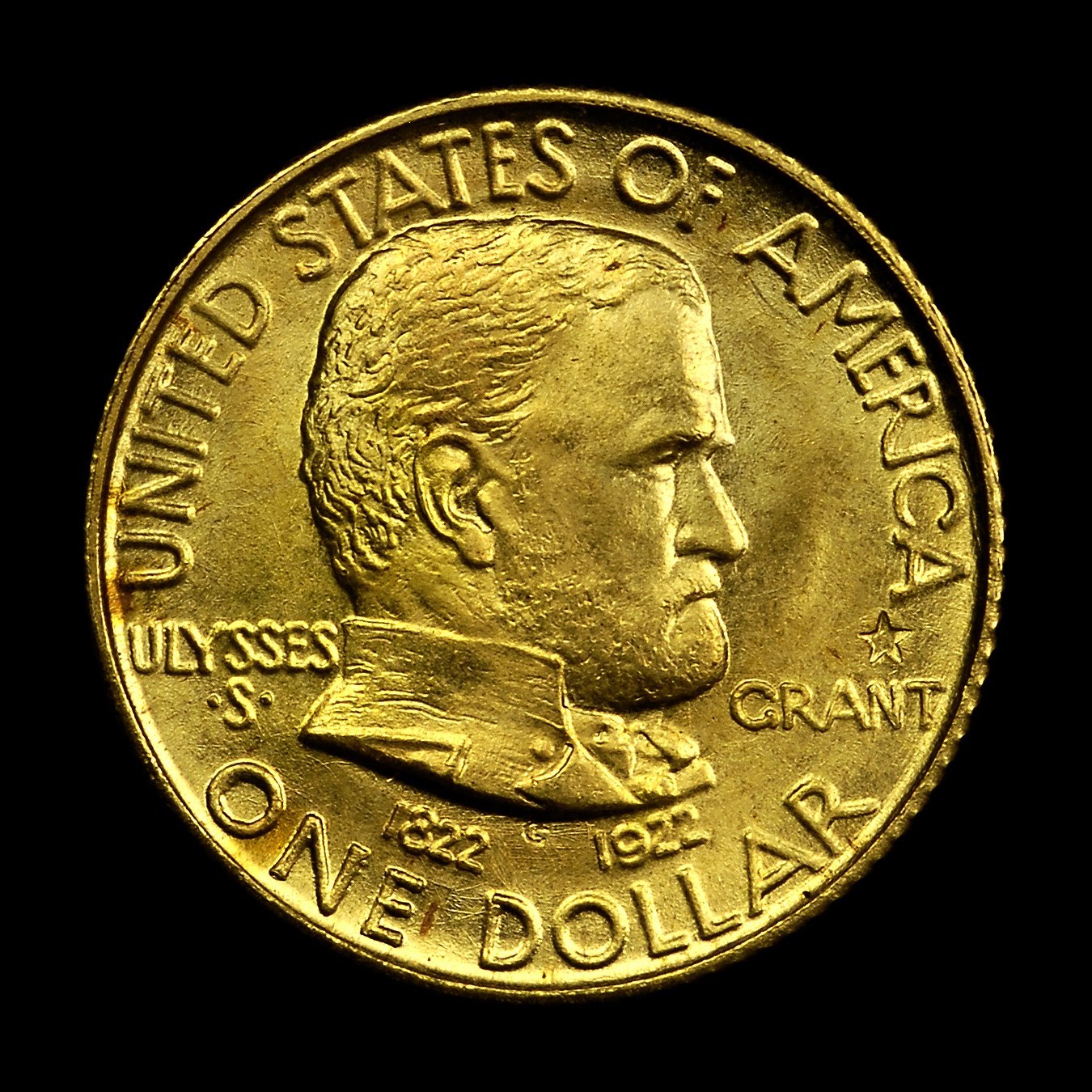
Begin with the obverse, which is the most reliable point of identification. A genuine Grant Memorial gold dollar shows a bare-headed profile of Ulysses S. Grant facing right, the dual dates 1822-1922, the name GRANT, and the denomination ONE DOLLAR. If the portrait, dates, or denomination differ, you are not looking at this type.
Confirm the physical specifications, because size is a fast filter. This is a classic gold dollar measuring only about 15 mm in diameter and weighing roughly 1.67 grams in .900 fine gold — smaller than a U.S. cent. The color should be a warm, rich gold. A coin that is markedly larger, heavier, or a pale off-color is a warning sign. Weighing and measuring the piece is worthwhile given its value.
Check the reverse (not shown in the sample photo) for the log-cabin design representing Grant's Point Pleasant, Ohio, birthplace, framed by trees, with UNITED STATES OF AMERICA and the motto. Then look carefully for the small incuse star in the obverse field above GRANT: its presence marks the 'with star' variety and its absence the 'no star' variety. A loupe helps, because the star is small and can be missed or, on altered coins, added or tooled.
Be alert to authentication risks. Because the coin is tiny, valuable, and struck in soft gold, counterfeits, cast copies, and pieces with an added or removed star exist. There is no mint mark to check — all genuine examples are Philadelphia strikes — so focus instead on correct weight and diameter, crisp original detail in Grant's hair and features, and the natural gold surface. For any significant purchase, rely on coins certified by a major grading service such as PCGS or NGC rather than on eye appeal alone.
Frequently asked questions
How do I tell the star variety from the no-star variety?
Examine the obverse field above the name GRANT with a loupe. A small incuse five-pointed star there means the 'with star' variety; a plain field with no star means the 'no star' variety. Because the star can be faint, good lighting and magnification help.
What size and weight should a genuine coin be?
It should measure about 15 mm across and weigh roughly 1.67 grams in .900 fine gold. A Grant gold dollar that is noticeably larger, heavier, or lighter than these figures is a strong candidate for a counterfeit.
Where is the mint mark located?
There isn't one. Every genuine Grant Memorial gold dollar was struck at Philadelphia with no mint mark. A Grant gold dollar bearing a mint mark should be regarded as suspect and examined closely.
How can I be sure an example is authentic before buying?
Verify the correct diameter and weight, look for sharp original detail and natural gold color, and confirm the star's status. For a coin of this value, the safest route is to buy an example certified by PCGS or NGC.