
How to Identify the Gouden Dukaat
A collector's guide to confirming a Dutch gold ducat by its standing knight, seven arrows, scrolled Latin tablet, and small high-purity gold flan.
Read the full Gouden Dukaat encyclopedia entry →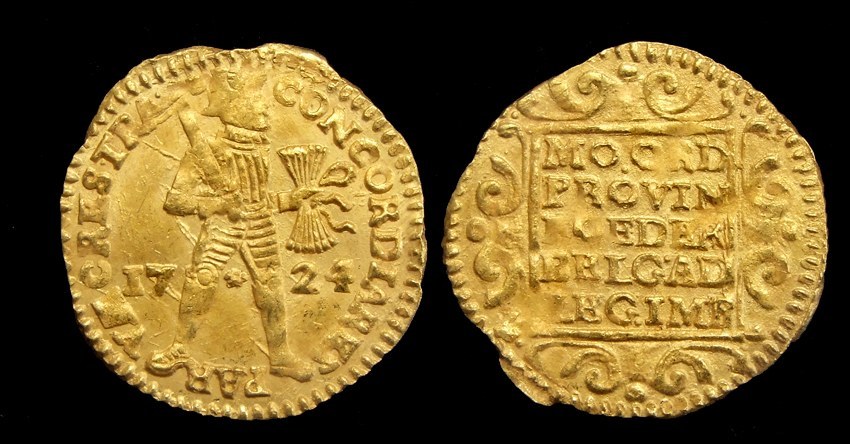
Read the Two Sides Together
Start by confirming both faces match the type. The obverse must show a standing armored, helmeted knight holding a sword and a bundle of arrows, with the date, here 1724, in the field and a Latin legend of the CONCORDIA RES PARVAE CRESCUNT family around the rim. The reverse must show an ornate rectangular tablet, framed by scrollwork, filled with several lines of Latin text. If either side is missing, for example a portrait bust instead of the standing figure, it is not this type.
Check the Symbolism and Legends
The bundle of arrows in the knight's hand is a key diagnostic: it stands for the united provinces and appears on genuine ducats. The reverse tablet should read in the sense of MONETA ORDINUM PROVINCIARUM FOEDERATARUM BELGICARUM AD LEGEM IMPERII. Small abbreviations in the obverse legend identify which province struck the coin, so look closely at the letters near the legend break to attribute the individual piece.
Confirm Size, Weight, and Metal
A true ducat is small and thin, roughly 21 to 22 mm across and only about 3.5 grams, struck in near-pure "ducat gold" with a bright, warm yellow color. It should feel surprisingly light for gold because it is thin, but the metal should show no coppery or pale tone. Weighing and measuring the coin is one of the fastest authenticity checks, since fakes often miss the correct weight or thickness.
Rule Out Look-Alikes and Restrikes
Many countries copied the ducat standard, and the same standing-knight design was continued long after 1724 by the Kingdom of the Netherlands and is still struck today, so a modern-looking ducat with a later date may be a restrike rather than a period coin. Read the date carefully and compare the exact province marks and legend spelling to trusted references to separate an eighteenth-century coin from a much later strike or a foreign imitation.
Authentication Cautions
Because it is gold and thin, this coin attracts both counterfeits and gilded or cast fakes, and period coins are often bent, wavy, or mounted. Check for solder marks, filed edges, and unnatural surfaces, and be wary of a coin that is the right design but the wrong weight. Bends and light waviness are common on genuine ducats, but holes, mounts, and cleaning reduce value, so for higher-grade or high-value pieces third-party authentication is worthwhile.
Frequently asked questions
What is the single most telling feature?
The standing armored knight holding a sword and a bundle of arrows, paired with a scrolled Latin inscription tablet on the reverse. Together these mark the classic Dutch trade ducat rather than a portrait coin.
What size and weight should a genuine ducat be?
Expect a small, thin coin about 21 to 22 mm across and roughly 3.5 grams in near-pure gold. It feels light because it is thin, but the color should be a bright, warm yellow with no coppery tone.
How do I tell a 1724 coin from a modern restrike?
Read the date and province marks carefully. The same design is still struck today, so a coin with a much later date, very fresh surfaces, and modern lettering is likely a restrike rather than an eighteenth-century piece.
Should I have it authenticated?
For anything beyond a common, obviously worn coin, yes. Gold ducats are faked and often mounted or bent, so verifying weight, diameter, and design, or using third-party certification, protects against counterfeits and altered pieces.