
How to Identify the Gothic Crown
The Gothic Crown is a Victorian silver crown from the 1840s-1850s prized for its ornate blackletter lettering and Gothic-numeral date, designed by William Wyon.
Read the full Gothic Crown encyclopedia entry →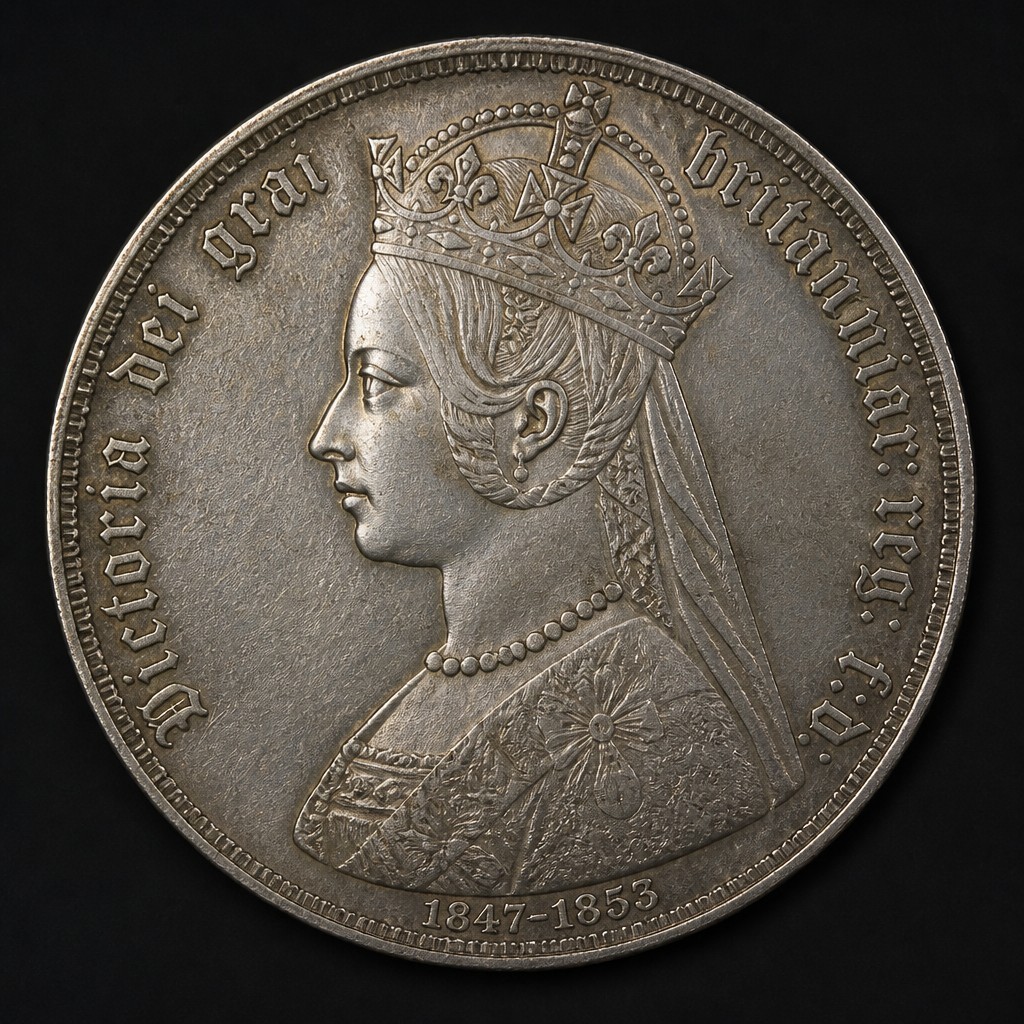
What Is It
The Gothic Crown is the popular name for a silver crown (five shilling coin) struck for Queen Victoria in the mid-19th century, so called because its obverse lettering and date are rendered in an ornate Gothic (blackletter) script rather than standard Roman capitals. Designed by William Wyon, it is considered one of the most artistically elaborate coins in British numismatic history and was produced mainly as a proof or limited currency issue rather than a high-volume circulating coin.
Obverse Design
The obverse depicts a young Queen Victoria in an elaborately decorated, almost medieval-style gown, with her hair styled in ringlets. The surrounding legend, VICTORIA DEI GRATIA, is set in decorative Gothic lettering rather than the plain capitals used on most British coins, and the date appears at the base of the design written out in Gothic-style Roman numerals (for example MDCCCXLVII for 1847) instead of standard Arabic numerals.
Reverse Design
The reverse features cruciform shields bearing the arms of England, Scotland, and Ireland arranged around a central rose, thistle, and shamrock cluster representing the union of the home nations. A Latin motto, TUEATUR UNITA DEUS ("May God guard these united"), runs around the rim, echoing the reverse layout later reused on the so-called Gothic florins of subsequent decades.
Size, Weight, and Metal
The Gothic Crown is struck in sterling silver (.925 fine), weighs approximately 28.3 grams, and measures about 38mm in diameter, consistent with other Victorian crown-sized coins. The edge typically carries a milled or lettered finish, and some issues include an incuse regnal-year inscription.
Mint Marks and Where to Find Them
As a Royal Mint product struck in London, the Gothic Crown carries no branch mint mark. Identification instead relies on reading the Gothic-numeral date at the base of the obverse portrait, which takes practice to decipher compared with ordinary Arabic-numeral dates.
Telling It Apart from Similar Coins
The distinctive Gothic lettering and script date make this crown hard to confuse with other Victorian crowns, which use plain Roman lettering and standard numeral dates. The closest visual relative is the later "Godless" and Gothic florin series, which reuses similar cruciform shield artwork but is a smaller two-shilling coin rather than a full crown, so diameter and weight quickly settle any doubt.
Judging Condition at a Glance
Wear first appears on Victoria's hair detail and the raised folds of her gown on the obverse, and on the highest points of the central shields on the reverse. Because many surviving examples are proof strikes intended for collectors rather than everyday spending money, sharp, lustrous, near-mint specimens are more commonly encountered than heavily worn ones.
Authenticity Red Flags
Given the coin's collector appeal, reproductions and later fantasy strikes exist; genuine pieces should show crisp, needle-sharp Gothic lettering, since the script is difficult to reproduce convincingly by casting. Blurred, mushy, or inconsistently sized lettering, an incorrect diameter or weight, or a poorly struck date are all signs of a copy rather than an original Royal Mint issue.
Frequently asked questions
Why is it called the Gothic Crown?
The name comes from its ornate Gothic (blackletter) style lettering and Gothic-numeral date on the obverse, a design style unusual for British coinage of the period.
How do I read the date on a Gothic Crown?
The date is written as Roman numerals in decorative Gothic script at the base of the obverse portrait, so 1847 appears as MDCCCXLVII rather than standard digits.
Is the Gothic Crown the same as a Gothic florin?
No, they share a similar artistic style and cruciform shield reverse, but the crown is a larger, heavier five shilling coin while the Gothic florin is a smaller two shilling coin.
Was the Gothic Crown meant for everyday spending?
Most surviving examples are proof or limited-issue coins struck for collectors and special occasions rather than heavy general circulation, which is why many are found in high grade.