
How to Identify the Gold Toman of Agha Mohammad Khan Qajar
A collector's guide to attributing an early Qajar gold toman: reading its Persian legends, the Qazvin mint and AH date, judging metal and flan, and spotting look-alikes.
Read the full Gold Toman of Agha Mohammad Khan Qajar encyclopedia entry →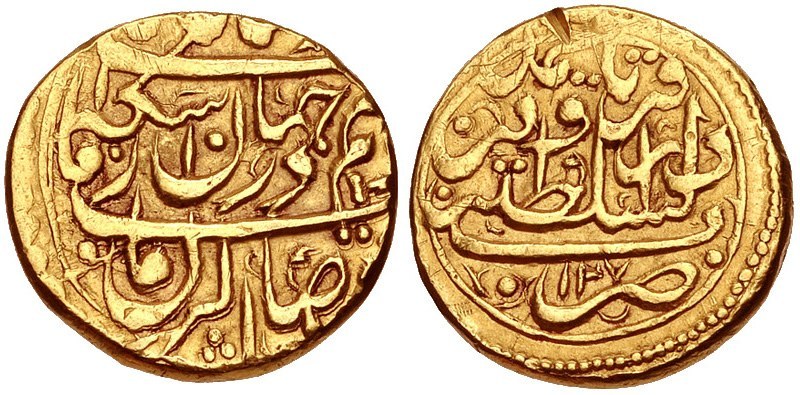
Begin by confirming the coin is entirely calligraphic. A gold toman of Agha Mohammad Khan carries only Persian and Arabic script on both faces, with no portrait, animal, or emblem anywhere. The obverse arranges the inscriptions in horizontal lines containing the ruler's name and royal formula, while the reverse carries the mint-and-date legend. If you find any figural image or Latin lettering, the coin is not an early Qajar toman.
Read the legends to attribute the piece. The reverse formula is the key: it states that the coin was struck at a named mint — on this type, Qazvin — and gives the Hijri year, here AH 1206–1207 (1792–1793). The obverse names Agha Mohammad Khan in a royal couplet or titulature. Being able to read, or match against a reference, the ruler's name plus the Qazvin mint and the AH date is what separates this coin from other Qajar and pre-Qajar gold.
Examine the physical coin. This is gold, so look for a warm yellow color and the softness of a high-purity alloy; it should not have the grey tone of silver or the reddish cast of copper. Early tomans are struck on small, comparatively thick flans and are hand-made, so expect slightly irregular outlines and some off-center striking, with parts of the legend crowded toward the edge. Weight matters, since tomans were issued alongside fractional gold pieces, and an underweight or clipped coin should be treated with caution.
Be alert to look-alikes. Silver and copper coins of the same reign share the aniconic calligraphic style but are the wrong metal and color, and gold coins of later Qajar rulers such as Fath Ali Shah carry different names and dates. Other Persian and Islamic dynasties also struck all-calligraphy gold, so the specific ruler's name together with the Qazvin mint and the AH 1206–1207 date — not the general look — is what pins the coin to this issue.
Apply sound authentication checks. Because these are rare gold coins, they are a target for forgery. Genuine pieces are struck, showing the crisp but slightly uneven relief of hand production; be wary of cast copies with soft, blurry detail, seams, or bubbles, and of pieces whose weight or gold color seems wrong for the type. When the legend cannot be read clearly or the metal is in doubt, weigh and measure the coin and compare it against a specialist catalog of Qajar coinage, or seek an expert opinion before accepting a firm attribution.
Frequently asked questions
How do I read the mint and date?
Both appear in the reverse legend. The mint name, Qazvin, is given as part of the phrase stating where the coin was struck, and the year is written in the Hijri (AH) calendar — here AH 1206–1207, which converts to 1792–1793 CE.
How can I tell it from a later Qajar toman?
Read the ruler's name in the obverse formula. Later Qajar shahs such as Fath Ali Shah struck similar all-calligraphy gold but under different names and dates. The name of Agha Mohammad Khan with the AH 1206–1207 date identifies this early issue.
How do I know it is really gold?
Genuine tomans are high-purity gold with a warm yellow color and characteristic softness and heft for their size. Weighing and measuring the coin and comparing it to published standards helps confirm the metal; a wrong weight or off color is a warning sign.
How do I spot a fake?
Watch for casting seams, bubbles, and mushy, indistinct script, which suggest a cast copy rather than a struck coin, and for weight or color that does not match the type. Because these gold coins are valuable and scarce, verify doubtful examples against a specialist catalog or with an expert.