
How to Identify the Gold Noble
A visual guide to the medieval English Gold Noble, identified by its iconic king-in-a-ship obverse and ornate cross-and-lions reverse.
Read the full Gold Noble encyclopedia entry →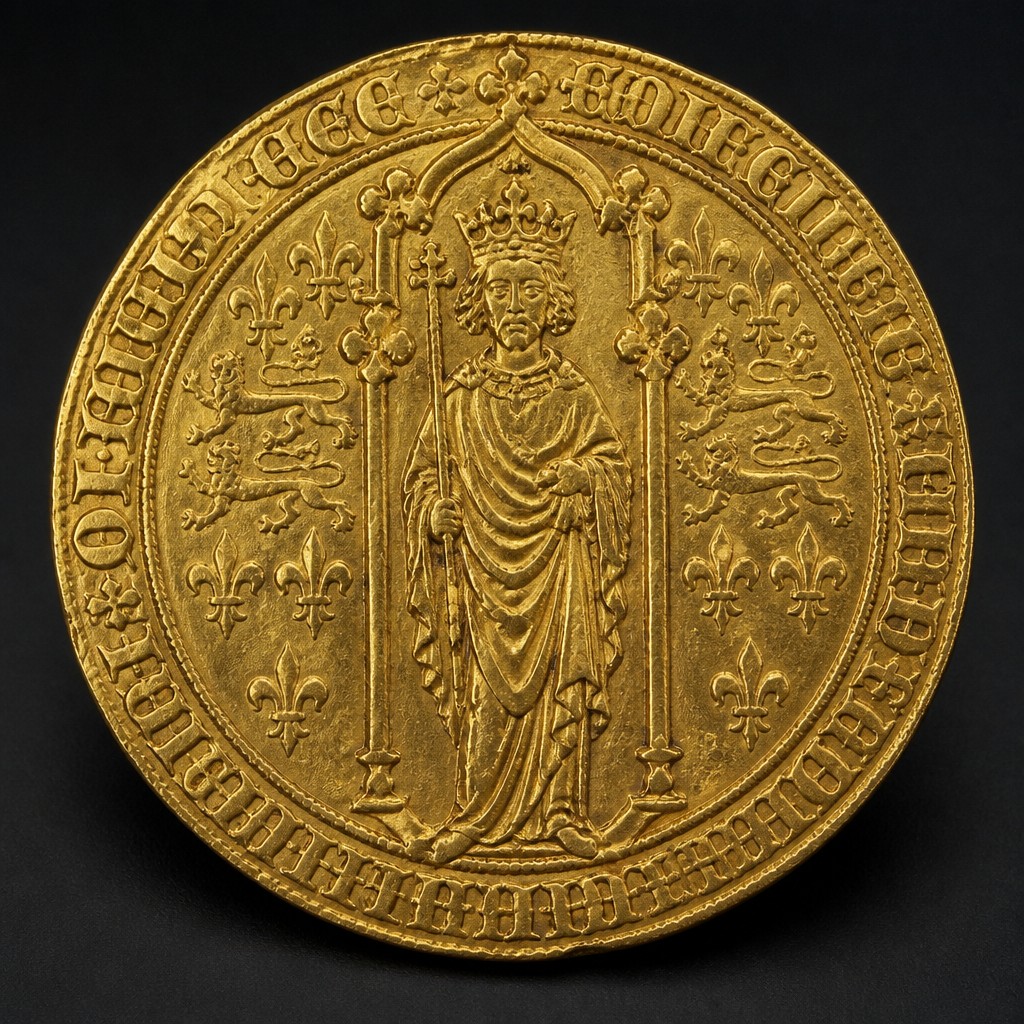
What It Is
The Gold Noble was a substantial English gold coin first issued in 1344 under King Edward III, valued at six shillings and eight pence (equivalent to half a mark). It represented a major milestone as one of England's earliest successful gold coinages and remained in production, with adjustments to weight and design, through subsequent reigns before eventually giving way to later gold denominations like the ryal and angel.
Obverse Design and Inscriptions
The obverse shows the king standing within a ship, holding a sword and shield, a design widely believed to commemorate English naval strength, possibly linked to the 1340 naval victory at Sluys. A Latin legend naming the king and his titles runs around the rim.
Reverse Design and Inscriptions
The reverse displays an ornate cross with a small lion or leopard in each angle, surrounded by a decorative border often composed of small crowns or lettered arcs, along with a continuing Latin religious inscription, commonly a biblical phrase invoking protection or blessing.
Size, Weight, Metal, and Edge
Gold Nobles were struck in high-purity gold and were relatively large and thick for a hand-struck medieval coin, with early issues weighing around 7.7-7.8 grams before later weight reductions occurred across different reissues as gold values shifted. As hand-hammered coins, they lack a machine-made reeded edge; edges are typically plain and somewhat irregular, consistent with hammered striking methods of the period.
Mint Marks and Where to Find Them
Medieval English coins often carry a small privy mark, such as a symbol placed at the start of the obverse or reverse legend, used to identify the specific minting period or moneyer. These marks require comparison to specialist medieval coinage references for precise dating.
Telling It Apart From Similar Coins
The ship-and-king obverse is highly distinctive and not shared with other English gold coins of the era, making the Gold Noble relatively easy to identify by design alone once genuineness is established. It should not be confused with the later Angel (which shows the Archangel Michael) or the Ryal (a heavier gold coin with a related but distinct ship design introduced later).
Judging Condition at a Glance
Because these coins are centuries old and hand-struck, look at the sharpness of the king's figure and the ship's details, as well as the legibility of the surrounding legend, keeping in mind that hammered coins often show some natural off-center striking or slight doubling even when genuinely unworn from circulation.
Authenticity Red Flags
Given the high value and historic importance of genuine Gold Nobles, be very cautious of examples with modern, overly uniform edges, incorrect weight for the specific issue, or crude, poorly detailed engraving that does not match the fine linework typical of genuine medieval die-cutting. Given the complexity of attributing hammered gold coinage, professional examination is strongly advisable before assuming authenticity.
Frequently asked questions
What does the ship on the Gold Noble represent?
It is widely thought to commemorate English naval power, possibly referencing the 1340 English victory at the Battle of Sluys, though the exact intent is debated among historians.
How much was a Gold Noble worth?
It was valued at six shillings and eight pence, equivalent to half a mark in medieval English currency.
When was the Gold Noble first issued?
It was first struck in 1344 during the reign of King Edward III.
What coin replaced the Gold Noble?
Over time it gave way to related gold denominations such as the ryal and later the angel, as English gold coinage continued to evolve.