
How to Identify the Gold Dinar of Baybars I
A collector's guide to recognizing a Mamluk gold dinar of Baybars: gold metal, aniconic Arabic legends, the ruler's name and titles, mints, look-alikes and fakes.
Read the full Gold Dinar of Baybars I encyclopedia entry →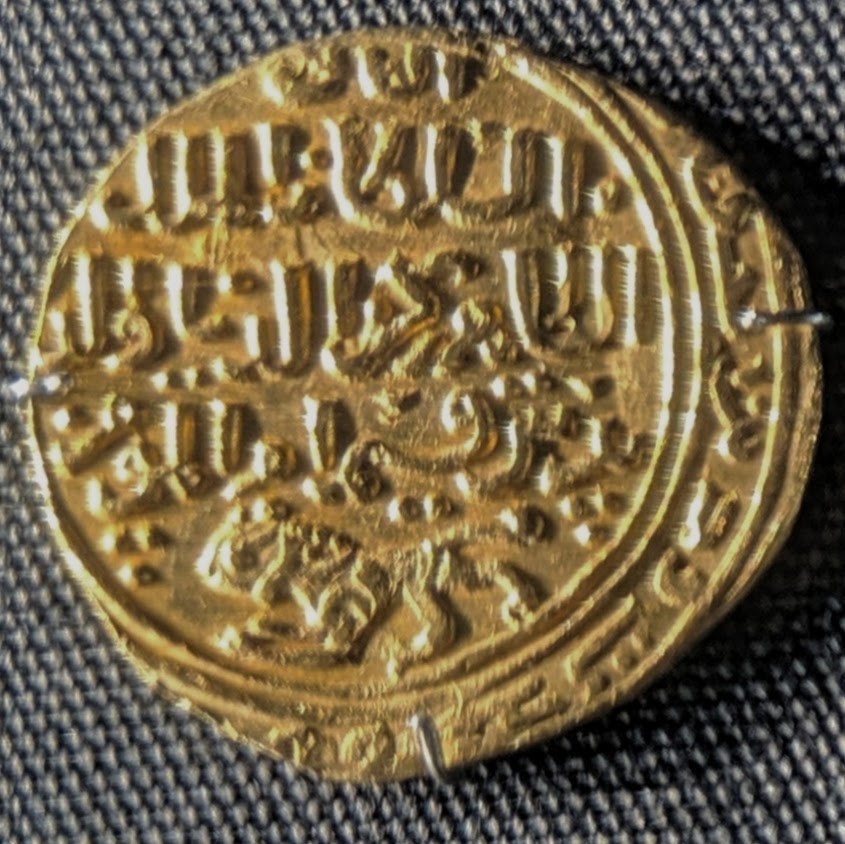
Begin with the metal and the feel of the coin. A dinar of Baybars is gold — warm yellow, dense in the hand, and completely non-magnetic. Early Mamluk gold was struck by hand, so expect a small coin, broadly in the 20–25 mm range and roughly 3.5–7 grams, often on a slightly irregular flan with an uneven or off-center strike. A coin that is magnetic, pale, lightweight for its size, or shows plating wear is a warning sign rather than a genuine gold dinar.
Read the design, not just the shine. Both faces should be filled with Arabic calligraphy and carry no portrait. You are looking for religious formulas — the profession of faith and pious phrases — combined with the ruler's names and titles. The key diagnostic is the name Baybars together with the honorific al-Malik al-Zahir and further royal styles; identifying those words in the legend is what ties the coin to this sultan rather than to another Mamluk or Islamic ruler.
Use the mint and date in the inscription to place the coin. Mamluk dinars name a mint and Hijri year within the legends, commonly Cairo (al-Qahira) or Damascus (Dimashq), with a date in the range AH 658–676 for Baybars. Because the epigraphic template is shared across many Islamic dinars, the specific mint, year, and titulature — not the general appearance — are what confirm the attribution and largely set rarity.
Watch for look-alikes. Dinars of other Mamluk sultans, Ayyubid gold, and other medieval Islamic gold issues all use the same aniconic, all-calligraphy layout and can resemble a Baybars dinar at a glance. Never assume an Arabic-script gold coin is Baybars without reading the ruler's name; the design changed only gradually between rulers and dynasties. A lion or panther emblem, where present, is a helpful Mamluk clue associated with Baybars, but the legend remains the decisive evidence.
Be especially careful about authenticity, because gold dinars of famous rulers are frequently forged. Genuine dinars are struck from dies, not cast, so casting seams, surface bubbles, a soft or grainy texture, a mold line around the edge, or an off-standard weight are red flags. Modern replicas and gilt copies exist. When in doubt, weigh and measure the coin, test that it is non-magnetic, photograph both faces clearly, and have the legend and gold verified against standard references or by a specialist in Islamic coinage.
Frequently asked questions
What is the single best way to confirm a Baybars dinar?
Read the legend for the ruler's name and titles. Finding the name Baybars with the honorific al-Malik al-Zahir, backed by a mint and Hijri date within AH 658–676, is the decisive confirmation; the metal and aniconic design alone are not enough because many Islamic dinars share the same template.
How can I tell it apart from another Mamluk sultan's dinar?
By the names and titles in the inscription. Many Mamluk dinars share the same layout and formulas, so appearance is not enough — the specific ruler's name, honorifics, mint, and Hijri year read from the legend are what separate a Baybars coin from that of a later sultan.
What should a genuine gold dinar look and feel like?
It should be warm yellow, dense, and completely non-magnetic, generally about 20–25 mm across, on a hand-struck and often slightly irregular flan. Pale color, magnetism, low density, or plating wear indicate a base-metal or gilt fake.
How do I spot a cast or forged dinar?
Genuine dinars were struck from dies, not poured into molds, so look for casting seams, air bubbles, a mushy or grainy surface, a raised mold line at the edge, or an incorrect weight. Because famous rulers' gold is often forged, verify the coin against references or with a specialist when unsure.