
How to Identify the Gobrecht Dollar
A collector's walkthrough for the 1836 Gobrecht Dollar: the seated Liberty obverse, flying-eagle reverse, the Gobrecht signature, and authentication cautions.
Read the full Gobrecht Dollar encyclopedia entry →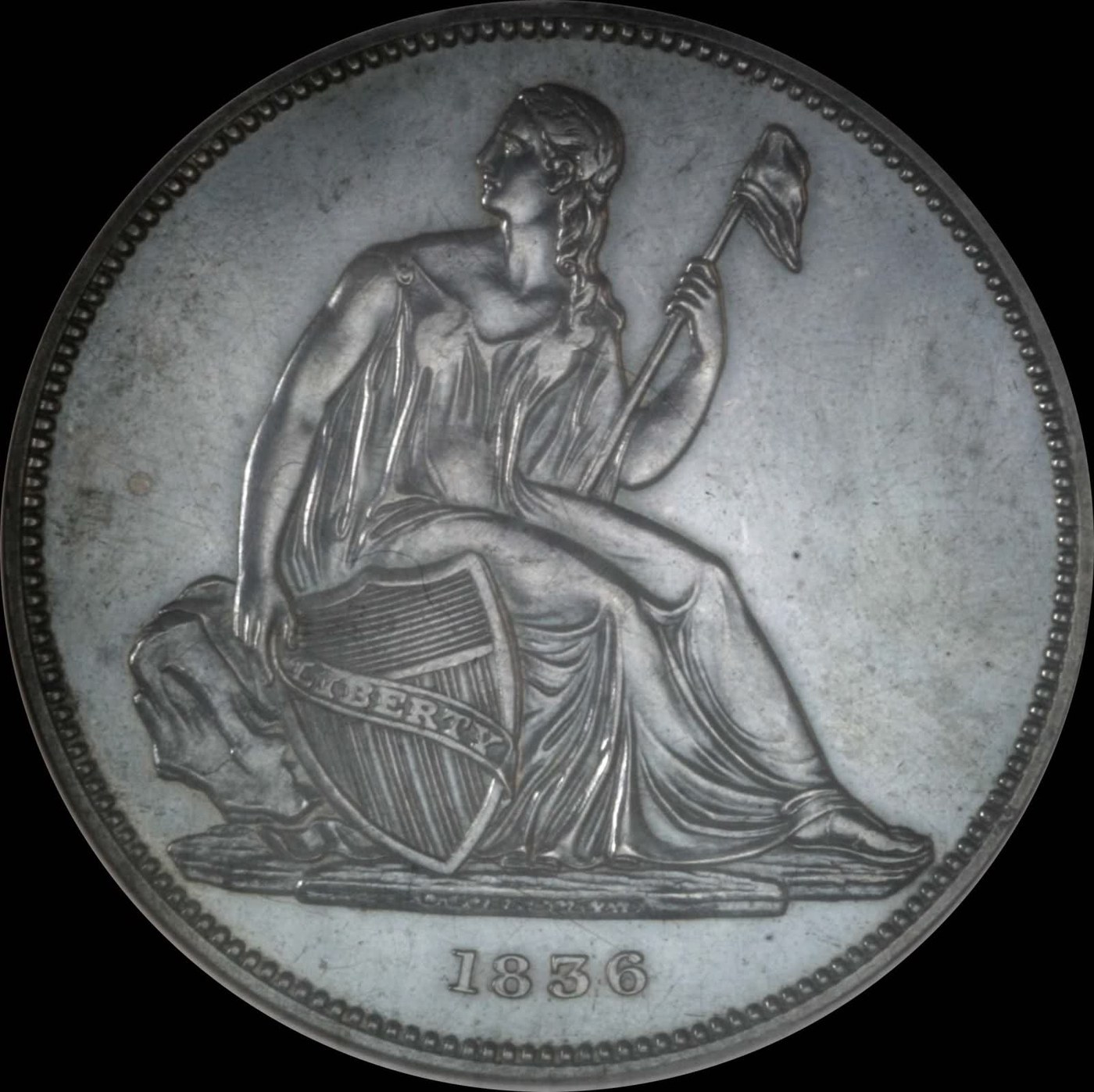
Begin with the obverse, which is the design's signature. Liberty sits on a rock in flowing classical drapery, one hand raising a pole topped by a soft liberty (freedom) cap, the other steadying a striped shield capped with a small star. On many 1836 pieces stars ring the figure and the date sits below. This full seated-Liberty composition, paired with a dollar-size silver planchet, is the core of the type.
Look for the engraver's signature. Several 1836 issues carry the inscription C. GOBRECHT F. in the field near the base of Liberty's seat (the "F." stands for the Latin fecit). Its presence, and its exact placement, is a meaningful diagnostic — but note that not every variety displays it in the same way, so its absence alone does not settle attribution.
Turn to the reverse and study the eagle. The Gobrecht reverse shows an eagle in free flight, wings outstretched, moving across a field of stars with olive-branch elements — not the stiff heraldic eagle of many other U.S. coins. The direction the eagle flies relative to the obverse (its die alignment), and the arrangement and count of the surrounding stars, are used by specialists to separate die varieties, originals, and later restrikes.
Confirm the physical basics: this is a silver coin of about dollar size (roughly 38–39 mm) and dollar weight, with a reeded edge on the standard strikes. A piece that is off in diameter, non-silver in appearance, or has a plain edge should raise immediate doubt.
Finally, be cautious. Because genuine Gobrecht Dollars are rare and expensive, replicas, electrotypes, and altered coins exist, and distinguishing an original from a Mint restrike is a specialist task in itself. Do not rely on eye appeal alone — any suspected Gobrecht Dollar should be authenticated and attributed by a reputable grading service before money changes hands.
Frequently asked questions
What is the quickest way to recognize a Gobrecht Dollar?
The combination is distinctive: a full seated Liberty holding a cap on a pole and a shield on the obverse, and an eagle in flight among stars on the reverse, on a silver dollar-size coin dated 1836.
Where is the Gobrecht signature and does every coin have it?
When present, C. GOBRECHT F. appears in the field near the base of Liberty's seat. Not all varieties show it the same way, so use it as supporting evidence rather than the sole test.
How do I tell an original from a restrike or a copy?
It is genuinely difficult. Die alignment, star arrangement, and edge and surface details all matter, and the Mint produced later restrikes. This is a job for a professional grading service, not a naked-eye call.
My 'Gobrecht Dollar' feels light or looks non-silver — what does that mean?
Wrong weight, a non-silver tone, or a plain edge strongly suggest a replica or novelty piece. Genuine examples are silver, dollar-sized, and reeded-edge; have anything promising examined by an expert.