
How to Identify the Glycon Bronze Coin
A collector's guide to spotting the ancient snake-god Glycon by his humanized serpent head, coiled reverse, bronze fabric, and Greek legends.
Read the full Glycon Bronze Coin encyclopedia entry →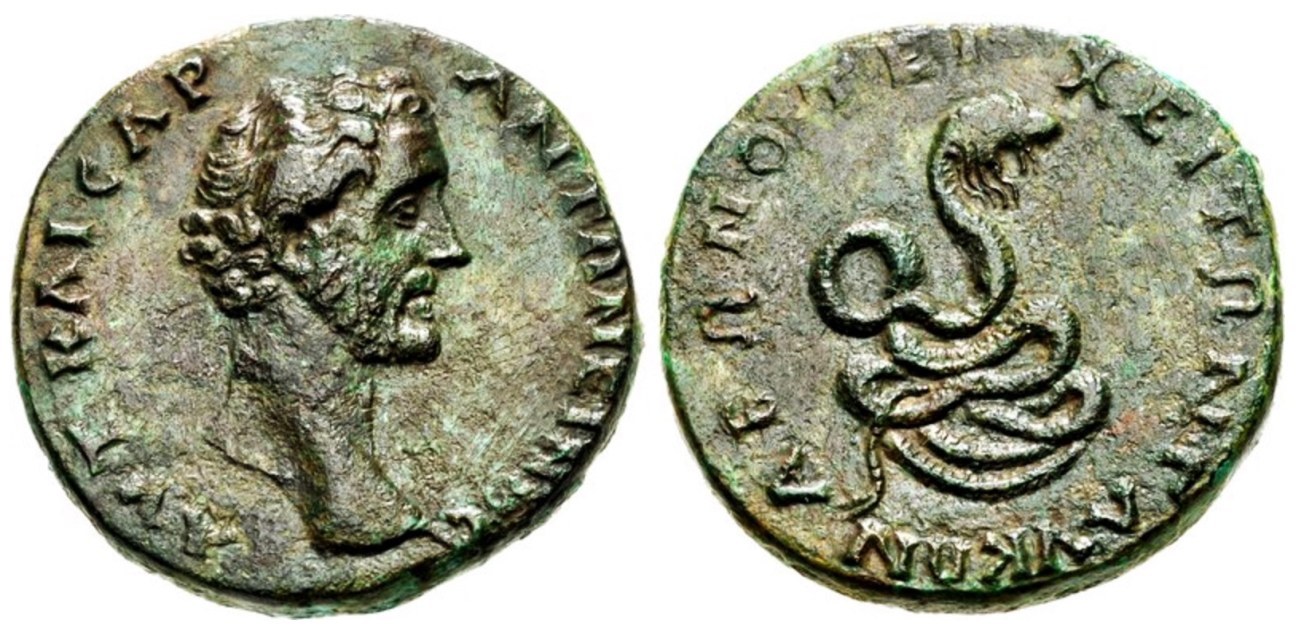
Begin with the deity, because Glycon is the whole point of the type. Look for a serpent shown with human or lion-like traits: a bearded, manlike face, flowing hair, and sometimes ears. This humanized snake head is the decisive diagnostic. A snake rendered with a plain reptilian head is probably an Asklepios or generic civic serpent, not Glycon.
Check the two faces together. The obverse here carries the bearded serpent head; the reverse shows the snake coiled into a spiral with the head raised. Seeing the same distinctive creature emphasized on both sides is characteristic of dedicated Glycon issues, as opposed to coins where a snake is only a minor attribute beside another god or an emperor's portrait.
Assess the fabric and script. This is a hand-struck bronze, so expect an irregular round flan, uneven strike, and an earthen or green patina rather than a machine-perfect disc. Legends, where legible, are usually in Greek, reflecting the eastern provinces where the cult flourished, and may name the issuing city such as Abonoteichos or Ionopolis. Size and weight vary by mint, so use the imagery, not exact dimensions, as your primary guide.
Watch for look-alikes and modern reproductions. Because Glycon is a popular subject, the type is reproduced as tourist replicas, museum copies, and outright fakes; cast copies often show a seam, bubbly surface, or unnaturally smooth uniform patina. Genuine strikes have crisp raised detail on a metal that looks and feels like ancient bronze. When value matters, buy from a dealer who guarantees authenticity or seek expert attribution, since surface encrustation can hide both wear and telltale signs of casting.
Frequently asked questions
What single feature confirms a coin is Glycon?
The humanized serpent: a snake given a bearded, manlike face with hair and sometimes ears. That fusion of human and snake features is unique to Glycon and separates it from ordinary snake types.
How do I tell Glycon apart from an Asklepios snake coin?
Asklepios coins usually show a man with a staff entwined by a plain snake, or a naturalistic serpent. Glycon is the snake itself given human features and shown coiled, without a separate human god beside it.
What language are the inscriptions in?
Usually Greek, because these are provincial coins from the Greek-speaking eastern Roman provinces. Legends may name the issuing city and are often worn, so rely on the imagery to confirm the type.
How can I spot a fake Glycon coin?
Be wary of casting seams, a bubbly or grainy surface, and an overly smooth, uniform patina, all signs of a modern copy. Authentic examples show sharp struck detail on genuine ancient bronze; get expert verification for higher-value pieces.