
How to Identify the Ghana 20 Pesewas
A collector's guide to identifying the 1967 Ghana 20 pesewas by its eagle, motto, coat-of-arms shield, spelled-out value, metal, and date.
Read the full Ghana 20 Pesewas encyclopedia entry →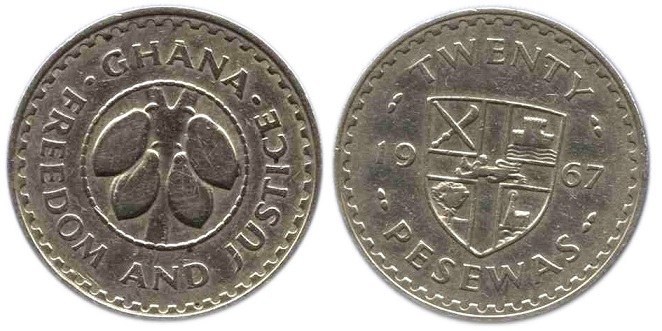
Start with the lettering. The decisive clues are the motto FREEDOM AND JUSTICE on the eagle side and the spelled-out value TWENTY PESEWAS with the date 1967 on the shield side. Reading both inscriptions together, rather than judging by the design at a glance, is the reliable way to confirm the type and its denomination.
Examine the two faces. One shows a national eagle, an emblem drawn from Ghana's coat of arms; the other shows the arms' shield accompanied by the date and value. There is no ruler's portrait to look for. This emblem-on-both-sides layout is characteristic of Ghana's 1967 republican coinage and helps set it apart from portrait coins of the earlier period.
Check metal, size, and edge. The coin is round and struck in a pale base-metal alloy of the nickel family, giving a silvery tone with no gold or copper colour and no precious-metal content. It is a mid-size circulation piece. Weighing and measuring it and comparing the figures to a standard world-coin catalogue entry for the Ghana 20 pesewas will confirm you have the 20-pesewa value rather than a smaller or larger denomination in the same series.
Distinguish it within the series. Ghana's 1967 coinage included several pesewa values sharing the same emblematic style, so the written denomination is what separates them. Confirm the words TWENTY PESEWAS to avoid confusing it with the 10, 5, or other pesewa coins, which look similar but state different values.
Watch for condition and authenticity issues. As an inexpensive base-metal coin, deceptive counterfeits are uncommon, but heavily cleaned, corroded, or polished pieces are frequently encountered and lose collector value. Surfaces that look unnaturally bright, pitting, or a weight that does not match the catalogue are reasons to look more closely. When in doubt, compare against a documented example of the 1967 type.
Frequently asked questions
How do I tell the 20 pesewas from other pesewa coins?
Read the spelled-out value. Ghana's 1967 series shares an emblematic style across denominations, so confirming the words TWENTY PESEWAS is what separates this coin from the 10, 5, or other pesewa values.
Where are the date and country identity shown?
The date 1967 sits with the coat-of-arms shield and the value on one face, while the motto FREEDOM AND JUSTICE and the eagle on the other confirm the coin as Ghanaian. There is no separate portrait or ruler name.
Does the lack of a portrait mean the coin is wrong?
No. The 1967 coinage deliberately uses national emblems, the eagle and the coat-of-arms shield, instead of a portrait. That emblematic design is normal and expected for the type.
Is it worth authenticating professionally?
Usually not. This is a low-value base-metal circulation coin, so paid authentication rarely makes sense. Confirm the inscriptions, metal, size, and date against a standard world-coin reference instead.